
13
Mar 2026
12:16 UTC
Netherlands Analysis: PM Jetten-led minority coalition to face legislative constraints, policy deadlock, though government collapse remains unlikely in near-to-medium term
Executive Summary
- On February 23, Rob Jetten of the center-left D66 was sworn in as Prime Minister, forming a minority coalition with center-right VVD and CDA. The coalition controls 66 of 150 seats in Tweede Kamer, the lower house, and 22 of 53 seats in the upper house.
- The coalition agreement outlined plans to increase healthcare deductibles, shorten unemployment benefit duration, strengthen security and defense spending, tighten asylum policies, expand social housing and green energy investment, and reduce nitrogen emissions, potentially requiring some farms to scale down operations.
- The government’s minority status and lack of a formal external support arrangement are likely to complicate policymaking and slow legislative progress. This increases the likelihood of policy delays and dilutions.
- Prolonged deadlock, particularly during budget negotiations, increases the potential risk of no-confidence motions over the medium term, though a near-term political instability, including government collapse, remains unlikely due to parties’ reluctance to trigger early elections.
- Jetten cabinet’s proposed migration, nitrogen, fiscal, and climate policies are likely to trigger recurring nationwide protests in the near-to-medium term, with the precedent of protest actions over these issues increasing the risk of recurring unrest, road blockades, and supply chain disruptions.
- Travel to the Netherlands may continue while remaining cognizant of ongoing political developments and maintaining heightened vigilance in the vicinity of large-scale protests linked to migration and nitrogen reduction policies.
Current Situation
- On February 23, Rob Jetten of the center-left party Democraten 66 (D66) was sworn in as Prime Minister, along with the ministers of a new minority government. This followed the snap parliamentary elections held on October 29, 2025, and a 117-day negotiation process for forming a coalition.
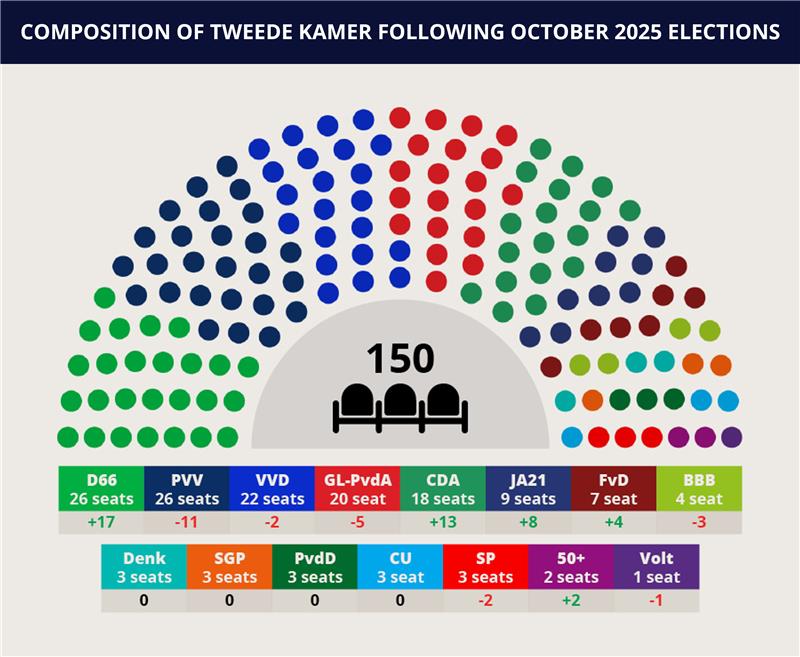
- The new government holds 66 of the 150 seats in the Tweede Kamer, the lower house of the Dutch parliament. It is composed of the D66, which won 26 seats in the October 2025 elections, the center-right Volkspartij voor Vrijheid en Democratie (VVD) with 22 seats, and the center-right Christen Democratisch Appel (CDA) with 18 seats. In Eerste Kamer, the upper house of parliament, the coalition controls 22 of the 53 seats.
- The cabinet includes 10 ministers from D66, nine from VVD, eight from CDA, and one independent minister. Details regarding the portfolio allocation are available here.
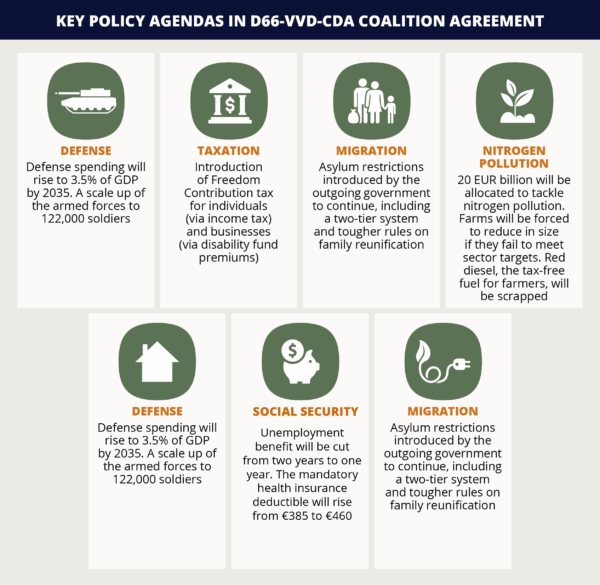
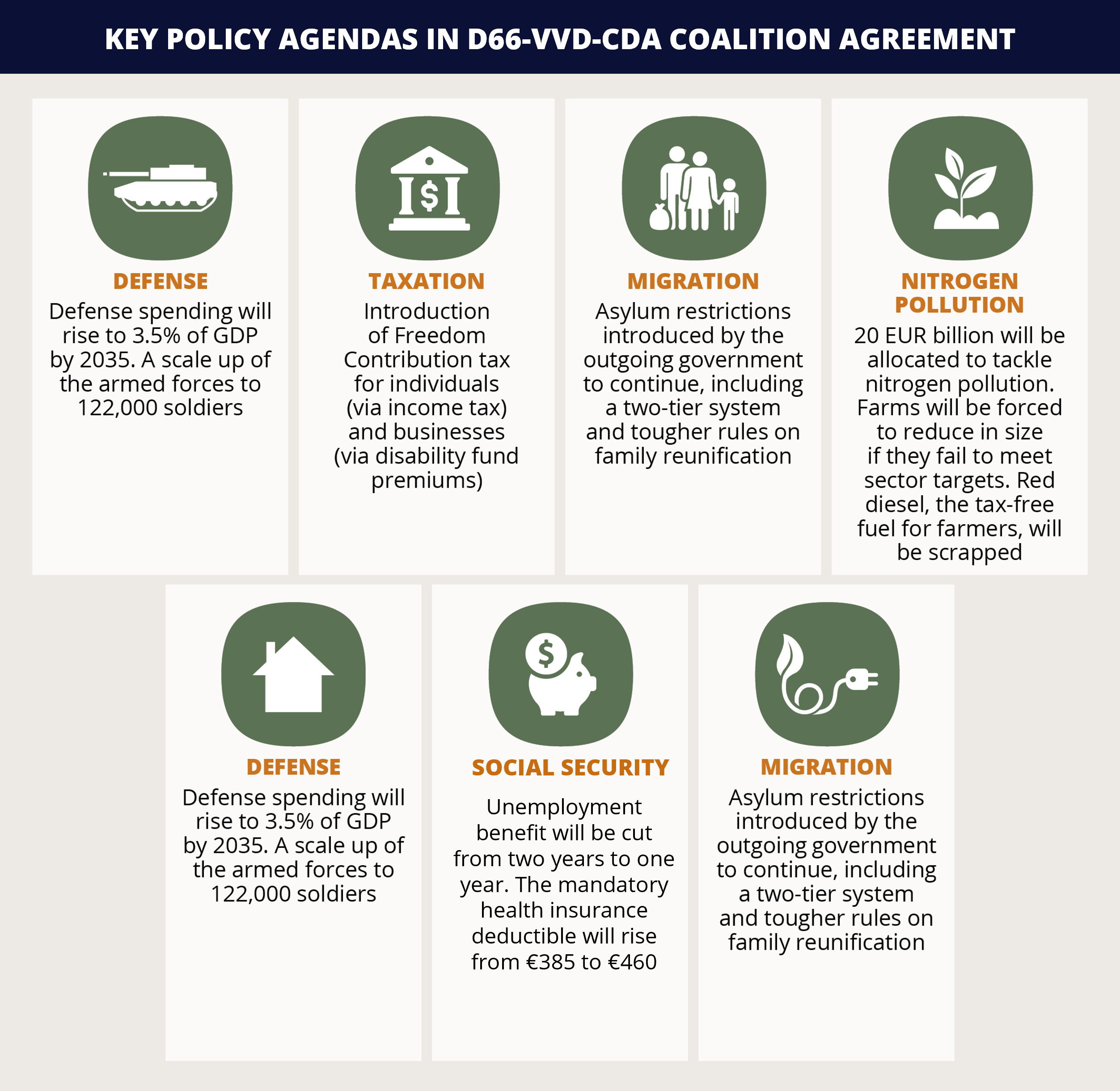
- Under the coalition agreement, the government plans to increase healthcare deductibles and reform unemployment benefits by making them higher but limiting their duration. The government also intends to strengthen security by increasing police resources, expanding prison capacity, and raising defense spending while enhancing cooperation with NATO and European partners. Migration policy will focus on reducing asylum inflows and speeding up asylum decisions. The agreement also includes plans to increase investment in social housing, green energy production, and defense, as well as measures to reduce nitrogen pollution, which could require farms that fail to meet sector targets to scale down their operations. Further details regarding the coalition agreement are available here (in Dutch).
Assessments & Forecast
Jetten's minority government is unlikely to secure sustained external backing, increasing the likelihood of prolonged legislative and policymaking procedures
- These developments are notable as minority governments are rare in the Netherlands, with the most recent precedent being the Mark Rutte–led cabinet formed in 2010, the first such arrangement since the early 1980s. The 2010 Rutte government relied on external parliamentary support from the far-right Partij voor de Vrijheid (PVV) to pass legislation and ultimately collapsed in 2012 after the PVV withdrew its backing during negotiations over austerity measures.
- Similarly, the Jetten-led minority government will need to rely on support from other parties to advance its legislative agenda. However, unlike the 2010 Rutte cabinet, no party has committed to providing consistent backing. The absence of a stable external support arrangement means the government will likely need to negotiate support for each legislative proposal individually, increasing the political cost and uncertainty associated with passing major reforms.
- Additionally, the coalition’s already strained relations with key opposition parties suggest that it will struggle to secure sustained opposition support. The largest opposition bloc, the left-wing GroenLinks–PvdA alliance (GL-PvdA), which holds 20 seats, was blocked by the VVD from participating in coalition negotiations and has already opposed key elements of the government’s platform, particularly proposed changes to healthcare costs and unemployment benefits. At the same time, Geert Wilders, leader of the Partij voor de Vrijheid (PVV), which currently holds 19 seats after internal defections reduced its representation, has stated that his party will oppose all initiatives of the Jetten government, while coalition parties have ruled out formal cooperation with the PVV. Meanwhile, the right-wing JA21 party, which secured nine seats, may support certain initiatives, particularly on immigration and defense. However, its exclusion from coalition negotiations due to opposition from D66 suggests that sustained cooperation with the party is unlikely.
- These constraints are expected to be further compounded by the coalition’s limited position in the Eerste Kamer, the upper house of parliament, where the government holds 22 of 53 seats. As most legislation must also pass through the Senate, the cabinet will be required to secure opposition support in both chambers, further increasing the complexity of the legislative process, mainly the risk of legislative gridlock on major reforms.
- These developments are notable as minority governments are rare in the Netherlands, with the most recent precedent being the Mark Rutte–led cabinet formed in 2010, the first such arrangement since the early 1980s. The 2010 Rutte government relied on external parliamentary support from the far-right Partij voor de Vrijheid (PVV) to pass legislation and ultimately collapsed in 2012 after the PVV withdrew its backing during negotiations over austerity measures.
- Similarly, the Jetten-led minority government will need to rely on support from other parties to advance its legislative agenda. However, unlike the 2010 Rutte cabinet, no party has committed to providing consistent backing. The absence of a stable external support arrangement means the government will likely need to negotiate support for each legislative proposal individually, increasing the political cost and uncertainty associated with passing major reforms.
- Additionally, the coalition’s already strained relations with key opposition parties suggest that it will struggle to secure sustained opposition support. The largest opposition bloc, the left-wing GroenLinks–PvdA alliance (GL-PvdA), which holds 20 seats, was blocked by the VVD from participating in coalition negotiations and has already opposed key elements of the government’s platform, particularly proposed changes to healthcare costs and unemployment benefits. At the same time, Geert Wilders, leader of the Partij voor de Vrijheid (PVV), which currently holds 19 seats after internal defections reduced its representation, has stated that his party will oppose all initiatives of the Jetten government, while coalition parties have ruled out formal cooperation with the PVV. Meanwhile, the right-wing JA21 party, which secured nine seats, may support certain initiatives, particularly on immigration and defense. However, its exclusion from coalition negotiations due to opposition from D66 suggests that sustained cooperation with the party is unlikely.
- These constraints are expected to be further compounded by the coalition’s limited position in the Eerste Kamer, the upper house of parliament, where the government holds 22 of 53 seats. As most legislation must also pass through the Senate, the cabinet will be required to secure opposition support in both chambers, further increasing the complexity of the legislative process, mainly the risk of legislative gridlock on major reforms.
Stalled negotiations over high salience, comprehensive legislative packages likely to trigger no-confidence votes, associated political uncertainty over medium term
- Since the government will likely need to secure support from the opposition parties on a bill-by-bill basis, it will allow the cabinet to pass narrow and one-off legislation in certain areas, for example, by gaining backing from right-wing parties on migration or security measures and from left-leaning parties on social or environmental policies. However, such shifting alliances will likely slow down the legislative process and require frequent compromises. FORECAST: Over time, repeated negotiations with different parties are likely to weaken proposed reforms and limit the government’s ability to advance a consistent policy agenda.
- These constraints are expected to be more pronounced for complex or politically sensitive legislation, such as the national budget, welfare reforms, and climate policy. Unlike narrower policy measures, these proposals typically combine fiscal, social, and environmental elements, making it more difficult to assemble a stable parliamentary majority. Right-wing parties that may support stricter migration policies will likely oppose expanded welfare spending or environmental regulation, while left-leaning parties that support social measures will likely resist the coalition’s fiscal and migration policies.
- The prolonged legislative deadlock, especially during negotiations over the national budget or major fiscal reforms, would likely heighten political tensions and increase the likelihood of no-confidence motions, especially if divisions emerge within the coalition. The most plausible trigger for political instability would be the government’s failure to secure parliamentary approval for a national budget or major fiscal package for 2027, which will expose divisions between coalition partners and opposition parties. Despite these structural limitations, a near-term government collapse remains unlikely, as both coalition and opposition parties retain incentives to avoid early elections, particularly amid public frustration with political instability.
- Since the government will likely need to secure support from the opposition parties on a bill-by-bill basis, it will allow the cabinet to pass narrow and one-off legislation in certain areas, for example, by gaining backing from right-wing parties on migration or security measures and from left-leaning parties on social or environmental policies. However, such shifting alliances will likely slow down the legislative process and require frequent compromises. FORECAST: Over time, repeated negotiations with different parties are likely to weaken proposed reforms and limit the government’s ability to advance a consistent policy agenda.
- These constraints are expected to be more pronounced for complex or politically sensitive legislation, such as the national budget, welfare reforms, and climate policy. Unlike narrower policy measures, these proposals typically combine fiscal, social, and environmental elements, making it more difficult to assemble a stable parliamentary majority. Right-wing parties that may support stricter migration policies will likely oppose expanded welfare spending or environmental regulation, while left-leaning parties that support social measures will likely resist the coalition’s fiscal and migration policies.
- The prolonged legislative deadlock, especially during negotiations over the national budget or major fiscal reforms, would likely heighten political tensions and increase the likelihood of no-confidence motions, especially if divisions emerge within the coalition. The most plausible trigger for political instability would be the government’s failure to secure parliamentary approval for a national budget or major fiscal package for 2027, which will expose divisions between coalition partners and opposition parties. Despite these structural limitations, a near-term government collapse remains unlikely, as both coalition and opposition parties retain incentives to avoid early elections, particularly amid public frustration with political instability.
Jetten cabinet’s proposed migration, nitrogen, fiscal and climate policies likely to trigger recurring protests, political backlash
- In addition to the political uncertainty and governance challenges, several policies proposed in the coalition agreement are likely to draw backlash from opposition parties and civil society groups. This is particularly the case as policy agendas related to migration, nitrogen reduction measures, and cuts to social spending remain highly controversial within the Netherlands, considering its already polarized socio-political landscape.
- Migration policy has remained a central and contentious issue in Dutch politics, contributing to the collapse of the most recent government, coinciding with rising electoral support for the anti-immigration PVV party since 2023, and recurring anti-asylum protests, some involving unrest in several municipalities nationwide during 2024–2025. At the same time, stricter asylum policies have faced opposition from left-leaning parties, including members of D66, and civil society groups, leading to repeated parliamentary resistance to such measures. In this context, the Jetten government’s intention to retain elements of the previous PVV-led government’s restrictive migration agenda, including the proposed two-tier asylum system and tighter family reunification rules, is expected to draw backlash from both sides of the political spectrum. The PVV, which quit the last government demanding more hardline asylum rules, and right-wing groups are likely to continue opposing these policies as insufficiently strict, which is expected to sustain anti-asylum mobilizations against the government in the coming months.
- FORECAST: Based on the precedent of recurring protests in 2024–2025, such demonstrations are likely to occur outside municipal offices and near asylum accommodation facilities nationwide, particularly when municipalities announce plans to host asylum seekers, expand reception capacity, or vote on local reception policies. Protests are also likely around key developments such as parliamentary debates, major policy announcements, or court rulings related to asylum policy. There remains a credible risk of localized unrest, including vandalism and arson targeting asylum accommodations, clashes with police and potential counter-protesters, as well as physical confrontations with individuals with immigrant backgrounds.
- In addition to migration policy, the government’s proposed nitrogen reduction measures are likely to remain a major flashpoint and could trigger significant political backlash and farmer protests once formally introduced in parliament. The cabinet has pledged to substantially reduce agricultural nitrogen emissions while also considering the removal of certain tax exemptions for agricultural fuel. Similar nitrogen reduction proposals between 2019 and 2023 triggered large-scale farmer mobilization, leading to widespread unrest across the Netherlands, involving tractor convoys, highway blockades, supply chain disruptions, and demonstrations near government buildings and retail logistics hubs.
- FORECAST: Although the Jetten coalition’s nitrogen policy places greater emphasis on voluntary adjustments and financial incentives than earlier proposals under the cabinet led by Mark Rutte, it is still likely to draw large-scale backlash. This is due to entrenched distrust among farmers toward government assurances, continued pressure to reduce livestock and emissions, and the highly politicized nature of the issue, particularly among right-wing and conservative parties such as BoerBurgerBeweging (BBB).
- Meanwhile, the Jetten cabinet’s fiscal measures, including plans to increase defense spending partly through new taxes and reductions in welfare and social benefits, are likely to trigger labor mobilization and associated protests. These proposals have already drawn criticism from both left- and right-wing parties and are expected to face opposition from major labor unions. Notably, the three largest Dutch trade unions, Federatie Nederlandse Vakbeweging (FNV), Christelijk Nationaal Vakverbond (CNV), and Vakcentrale voor Professionals (VCP), reportedly suspended consultations with the government on March 2, signaling growing tensions. FORECAST: Frequent anti-austerity strikes and demonstrations are therefore likely in the near to medium term, particularly in the public sector. Similar mobilization was observed in 2025, when large demonstrations against education budget cuts were recorded in March, April, June, and December. While such labor actions generally remain peaceful, increased strike activity could disrupt transport, public services, and supply chains.
- FORECAST: Given the entrenched presence of climate activist groups in the Netherlands, protest actions criticizing government climate policies are expected to persist. Although the government aims to reduce greenhouse gas emissions by around 60 percent by 2030 compared to 1990 levels and expand investment in renewable energy, activists argue that current measures remain insufficient to meet climate targets. This perception is likely to sustain mobilization, as illustrated by a demonstration organized by Extinction Rebellion (XR) outside the swearing-in ceremony of the cabinet led by Rob Jetten on February 23. A Dutch district court ruling on January 28 stating that the Netherlands exceeds its fair share of carbon emissions and ordering a review of the emissions reduction plan is also likely to intensify activism. Consequently, climate protests involve disruptive but largely nonviolent tactics such as road blockades as well as sit-ins at government and private sector establishments deemed harmful to the climate.
- In addition to the political uncertainty and governance challenges, several policies proposed in the coalition agreement are likely to draw backlash from opposition parties and civil society groups. This is particularly the case as policy agendas related to migration, nitrogen reduction measures, and cuts to social spending remain highly controversial within the Netherlands, considering its already polarized socio-political landscape.
- Migration policy has remained a central and contentious issue in Dutch politics, contributing to the collapse of the most recent government, coinciding with rising electoral support for the anti-immigration PVV party since 2023, and recurring anti-asylum protests, some involving unrest in several municipalities nationwide during 2024–2025. At the same time, stricter asylum policies have faced opposition from left-leaning parties, including members of D66, and civil society groups, leading to repeated parliamentary resistance to such measures. In this context, the Jetten government’s intention to retain elements of the previous PVV-led government’s restrictive migration agenda, including the proposed two-tier asylum system and tighter family reunification rules, is expected to draw backlash from both sides of the political spectrum. The PVV, which quit the last government demanding more hardline asylum rules, and right-wing groups are likely to continue opposing these policies as insufficiently strict, which is expected to sustain anti-asylum mobilizations against the government in the coming months.
- FORECAST: Based on the precedent of recurring protests in 2024–2025, such demonstrations are likely to occur outside municipal offices and near asylum accommodation facilities nationwide, particularly when municipalities announce plans to host asylum seekers, expand reception capacity, or vote on local reception policies. Protests are also likely around key developments such as parliamentary debates, major policy announcements, or court rulings related to asylum policy. There remains a credible risk of localized unrest, including vandalism and arson targeting asylum accommodations, clashes with police and potential counter-protesters, as well as physical confrontations with individuals with immigrant backgrounds.
- In addition to migration policy, the government’s proposed nitrogen reduction measures are likely to remain a major flashpoint and could trigger significant political backlash and farmer protests once formally introduced in parliament. The cabinet has pledged to substantially reduce agricultural nitrogen emissions while also considering the removal of certain tax exemptions for agricultural fuel. Similar nitrogen reduction proposals between 2019 and 2023 triggered large-scale farmer mobilization, leading to widespread unrest across the Netherlands, involving tractor convoys, highway blockades, supply chain disruptions, and demonstrations near government buildings and retail logistics hubs.
- FORECAST: Although the Jetten coalition’s nitrogen policy places greater emphasis on voluntary adjustments and financial incentives than earlier proposals under the cabinet led by Mark Rutte, it is still likely to draw large-scale backlash. This is due to entrenched distrust among farmers toward government assurances, continued pressure to reduce livestock and emissions, and the highly politicized nature of the issue, particularly among right-wing and conservative parties such as BoerBurgerBeweging (BBB).
- Meanwhile, the Jetten cabinet’s fiscal measures, including plans to increase defense spending partly through new taxes and reductions in welfare and social benefits, are likely to trigger labor mobilization and associated protests. These proposals have already drawn criticism from both left- and right-wing parties and are expected to face opposition from major labor unions. Notably, the three largest Dutch trade unions, Federatie Nederlandse Vakbeweging (FNV), Christelijk Nationaal Vakverbond (CNV), and Vakcentrale voor Professionals (VCP), reportedly suspended consultations with the government on March 2, signaling growing tensions. FORECAST: Frequent anti-austerity strikes and demonstrations are therefore likely in the near to medium term, particularly in the public sector. Similar mobilization was observed in 2025, when large demonstrations against education budget cuts were recorded in March, April, June, and December. While such labor actions generally remain peaceful, increased strike activity could disrupt transport, public services, and supply chains.
- FORECAST: Given the entrenched presence of climate activist groups in the Netherlands, protest actions criticizing government climate policies are expected to persist. Although the government aims to reduce greenhouse gas emissions by around 60 percent by 2030 compared to 1990 levels and expand investment in renewable energy, activists argue that current measures remain insufficient to meet climate targets. This perception is likely to sustain mobilization, as illustrated by a demonstration organized by Extinction Rebellion (XR) outside the swearing-in ceremony of the cabinet led by Rob Jetten on February 23. A Dutch district court ruling on January 28 stating that the Netherlands exceeds its fair share of carbon emissions and ordering a review of the emissions reduction plan is also likely to intensify activism. Consequently, climate protests involve disruptive but largely nonviolent tactics such as road blockades as well as sit-ins at government and private sector establishments deemed harmful to the climate.
Recommendations
- Travel to the Netherlands may continue while remaining cognizant of ongoing political developments.
- Maintain heightened vigilance in the vicinity of any protests on the issues of immigration, nitrogen, and climate policies.
- For more information on the political and security situation, as well as planning for the upcoming political developments, please contact [email protected].
Executive Summary
- On February 23, Rob Jetten of the center-left D66 was sworn in as Prime Minister, forming a minority coalition with center-right VVD and CDA. The coalition controls 66 of 150 seats in Tweede Kamer, the lower house, and 22 of 53 seats in the upper house.
- The coalition agreement outlined plans to increase healthcare deductibles, shorten unemployment benefit duration, strengthen security and defense spending, tighten asylum policies, expand social housing and green energy investment, and reduce nitrogen emissions, potentially requiring some farms to scale down operations.
- The government’s minority status and lack of a formal external support arrangement are likely to complicate policymaking and slow legislative progress. This increases the likelihood of policy delays and dilutions.
- Prolonged deadlock, particularly during budget negotiations, increases the potential risk of no-confidence motions over the medium term, though a near-term political instability, including government collapse, remains unlikely due to parties’ reluctance to trigger early elections.
- Jetten cabinet’s proposed migration, nitrogen, fiscal, and climate policies are likely to trigger recurring nationwide protests in the near-to-medium term, with the precedent of protest actions over these issues increasing the risk of recurring unrest, road blockades, and supply chain disruptions.
- Travel to the Netherlands may continue while remaining cognizant of ongoing political developments and maintaining heightened vigilance in the vicinity of large-scale protests linked to migration and nitrogen reduction policies.
Current Situation
- On February 23, Rob Jetten of the center-left party Democraten 66 (D66) was sworn in as Prime Minister, along with the ministers of a new minority government. This followed the snap parliamentary elections held on October 29, 2025, and a 117-day negotiation process for forming a coalition.
- The new government holds 66 of the 150 seats in the Tweede Kamer, the lower house of the Dutch parliament. It is composed of the D66, which won 26 seats in the October 2025 elections, the center-right Volkspartij voor Vrijheid en Democratie (VVD) with 22 seats, and the center-right Christen Democratisch Appel (CDA) with 18 seats. In Eerste Kamer, the upper house of parliament, the coalition controls 22 of the 53 seats.
- The cabinet includes 10 ministers from D66, nine from VVD, eight from CDA, and one independent minister. Details regarding the portfolio allocation are available here.
- Under the coalition agreement, the government plans to increase healthcare deductibles and reform unemployment benefits by making them higher but limiting their duration. The government also intends to strengthen security by increasing police resources, expanding prison capacity, and raising defense spending while enhancing cooperation with NATO and European partners. Migration policy will focus on reducing asylum inflows and speeding up asylum decisions. The agreement also includes plans to increase investment in social housing, green energy production, and defense, as well as measures to reduce nitrogen pollution, which could require farms that fail to meet sector targets to scale down their operations. Further details regarding the coalition agreement are available here (in Dutch).
Assessments & Forecast
Jetten's minority government is unlikely to secure sustained external backing, increasing the likelihood of prolonged legislative and policymaking procedures
- These developments are notable as minority governments are rare in the Netherlands, with the most recent precedent being the Mark Rutte–led cabinet formed in 2010, the first such arrangement since the early 1980s. The 2010 Rutte government relied on external parliamentary support from the far-right Partij voor de Vrijheid (PVV) to pass legislation and ultimately collapsed in 2012 after the PVV withdrew its backing during negotiations over austerity measures.
- Similarly, the Jetten-led minority government will need to rely on support from other parties to advance its legislative agenda. However, unlike the 2010 Rutte cabinet, no party has committed to providing consistent backing. The absence of a stable external support arrangement means the government will likely need to negotiate support for each legislative proposal individually, increasing the political cost and uncertainty associated with passing major reforms.
- Additionally, the coalition’s already strained relations with key opposition parties suggest that it will struggle to secure sustained opposition support. The largest opposition bloc, the left-wing GroenLinks–PvdA alliance (GL-PvdA), which holds 20 seats, was blocked by the VVD from participating in coalition negotiations and has already opposed key elements of the government’s platform, particularly proposed changes to healthcare costs and unemployment benefits. At the same time, Geert Wilders, leader of the Partij voor de Vrijheid (PVV), which currently holds 19 seats after internal defections reduced its representation, has stated that his party will oppose all initiatives of the Jetten government, while coalition parties have ruled out formal cooperation with the PVV. Meanwhile, the right-wing JA21 party, which secured nine seats, may support certain initiatives, particularly on immigration and defense. However, its exclusion from coalition negotiations due to opposition from D66 suggests that sustained cooperation with the party is unlikely.
- These constraints are expected to be further compounded by the coalition’s limited position in the Eerste Kamer, the upper house of parliament, where the government holds 22 of 53 seats. As most legislation must also pass through the Senate, the cabinet will be required to secure opposition support in both chambers, further increasing the complexity of the legislative process, mainly the risk of legislative gridlock on major reforms.
- These developments are notable as minority governments are rare in the Netherlands, with the most recent precedent being the Mark Rutte–led cabinet formed in 2010, the first such arrangement since the early 1980s. The 2010 Rutte government relied on external parliamentary support from the far-right Partij voor de Vrijheid (PVV) to pass legislation and ultimately collapsed in 2012 after the PVV withdrew its backing during negotiations over austerity measures.
- Similarly, the Jetten-led minority government will need to rely on support from other parties to advance its legislative agenda. However, unlike the 2010 Rutte cabinet, no party has committed to providing consistent backing. The absence of a stable external support arrangement means the government will likely need to negotiate support for each legislative proposal individually, increasing the political cost and uncertainty associated with passing major reforms.
- Additionally, the coalition’s already strained relations with key opposition parties suggest that it will struggle to secure sustained opposition support. The largest opposition bloc, the left-wing GroenLinks–PvdA alliance (GL-PvdA), which holds 20 seats, was blocked by the VVD from participating in coalition negotiations and has already opposed key elements of the government’s platform, particularly proposed changes to healthcare costs and unemployment benefits. At the same time, Geert Wilders, leader of the Partij voor de Vrijheid (PVV), which currently holds 19 seats after internal defections reduced its representation, has stated that his party will oppose all initiatives of the Jetten government, while coalition parties have ruled out formal cooperation with the PVV. Meanwhile, the right-wing JA21 party, which secured nine seats, may support certain initiatives, particularly on immigration and defense. However, its exclusion from coalition negotiations due to opposition from D66 suggests that sustained cooperation with the party is unlikely.
- These constraints are expected to be further compounded by the coalition’s limited position in the Eerste Kamer, the upper house of parliament, where the government holds 22 of 53 seats. As most legislation must also pass through the Senate, the cabinet will be required to secure opposition support in both chambers, further increasing the complexity of the legislative process, mainly the risk of legislative gridlock on major reforms.
Stalled negotiations over high salience, comprehensive legislative packages likely to trigger no-confidence votes, associated political uncertainty over medium term
- Since the government will likely need to secure support from the opposition parties on a bill-by-bill basis, it will allow the cabinet to pass narrow and one-off legislation in certain areas, for example, by gaining backing from right-wing parties on migration or security measures and from left-leaning parties on social or environmental policies. However, such shifting alliances will likely slow down the legislative process and require frequent compromises. FORECAST: Over time, repeated negotiations with different parties are likely to weaken proposed reforms and limit the government’s ability to advance a consistent policy agenda.
- These constraints are expected to be more pronounced for complex or politically sensitive legislation, such as the national budget, welfare reforms, and climate policy. Unlike narrower policy measures, these proposals typically combine fiscal, social, and environmental elements, making it more difficult to assemble a stable parliamentary majority. Right-wing parties that may support stricter migration policies will likely oppose expanded welfare spending or environmental regulation, while left-leaning parties that support social measures will likely resist the coalition’s fiscal and migration policies.
- The prolonged legislative deadlock, especially during negotiations over the national budget or major fiscal reforms, would likely heighten political tensions and increase the likelihood of no-confidence motions, especially if divisions emerge within the coalition. The most plausible trigger for political instability would be the government’s failure to secure parliamentary approval for a national budget or major fiscal package for 2027, which will expose divisions between coalition partners and opposition parties. Despite these structural limitations, a near-term government collapse remains unlikely, as both coalition and opposition parties retain incentives to avoid early elections, particularly amid public frustration with political instability.
- Since the government will likely need to secure support from the opposition parties on a bill-by-bill basis, it will allow the cabinet to pass narrow and one-off legislation in certain areas, for example, by gaining backing from right-wing parties on migration or security measures and from left-leaning parties on social or environmental policies. However, such shifting alliances will likely slow down the legislative process and require frequent compromises. FORECAST: Over time, repeated negotiations with different parties are likely to weaken proposed reforms and limit the government’s ability to advance a consistent policy agenda.
- These constraints are expected to be more pronounced for complex or politically sensitive legislation, such as the national budget, welfare reforms, and climate policy. Unlike narrower policy measures, these proposals typically combine fiscal, social, and environmental elements, making it more difficult to assemble a stable parliamentary majority. Right-wing parties that may support stricter migration policies will likely oppose expanded welfare spending or environmental regulation, while left-leaning parties that support social measures will likely resist the coalition’s fiscal and migration policies.
- The prolonged legislative deadlock, especially during negotiations over the national budget or major fiscal reforms, would likely heighten political tensions and increase the likelihood of no-confidence motions, especially if divisions emerge within the coalition. The most plausible trigger for political instability would be the government’s failure to secure parliamentary approval for a national budget or major fiscal package for 2027, which will expose divisions between coalition partners and opposition parties. Despite these structural limitations, a near-term government collapse remains unlikely, as both coalition and opposition parties retain incentives to avoid early elections, particularly amid public frustration with political instability.
Jetten cabinet’s proposed migration, nitrogen, fiscal and climate policies likely to trigger recurring protests, political backlash
- In addition to the political uncertainty and governance challenges, several policies proposed in the coalition agreement are likely to draw backlash from opposition parties and civil society groups. This is particularly the case as policy agendas related to migration, nitrogen reduction measures, and cuts to social spending remain highly controversial within the Netherlands, considering its already polarized socio-political landscape.
- Migration policy has remained a central and contentious issue in Dutch politics, contributing to the collapse of the most recent government, coinciding with rising electoral support for the anti-immigration PVV party since 2023, and recurring anti-asylum protests, some involving unrest in several municipalities nationwide during 2024–2025. At the same time, stricter asylum policies have faced opposition from left-leaning parties, including members of D66, and civil society groups, leading to repeated parliamentary resistance to such measures. In this context, the Jetten government’s intention to retain elements of the previous PVV-led government’s restrictive migration agenda, including the proposed two-tier asylum system and tighter family reunification rules, is expected to draw backlash from both sides of the political spectrum. The PVV, which quit the last government demanding more hardline asylum rules, and right-wing groups are likely to continue opposing these policies as insufficiently strict, which is expected to sustain anti-asylum mobilizations against the government in the coming months.
- FORECAST: Based on the precedent of recurring protests in 2024–2025, such demonstrations are likely to occur outside municipal offices and near asylum accommodation facilities nationwide, particularly when municipalities announce plans to host asylum seekers, expand reception capacity, or vote on local reception policies. Protests are also likely around key developments such as parliamentary debates, major policy announcements, or court rulings related to asylum policy. There remains a credible risk of localized unrest, including vandalism and arson targeting asylum accommodations, clashes with police and potential counter-protesters, as well as physical confrontations with individuals with immigrant backgrounds.
- In addition to migration policy, the government’s proposed nitrogen reduction measures are likely to remain a major flashpoint and could trigger significant political backlash and farmer protests once formally introduced in parliament. The cabinet has pledged to substantially reduce agricultural nitrogen emissions while also considering the removal of certain tax exemptions for agricultural fuel. Similar nitrogen reduction proposals between 2019 and 2023 triggered large-scale farmer mobilization, leading to widespread unrest across the Netherlands, involving tractor convoys, highway blockades, supply chain disruptions, and demonstrations near government buildings and retail logistics hubs.
- FORECAST: Although the Jetten coalition’s nitrogen policy places greater emphasis on voluntary adjustments and financial incentives than earlier proposals under the cabinet led by Mark Rutte, it is still likely to draw large-scale backlash. This is due to entrenched distrust among farmers toward government assurances, continued pressure to reduce livestock and emissions, and the highly politicized nature of the issue, particularly among right-wing and conservative parties such as BoerBurgerBeweging (BBB).
- Meanwhile, the Jetten cabinet’s fiscal measures, including plans to increase defense spending partly through new taxes and reductions in welfare and social benefits, are likely to trigger labor mobilization and associated protests. These proposals have already drawn criticism from both left- and right-wing parties and are expected to face opposition from major labor unions. Notably, the three largest Dutch trade unions, Federatie Nederlandse Vakbeweging (FNV), Christelijk Nationaal Vakverbond (CNV), and Vakcentrale voor Professionals (VCP), reportedly suspended consultations with the government on March 2, signaling growing tensions. FORECAST: Frequent anti-austerity strikes and demonstrations are therefore likely in the near to medium term, particularly in the public sector. Similar mobilization was observed in 2025, when large demonstrations against education budget cuts were recorded in March, April, June, and December. While such labor actions generally remain peaceful, increased strike activity could disrupt transport, public services, and supply chains.
- FORECAST: Given the entrenched presence of climate activist groups in the Netherlands, protest actions criticizing government climate policies are expected to persist. Although the government aims to reduce greenhouse gas emissions by around 60 percent by 2030 compared to 1990 levels and expand investment in renewable energy, activists argue that current measures remain insufficient to meet climate targets. This perception is likely to sustain mobilization, as illustrated by a demonstration organized by Extinction Rebellion (XR) outside the swearing-in ceremony of the cabinet led by Rob Jetten on February 23. A Dutch district court ruling on January 28 stating that the Netherlands exceeds its fair share of carbon emissions and ordering a review of the emissions reduction plan is also likely to intensify activism. Consequently, climate protests involve disruptive but largely nonviolent tactics such as road blockades as well as sit-ins at government and private sector establishments deemed harmful to the climate.
- In addition to the political uncertainty and governance challenges, several policies proposed in the coalition agreement are likely to draw backlash from opposition parties and civil society groups. This is particularly the case as policy agendas related to migration, nitrogen reduction measures, and cuts to social spending remain highly controversial within the Netherlands, considering its already polarized socio-political landscape.
- Migration policy has remained a central and contentious issue in Dutch politics, contributing to the collapse of the most recent government, coinciding with rising electoral support for the anti-immigration PVV party since 2023, and recurring anti-asylum protests, some involving unrest in several municipalities nationwide during 2024–2025. At the same time, stricter asylum policies have faced opposition from left-leaning parties, including members of D66, and civil society groups, leading to repeated parliamentary resistance to such measures. In this context, the Jetten government’s intention to retain elements of the previous PVV-led government’s restrictive migration agenda, including the proposed two-tier asylum system and tighter family reunification rules, is expected to draw backlash from both sides of the political spectrum. The PVV, which quit the last government demanding more hardline asylum rules, and right-wing groups are likely to continue opposing these policies as insufficiently strict, which is expected to sustain anti-asylum mobilizations against the government in the coming months.
- FORECAST: Based on the precedent of recurring protests in 2024–2025, such demonstrations are likely to occur outside municipal offices and near asylum accommodation facilities nationwide, particularly when municipalities announce plans to host asylum seekers, expand reception capacity, or vote on local reception policies. Protests are also likely around key developments such as parliamentary debates, major policy announcements, or court rulings related to asylum policy. There remains a credible risk of localized unrest, including vandalism and arson targeting asylum accommodations, clashes with police and potential counter-protesters, as well as physical confrontations with individuals with immigrant backgrounds.
- In addition to migration policy, the government’s proposed nitrogen reduction measures are likely to remain a major flashpoint and could trigger significant political backlash and farmer protests once formally introduced in parliament. The cabinet has pledged to substantially reduce agricultural nitrogen emissions while also considering the removal of certain tax exemptions for agricultural fuel. Similar nitrogen reduction proposals between 2019 and 2023 triggered large-scale farmer mobilization, leading to widespread unrest across the Netherlands, involving tractor convoys, highway blockades, supply chain disruptions, and demonstrations near government buildings and retail logistics hubs.
- FORECAST: Although the Jetten coalition’s nitrogen policy places greater emphasis on voluntary adjustments and financial incentives than earlier proposals under the cabinet led by Mark Rutte, it is still likely to draw large-scale backlash. This is due to entrenched distrust among farmers toward government assurances, continued pressure to reduce livestock and emissions, and the highly politicized nature of the issue, particularly among right-wing and conservative parties such as BoerBurgerBeweging (BBB).
- Meanwhile, the Jetten cabinet’s fiscal measures, including plans to increase defense spending partly through new taxes and reductions in welfare and social benefits, are likely to trigger labor mobilization and associated protests. These proposals have already drawn criticism from both left- and right-wing parties and are expected to face opposition from major labor unions. Notably, the three largest Dutch trade unions, Federatie Nederlandse Vakbeweging (FNV), Christelijk Nationaal Vakverbond (CNV), and Vakcentrale voor Professionals (VCP), reportedly suspended consultations with the government on March 2, signaling growing tensions. FORECAST: Frequent anti-austerity strikes and demonstrations are therefore likely in the near to medium term, particularly in the public sector. Similar mobilization was observed in 2025, when large demonstrations against education budget cuts were recorded in March, April, June, and December. While such labor actions generally remain peaceful, increased strike activity could disrupt transport, public services, and supply chains.
- FORECAST: Given the entrenched presence of climate activist groups in the Netherlands, protest actions criticizing government climate policies are expected to persist. Although the government aims to reduce greenhouse gas emissions by around 60 percent by 2030 compared to 1990 levels and expand investment in renewable energy, activists argue that current measures remain insufficient to meet climate targets. This perception is likely to sustain mobilization, as illustrated by a demonstration organized by Extinction Rebellion (XR) outside the swearing-in ceremony of the cabinet led by Rob Jetten on February 23. A Dutch district court ruling on January 28 stating that the Netherlands exceeds its fair share of carbon emissions and ordering a review of the emissions reduction plan is also likely to intensify activism. Consequently, climate protests involve disruptive but largely nonviolent tactics such as road blockades as well as sit-ins at government and private sector establishments deemed harmful to the climate.
Recommendations
- Travel to the Netherlands may continue while remaining cognizant of ongoing political developments.
- Maintain heightened vigilance in the vicinity of any protests on the issues of immigration, nitrogen, and climate policies.
- For more information on the political and security situation, as well as planning for the upcoming political developments, please contact [email protected].
Related Reports
Netherlands
-
 Supply Chain DisruptionsGlobal Special Report: Increasing sanctions encourage shadow fleet expansion, resulting in disruptions to maritime supply chain amid heightened scrutiny, militarization
 -
Supply Chain DisruptionsGlobal Special Report: Maritime shipping environment in Arctic to be fragile amid regulatory hurdles, militarization along Russian coastline, around Greenland
Related Reports
Netherlands
-
Supply Chain DisruptionsGlobal Special Report: Increasing sanctions encourage shadow fleet expansion, resulting in disruptions to maritime supply chain amid heightened scrutiny, militarization
-
Supply Chain DisruptionsGlobal Special Report: Maritime shipping environment in Arctic to be fragile amid regulatory hurdles, militarization along Russian coastline, around Greenland