
MENA Analysis: Risk of regional escalation rises ahead of Israeli elections on October 27, US midterms on November 3
Executive Summary:
- Multiple developments in recent weeks depict rising US/Israel and Iran tensions ahead of the Israeli elections on October 27 and the US midterms on November 3.
- As the impact of the US economic warfare strategy takes effect, Iran’s proclivity to retaliate and break this new status quo has risen, as shown by an uptick in attacks in the Strait of Hormuz and its attempts to attack US assets beyond the Middle East.
- The seriousness with which Washington assesses the Iranian threat is underscored by both movements of US military assets to the region and internal security discussions in the US.
- Although Washington is less likely to renew major operations in Iran ahead of the midterm elections, it is plausible that the US/Israel will initiate military action after their respective polls.
- There is also a considerable risk of escalation ahead of the elections should Iran initiate hostilities, or if the US becomes embroiled in the deteriorating Saudi-Houthi hostilities, which could evoke attacks on US assets in the region by Iran or its proxies.
- MAX Security has strong on-the-ground capabilities across several arenas in MENA, including secure transportation, the provision of safe havens, and contingency consultation and planning. Contact us at [email protected] or +44 20-3540-0434.
Overview:
Multiple indications in recent weeks suggest that tensions between the US/Israel and Iran are rising, amid the breakdown of diplomatic talks. Despite efforts by Qatari and Emirati officials to reignite negotiations on the sidelines of the UN General Assembly (UNGA) on September 22, both Iran and the US have retained their hardened positions, resulting in an impasse. This primarily stems from diverging positions on the sequencing of negotiations. The US demands Iranian concessions prior to the release of frozen funds and sanctions relief, while Tehran demands the easing of financial measures prior to engagement on more contentious issues, including its nuclear program.
Assessments & Forecast:
Pressure on Iran increases amid persistent US economic warfare strategy
- The US stance likely stems from the assessment that it has reduced global economic pressure by facilitating the return of oil exports through the Strait of Hormuz to pre-war levels. Reports from October 5 suggest that oil exports from the region reportedly reached between 19.5 million barrels per day (bpd) and 22.5 million bpd between September 24-27, exceeding pre-war levels that averaged 18 million bpd between March 2025 and February 2026. This has granted Washington time to let economic pressure on Iran build as a result of Operation Economic Outcast.
- The campaign, launched on August 24, has accelerated financial pressure on Tehran by broadening the risk of secondary sanctions. This has reduced Iran’s capacity to engage in its traditional sanctions-evasion techniques because third parties are cracking down on such activity in their countries and financial institutions due to fear of being penalized themselves and frozen out of the US Dollar (USD) system. Such concerns will be further heightened following the US Treasury Department’s warning on October 5 that those continuing to engage in business with Iran or its financial institutions may be sanctioned without advanced notification.
- Operation Economic Outcast has thereby effectively accelerated financial pressure on Tehran by constricting its revenue streams funding critical sectors for the Iranian government. This has compounded the impact of the US naval blockade, which has effectively prevented Iran from exporting oil from its territory, which constitutes 85 percent of all Iranian government revenue generated from exports.
- Iran has since relied on sales generated from oil tankers loaded and dispatched from Iran between the US lifting of the naval blockade as part of the June 17 MoU and the reimposition of the blockade on July 14. However, according to a report by a commodity tracking firm on September 25, stockpiles of Iranian oil at sea and available for sale are now at 15 million barrels, reportedly falling from 105 million barrels prior to the reinstatement of the US naval blockade in July. The firm further stated that at the current drawdown pace, this is expected to be exhausted by early to mid-October, with revenues ceasing before the end of 2026. This assessment is broadly also shared by US Treasury Secretary Scott Bessent, who referenced this trend in recent weeks.
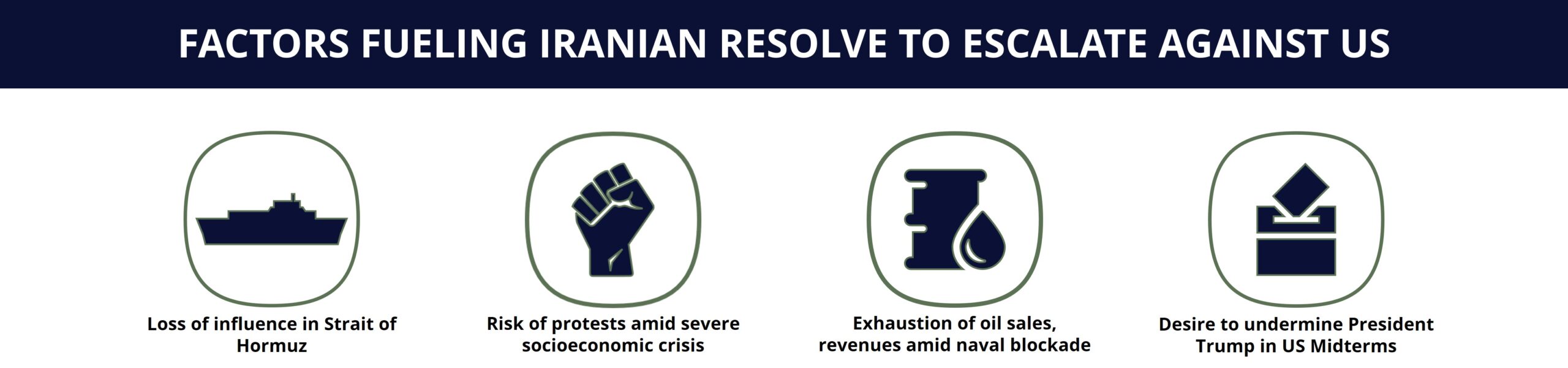
- The dual economic approach is already significantly impacting the Iranian population, with the Iranian Rial (IRR) reaching a record low, trading at around 2.68 million IRR to one US Dollar (USD) on October 3. The lack of state revenue, primarily from suspended oil exports, is reportedly resulting in the failure to pay pensions, triggering protests by retired government employees. Some workers in other critical sectors, such as nurses and teachers, have also reportedly quit their jobs as the salaries cannot support them with the continued depreciation of the IRR. These growing domestic tensions are compounding pressure on the Iranian government, likely fueling concerns over another protest wave erupting that could threaten its position, with the original protest wave in December-January emerging from such socioeconomic grievances.
Growing signs of Iran’s propensity to escalate vis-a-vis the US, Israel
- As the impact of Operation Economic Outcast and the ongoing US naval blockade builds on Tehran, Iran’s propensity to retaliate and break this new status quo has concurrently risen. This is underscored by recent threats from Iranian officials, heightening the threat perception among Israeli and US officials that Iran could escalate its attacks in the region over the coming weeks. This is particularly ahead of the Israeli elections on October 27, and the upcoming US midterms on November 3, with Israeli officials warning of security risks ahead of the polls (see below).
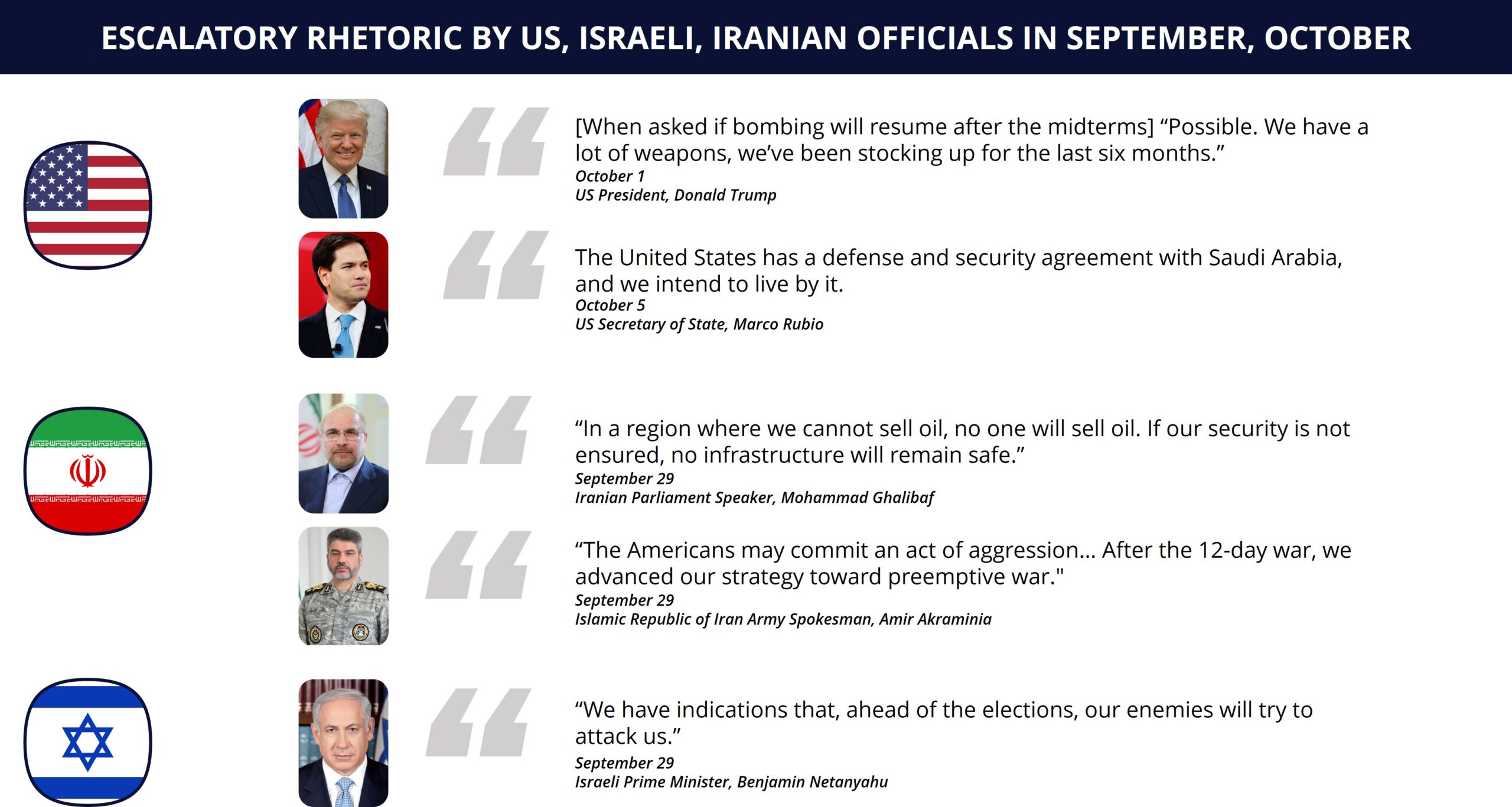
- An escalation of attacks in the region ahead of the US midterms would align with Iran’s aims to undermine the President Donald Trump-led administration. This is because it would drag Washington back into another conflict that has proved deeply unpopular in the US, potentially damaging President Trump and the Republicans’ support base, and reducing their prospects for success in the polls.
- Concrete indications of Iran’s proclivity to escalate have already arisen, with an uptick in attacks on vessels transiting the Strait of Hormuz (SoH) recorded in recent weeks. Since September 30, the UK Maritime Trade Operations (UKMTO) has reported at least 16 attacks on vessels transiting the region, compared to just seven attacks in the two weeks prior. This has included attacks closer to Emirati ports, as recorded on October 9, and at a greater distance from the SoH chokepoint, as underscored by an attack on a vessel over 500km north of the SoH in the Persian Gulf on October 7. This reiterates that the SoH remains Iran’s primary arena for retaliation against the US economic campaign and the restoration of oil exports from the region to pre-war levels. The uptick in attacks also points to Iran’s potential deployment of new hardware, such as radars, to reconstitute its ability to monitor ships at sea, which the US could seek to destroy again at some point.
- However, Iran does not view this as the only retaliatory pathway it can pursue, with indications that it is actively advancing attacks against US assets beyond the MENA region. On October 4, the US confirmed the withdrawal of all B1 bombers stationed at RAF Fairford in southern England to US territory. The sudden pullout was reportedly linked to the same apparent attack plot at the site that emerged on September 27. Five individuals were detained traveling in three vans near the military base, and a dual UK-Iran national was subsequently arrested on October 1. October 5 reports suggest that the latest withdrawal was triggered by a potential Iranian UAV attack at the base. US President Trump stated that Washington knows who is behind the threat, without specifying details of the plot, and that they are linked to Iran.
- An attempt to target US military assets that have been and would be critical to any American aerial campaign against Iran is plausible. It would mark a significant escalation and point to an Iranian strategy to expand the geographical scope of its retaliation beyond the Middle East to attack US Air Force aircraft in peacetime countries, potentially through the recruitment of local criminals and proxies, thereby granting Iran plausible deniability. Intelligence of similar plots in other European states, including Germany, has reportedly emerged in recent months. Taken together, Iran’s willingness to undertake such activity demonstrates the significant pressure it is facing and its resolve to expand its retaliatory activity to reverse the momentum of the conflict, which has swung in the US and Israel’s favor.
Heightened US threat perception, preparedness for escalation scenarios
- The seriousness with which Washington assesses the current Iranian threat is underscored by both movements of US military assets to the region and internal security discussions in the US. October 1 reports indicated that the US has deployed seven additional warships to the Middle East, carrying 9,000 troops. Unconfirmed October 2 reports citing US officials also indicate that Washington has sent two additional Patriot missile batteries to the region in recent weeks to protect oil and gas facilities in Saudi Arabia and Qatar.
- Notably, according to an unconfirmed October 2 report, the US National Security team held a secret meeting at Camp David recently to discuss the next steps in the war with Iran and the Saudi-Houthi conflict. Vice President JD Vance, Secretary of State Marco Rubio, Secretary of Defense Pete Hegseth, US Special Envoy Steve Witkoff, CIA Director John Ratcliffe, Chairman of the Joint Chiefs of Staff General Dan Caine, and Treasury Secretary Scott Bessent attended. According to the report, the last time such a meeting at Camp David took place was shortly before the US/Israel and Iran war in June 2025.
- The meeting points to a sense of urgency among the upper echelons of the US’s security apparatus and preparedness for escalation scenarios. This is particularly amid the continued stalemate in talks on Iran’s nuclear program, with President Trump’s repeatedly asserting in recent weeks that Iran will never have a nuclear weapon, and that this has “already been decided,” which he stated on October 5.
Elevated risk of escalation in short term around Israeli elections, US midterms
- Although Washington is less likely to renew major operations in Iran ahead of the midterm elections on November 3, it is plausible that the US/Israel will initiate military action after their respective polls. This would be based on the assessment that there is an opportune window to enforce their objectives vis-a-vis Iran, at a moment of weakness for the Iranian government, particularly amid its refusal to negotiate on its nuclear program.
- That said, there is also a considerable risk of escalation ahead of the elections. As outlined above, this could materialize if Iran initiates an escalation to break the new status quo. This would aim to distract from the acute socioeconomic crisis that it is experiencing, which will be compounded by the exhaustion of its final available oil sale revenues in early to mid-October, and to reverse its apparent loss of influence over shipping in the SoH.
- An Iran-initiated escalation scenario could include a further surge in attacks in this waterway, an expansion of maritime attacks to new waterways (Iran has previously threatened to launch attacks in the Indian Ocean), renewed attacks on critical infrastructure in regional Gulf states, or a successful Iranian attack outside the region, as seemingly plotted at the UK’s RAF Fairford. Additionally, Iran could stage a pre-emptive attack against Israel or US assets in the region based on the perception that Washington and Jerusalem are preparing to launch a new operation after the election period. Such messaging has started to emerge in Iranian media reports in recent days, underscoring this risk.
- Parallelly, the escalation of hostilities between Saudi Arabia and the Houthis could compound the US-Iran tensions and increase the likelihood of even limited exchanges between the US and Iran or its proxies. Following the Saudi-backed Presidential Command Council’s (PCC) launch of a major offensive on October 4 to reclaim territory captured by the Houthis in Yemen, cross-border hostilities have escalated, with multi-casualty attacks reported at Riyadh’s King Khalid International Airport. This has considerably raised the stakes and increases the spillover risk beyond Saudi Arabia and Yemen given the limited prospects of an off-ramp. This could materialize in an expansion of Houthi attacks to the UAE, or a broadening of the Houthi campaign in the Red Sea to target international vessels, expanding from threats against Saudi-linked vessels imposed as part of the Houthi naval blockade on Saudi.
- Iran could also separately initiate the Houthis to undertake this to compensate for its reduced capacity to disrupt oil flows in the SoH, and as part of its retaliation against the US. The persistent Houthi attacks on Saudi energy infrastructure, leading to suspensions of operations at critical sites, are already fulfilling these objectives to some extent and are likely to continue.
- While Washington has rejected Saudi calls for its participation in airstrikes so far, US President Trump may yet authorize such action in this context. The likelihood of such a scenario is increasing amid the acceleration of Houthi attacks in recent days. This was highlighted by President Trump, who stated on October 10 that the US is reviewing the latest Houthi attacks on Saudi Arabia and will decide what to do “quickly,” while Secretary of State Marco Rubio affirmed that Washington would live up to its defense agreement with Riyadh. Additionally, the US would likely intervene should the Houthis attempt to block navigation completely in the Red Sea.
- Any US involvement would likely prompt Iran to retaliate on behalf of its ally against Washington, either directly or through its other proxies, primarily Iraqi militias. Overall, this underscores how the escalatory trajectory between Saudi Arabia and the Houthis could compound US-Iran tensions and prospects for renewed hostilities.
- Collectively, the aforementioned factors depict an elevated risk of renewed escalation ahead of the Israeli elections and US midterms in the coming weeks. Tensions will remain elevated, and the regional security environment will be volatile. It may be subject to change on short notice, including flight cancellations and disruptions, even if hostilities resume at a threshold below full-scale war.
Recommendations:
MENA:
- Throughout the region, conduct timely risk assessments, refresh security protocols and business contingency plans (BCPs) for escalation scenarios, and continuously confirm travel itineraries.
- Avoid all travel to Iran, Yemen, Syria, and Iraq at the current juncture.
- Avoid nonessential travel to Israel, the Palestinian Territories, Lebanon, Jordan, and other Gulf Cooperation Council (GCC) states at the current juncture, and reconsider the necessity of currently planned trips in the coming weeks given the increased risk of renewed escalation.
- Conduct only critical business travel to Saudi Arabia at the current juncture and reconsider the necessity of currently planned trips, including to Jeddah and Riyadh. Minimize personnel footprint to the minimum required.
- Refrain from using high-profile international airports in Saudi Arabia, especially Dammam and Jeddah. Minimize personnel footprint as much as possible and consider alternative, lower-risk airports at this time, including developing plans for use of private jets. Consult with MAX’s Protection Division for further information.
- Remain cognizant of elevated risks to airports in GCC states, especially in Kuwait, Bahrain, and the UAE. Conduct repeated, timely risk assessments before using commercial airports in these countries.
- Continuously monitor official alert systems.
- Avoid all travel to military installations in the region, especially those hosting US personnel.
- Avoid all travel to major energy and heavy industry facilities (particularly petrochemical facilities), as well as major ports across the region, and implement precautions in such sites due to the continued threat to such infrastructure posed by Iran.
- Avoid travel to US-linked diplomatic and academic institutions in the region amid Iranian threats to target such locations.
- Avoid maritime travel through the Strait of Hormuz and take precautions in the Persian Gulf and Gulf of Oman, given the risk of attacks on vessels in these waterways.
- Avoid disseminating picture material and footage of interceptions, falling debris, and military assets on social media, as the circulation of such info is often illegal in Gulf states and may lead to prosecution.
- MAX Security has strong on-the-ground capabilities across several arenas in MENA, including secure transportation, the provision of safe havens, and contingency consultation and planning. Contact us at [email protected] or +44 20-3540-0434.
Maritime arena:
- Avoid maritime travel through the Strait of Hormuz and take precautions in the Persian Gulf and Gulf of Oman, given the risk of attacks on vessels in these waterways.
- Those operating vessels through the Red Sea, Bab al-Mandeb, and the Gulf of Aden are advised to remain cognizant of elevated risks to shipping and take precautions, given the risk of attacks on vessels in these waterways in light of the Houthi-proclaimed naval blockade on Saudi Arabia.
- Remain apprised of UKMTO and US DOT Maritime Administration-issued notices, as well as being aware of NATO Shipping Center alerts.
Potential attacks against critical infrastructure
- Map, increase awareness of, and avoid traveling to the vicinity of high-risk infrastructure in your assets’ vicinity. This includes major industrial hubs (with an emphasis on petrochemical sectors), energy, desalination, and military sites.
- Maintain emergency kits with a minimum 48–72-hour supply of:
- First aid supplies;
- Bottled water;
- Non-perishable food;
- Essential medications;
- N95/FFP2 respiratory masks (and provide guidance on correct usage);
- Flashlights and batteries;
- Backup communication devices.
- Monitor civil defense alerts and air quality monitors. Train employees to do the same in real time and/or develop a system to notify employees of such developments.
- Avoid outdoor activity during visible smoke events or when understanding that critical sites have been attacked.
- Define clear action thresholds, with preset actionables for different scenarios. Formulate thresholds for relocation/evacuation from certain areas in case of severe environmental/HAZMAT risks or significant utility failures. In this context, develop relocation plans within countries and evacuation plans from countries.
- Identify and prearrange alternative locations (further inland or upwind) that can host personnel if their residences become temporarily unsuitable.
- Ensure relocation sites have:
- Reliable HVAC;
- Backup power;
- Safe water access;
- The abovementioned emergency kit.
- Integrate this with existing business continuity and IT resilience plans.
- Brief staff about important aspects of plans and precautions, including:
- The risks involved and the specific mitigation procedures;
- What staff are expected to do when different action thresholds are met;
- Conduct drills to familiarize staff with different procedures;
- Identify personnel with respiratory conditions and/or cardiovascular vulnerabilities and ensure availability of critical medications and inhalers.
In-country mitigation and response:
Accommodation:
- Do not stay higher than the sixth floor.
- Identify protected areas in hotels/accommodations, such as shelters. If these do not exist, identify basements and interior stairwells, away from windows, exterior walls, and balconies.
- Verify emergency procedures with hotels.
- Opt for hotels away from strategic targets.
Iran:
- Avoid all travel to Iran at the current juncture.
- Those operating or residing in Iran are advised to shelter in place and avoid the vicinity of government, law enforcement, and military installations during US/Israeli strikes.
- Avoid all travel to hotspots of protest activity due to the elevated risk of violence and arbitrary arrests, and refrain from discussing protest activity in conversations and on social media. Maintain a low profile and avoid any public support for the protesters, including on social media, due to the heightened risk of arbitrary arrest and detention by Iranian authorities.
- Allot for continued and extensive disruptions to business continuity, including internet and telecommunications shutdowns.
Israel:
- Avoid nonessential travel to Israel at this time.
- Continue monitoring regional developments and promptly adhere to all Home Front Command (HFC) notifications. Ensure that the HFC application is downloaded and functioning to receive timely location-based alerts. Consider following other “Color Red” alert applications, such as “Tzofar”, “Tzeva Adom,” or “Cumta-Red Alerts.”
- Refresh and retain business contingency plans (BCPs) and security protocols and ensure shelters’ preparedness for extended periods to increase resilience in an escalation scenario.
- Remain cognizant of shelters’ locations during travel.
During Color Red sirens:
- Prefer reaching a shelter if possible. In “Mamads” (residential secure spaces), ensure that the room’s steel door and outer steel window are both locked to maintain safety.
- Remain in the shelter following the sounding of Color Red sirens until a follow-up “all-clear” notification from the HFC due to the risk of falling shrapnel and fragments.
- Approach the safe area calmly and remain cognizant of the fact that many injuries occur when people are running to the shelter panicked.
- If such a designated Mamad does not exist:
- Go to a room with as few external walls, windows, and openings as possible, sit on the floor below the window line, and near an internal wall;
- In an open area, lie down on the ground and cover your head with your hands;
- When driving, safely pull over and check your surroundings before vacating your vehicle and following the above instructions.
Executive Summary:
- Multiple developments in recent weeks depict rising US/Israel and Iran tensions ahead of the Israeli elections on October 27 and the US midterms on November 3.
- As the impact of the US economic warfare strategy takes effect, Iran’s proclivity to retaliate and break this new status quo has risen, as shown by an uptick in attacks in the Strait of Hormuz and its attempts to attack US assets beyond the Middle East.
- The seriousness with which Washington assesses the Iranian threat is underscored by both movements of US military assets to the region and internal security discussions in the US.
- Although Washington is less likely to renew major operations in Iran ahead of the midterm elections, it is plausible that the US/Israel will initiate military action after their respective polls.
- There is also a considerable risk of escalation ahead of the elections should Iran initiate hostilities, or if the US becomes embroiled in the deteriorating Saudi-Houthi hostilities, which could evoke attacks on US assets in the region by Iran or its proxies.
- MAX Security has strong on-the-ground capabilities across several arenas in MENA, including secure transportation, the provision of safe havens, and contingency consultation and planning. Contact us at [email protected] or +44 20-3540-0434.
Overview:
Multiple indications in recent weeks suggest that tensions between the US/Israel and Iran are rising, amid the breakdown of diplomatic talks. Despite efforts by Qatari and Emirati officials to reignite negotiations on the sidelines of the UN General Assembly (UNGA) on September 22, both Iran and the US have retained their hardened positions, resulting in an impasse. This primarily stems from diverging positions on the sequencing of negotiations. The US demands Iranian concessions prior to the release of frozen funds and sanctions relief, while Tehran demands the easing of financial measures prior to engagement on more contentious issues, including its nuclear program.
Assessments & Forecast:
Pressure on Iran increases amid persistent US economic warfare strategy
- The US stance likely stems from the assessment that it has reduced global economic pressure by facilitating the return of oil exports through the Strait of Hormuz to pre-war levels. Reports from October 5 suggest that oil exports from the region reportedly reached between 19.5 million barrels per day (bpd) and 22.5 million bpd between September 24-27, exceeding pre-war levels that averaged 18 million bpd between March 2025 and February 2026. This has granted Washington time to let economic pressure on Iran build as a result of Operation Economic Outcast.
- The campaign, launched on August 24, has accelerated financial pressure on Tehran by broadening the risk of secondary sanctions. This has reduced Iran’s capacity to engage in its traditional sanctions-evasion techniques because third parties are cracking down on such activity in their countries and financial institutions due to fear of being penalized themselves and frozen out of the US Dollar (USD) system. Such concerns will be further heightened following the US Treasury Department’s warning on October 5 that those continuing to engage in business with Iran or its financial institutions may be sanctioned without advanced notification.
- Operation Economic Outcast has thereby effectively accelerated financial pressure on Tehran by constricting its revenue streams funding critical sectors for the Iranian government. This has compounded the impact of the US naval blockade, which has effectively prevented Iran from exporting oil from its territory, which constitutes 85 percent of all Iranian government revenue generated from exports.
- Iran has since relied on sales generated from oil tankers loaded and dispatched from Iran between the US lifting of the naval blockade as part of the June 17 MoU and the reimposition of the blockade on July 14. However, according to a report by a commodity tracking firm on September 25, stockpiles of Iranian oil at sea and available for sale are now at 15 million barrels, reportedly falling from 105 million barrels prior to the reinstatement of the US naval blockade in July. The firm further stated that at the current drawdown pace, this is expected to be exhausted by early to mid-October, with revenues ceasing before the end of 2026. This assessment is broadly also shared by US Treasury Secretary Scott Bessent, who referenced this trend in recent weeks.
- The dual economic approach is already significantly impacting the Iranian population, with the Iranian Rial (IRR) reaching a record low, trading at around 2.68 million IRR to one US Dollar (USD) on October 3. The lack of state revenue, primarily from suspended oil exports, is reportedly resulting in the failure to pay pensions, triggering protests by retired government employees. Some workers in other critical sectors, such as nurses and teachers, have also reportedly quit their jobs as the salaries cannot support them with the continued depreciation of the IRR. These growing domestic tensions are compounding pressure on the Iranian government, likely fueling concerns over another protest wave erupting that could threaten its position, with the original protest wave in December-January emerging from such socioeconomic grievances.
Growing signs of Iran’s propensity to escalate vis-a-vis the US, Israel
- As the impact of Operation Economic Outcast and the ongoing US naval blockade builds on Tehran, Iran’s propensity to retaliate and break this new status quo has concurrently risen. This is underscored by recent threats from Iranian officials, heightening the threat perception among Israeli and US officials that Iran could escalate its attacks in the region over the coming weeks. This is particularly ahead of the Israeli elections on October 27, and the upcoming US midterms on November 3, with Israeli officials warning of security risks ahead of the polls (see below).
- An escalation of attacks in the region ahead of the US midterms would align with Iran’s aims to undermine the President Donald Trump-led administration. This is because it would drag Washington back into another conflict that has proved deeply unpopular in the US, potentially damaging President Trump and the Republicans’ support base, and reducing their prospects for success in the polls.
- Concrete indications of Iran’s proclivity to escalate have already arisen, with an uptick in attacks on vessels transiting the Strait of Hormuz (SoH) recorded in recent weeks. Since September 30, the UK Maritime Trade Operations (UKMTO) has reported at least 16 attacks on vessels transiting the region, compared to just seven attacks in the two weeks prior. This has included attacks closer to Emirati ports, as recorded on October 9, and at a greater distance from the SoH chokepoint, as underscored by an attack on a vessel over 500km north of the SoH in the Persian Gulf on October 7. This reiterates that the SoH remains Iran’s primary arena for retaliation against the US economic campaign and the restoration of oil exports from the region to pre-war levels. The uptick in attacks also points to Iran’s potential deployment of new hardware, such as radars, to reconstitute its ability to monitor ships at sea, which the US could seek to destroy again at some point.
- However, Iran does not view this as the only retaliatory pathway it can pursue, with indications that it is actively advancing attacks against US assets beyond the MENA region. On October 4, the US confirmed the withdrawal of all B1 bombers stationed at RAF Fairford in southern England to US territory. The sudden pullout was reportedly linked to the same apparent attack plot at the site that emerged on September 27. Five individuals were detained traveling in three vans near the military base, and a dual UK-Iran national was subsequently arrested on October 1. October 5 reports suggest that the latest withdrawal was triggered by a potential Iranian UAV attack at the base. US President Trump stated that Washington knows who is behind the threat, without specifying details of the plot, and that they are linked to Iran.
- An attempt to target US military assets that have been and would be critical to any American aerial campaign against Iran is plausible. It would mark a significant escalation and point to an Iranian strategy to expand the geographical scope of its retaliation beyond the Middle East to attack US Air Force aircraft in peacetime countries, potentially through the recruitment of local criminals and proxies, thereby granting Iran plausible deniability. Intelligence of similar plots in other European states, including Germany, has reportedly emerged in recent months. Taken together, Iran’s willingness to undertake such activity demonstrates the significant pressure it is facing and its resolve to expand its retaliatory activity to reverse the momentum of the conflict, which has swung in the US and Israel’s favor.
Heightened US threat perception, preparedness for escalation scenarios
- The seriousness with which Washington assesses the current Iranian threat is underscored by both movements of US military assets to the region and internal security discussions in the US. October 1 reports indicated that the US has deployed seven additional warships to the Middle East, carrying 9,000 troops. Unconfirmed October 2 reports citing US officials also indicate that Washington has sent two additional Patriot missile batteries to the region in recent weeks to protect oil and gas facilities in Saudi Arabia and Qatar.
- Notably, according to an unconfirmed October 2 report, the US National Security team held a secret meeting at Camp David recently to discuss the next steps in the war with Iran and the Saudi-Houthi conflict. Vice President JD Vance, Secretary of State Marco Rubio, Secretary of Defense Pete Hegseth, US Special Envoy Steve Witkoff, CIA Director John Ratcliffe, Chairman of the Joint Chiefs of Staff General Dan Caine, and Treasury Secretary Scott Bessent attended. According to the report, the last time such a meeting at Camp David took place was shortly before the US/Israel and Iran war in June 2025.
- The meeting points to a sense of urgency among the upper echelons of the US’s security apparatus and preparedness for escalation scenarios. This is particularly amid the continued stalemate in talks on Iran’s nuclear program, with President Trump’s repeatedly asserting in recent weeks that Iran will never have a nuclear weapon, and that this has “already been decided,” which he stated on October 5.
Elevated risk of escalation in short term around Israeli elections, US midterms
- Although Washington is less likely to renew major operations in Iran ahead of the midterm elections on November 3, it is plausible that the US/Israel will initiate military action after their respective polls. This would be based on the assessment that there is an opportune window to enforce their objectives vis-a-vis Iran, at a moment of weakness for the Iranian government, particularly amid its refusal to negotiate on its nuclear program.
- That said, there is also a considerable risk of escalation ahead of the elections. As outlined above, this could materialize if Iran initiates an escalation to break the new status quo. This would aim to distract from the acute socioeconomic crisis that it is experiencing, which will be compounded by the exhaustion of its final available oil sale revenues in early to mid-October, and to reverse its apparent loss of influence over shipping in the SoH.
- An Iran-initiated escalation scenario could include a further surge in attacks in this waterway, an expansion of maritime attacks to new waterways (Iran has previously threatened to launch attacks in the Indian Ocean), renewed attacks on critical infrastructure in regional Gulf states, or a successful Iranian attack outside the region, as seemingly plotted at the UK’s RAF Fairford. Additionally, Iran could stage a pre-emptive attack against Israel or US assets in the region based on the perception that Washington and Jerusalem are preparing to launch a new operation after the election period. Such messaging has started to emerge in Iranian media reports in recent days, underscoring this risk.
- Parallelly, the escalation of hostilities between Saudi Arabia and the Houthis could compound the US-Iran tensions and increase the likelihood of even limited exchanges between the US and Iran or its proxies. Following the Saudi-backed Presidential Command Council’s (PCC) launch of a major offensive on October 4 to reclaim territory captured by the Houthis in Yemen, cross-border hostilities have escalated, with multi-casualty attacks reported at Riyadh’s King Khalid International Airport. This has considerably raised the stakes and increases the spillover risk beyond Saudi Arabia and Yemen given the limited prospects of an off-ramp. This could materialize in an expansion of Houthi attacks to the UAE, or a broadening of the Houthi campaign in the Red Sea to target international vessels, expanding from threats against Saudi-linked vessels imposed as part of the Houthi naval blockade on Saudi.
- Iran could also separately initiate the Houthis to undertake this to compensate for its reduced capacity to disrupt oil flows in the SoH, and as part of its retaliation against the US. The persistent Houthi attacks on Saudi energy infrastructure, leading to suspensions of operations at critical sites, are already fulfilling these objectives to some extent and are likely to continue.
- While Washington has rejected Saudi calls for its participation in airstrikes so far, US President Trump may yet authorize such action in this context. The likelihood of such a scenario is increasing amid the acceleration of Houthi attacks in recent days. This was highlighted by President Trump, who stated on October 10 that the US is reviewing the latest Houthi attacks on Saudi Arabia and will decide what to do “quickly,” while Secretary of State Marco Rubio affirmed that Washington would live up to its defense agreement with Riyadh. Additionally, the US would likely intervene should the Houthis attempt to block navigation completely in the Red Sea.
- Any US involvement would likely prompt Iran to retaliate on behalf of its ally against Washington, either directly or through its other proxies, primarily Iraqi militias. Overall, this underscores how the escalatory trajectory between Saudi Arabia and the Houthis could compound US-Iran tensions and prospects for renewed hostilities.
- Collectively, the aforementioned factors depict an elevated risk of renewed escalation ahead of the Israeli elections and US midterms in the coming weeks. Tensions will remain elevated, and the regional security environment will be volatile. It may be subject to change on short notice, including flight cancellations and disruptions, even if hostilities resume at a threshold below full-scale war.
Recommendations:
MENA:
- Throughout the region, conduct timely risk assessments, refresh security protocols and business contingency plans (BCPs) for escalation scenarios, and continuously confirm travel itineraries.
- Avoid all travel to Iran, Yemen, Syria, and Iraq at the current juncture.
- Avoid nonessential travel to Israel, the Palestinian Territories, Lebanon, Jordan, and other Gulf Cooperation Council (GCC) states at the current juncture, and reconsider the necessity of currently planned trips in the coming weeks given the increased risk of renewed escalation.
- Conduct only critical business travel to Saudi Arabia at the current juncture and reconsider the necessity of currently planned trips, including to Jeddah and Riyadh. Minimize personnel footprint to the minimum required.
- Refrain from using high-profile international airports in Saudi Arabia, especially Dammam and Jeddah. Minimize personnel footprint as much as possible and consider alternative, lower-risk airports at this time, including developing plans for use of private jets. Consult with MAX’s Protection Division for further information.
- Remain cognizant of elevated risks to airports in GCC states, especially in Kuwait, Bahrain, and the UAE. Conduct repeated, timely risk assessments before using commercial airports in these countries.
- Continuously monitor official alert systems.
- Avoid all travel to military installations in the region, especially those hosting US personnel.
- Avoid all travel to major energy and heavy industry facilities (particularly petrochemical facilities), as well as major ports across the region, and implement precautions in such sites due to the continued threat to such infrastructure posed by Iran.
- Avoid travel to US-linked diplomatic and academic institutions in the region amid Iranian threats to target such locations.
- Avoid maritime travel through the Strait of Hormuz and take precautions in the Persian Gulf and Gulf of Oman, given the risk of attacks on vessels in these waterways.
- Avoid disseminating picture material and footage of interceptions, falling debris, and military assets on social media, as the circulation of such info is often illegal in Gulf states and may lead to prosecution.
- MAX Security has strong on-the-ground capabilities across several arenas in MENA, including secure transportation, the provision of safe havens, and contingency consultation and planning. Contact us at [email protected] or +44 20-3540-0434.
Maritime arena:
- Avoid maritime travel through the Strait of Hormuz and take precautions in the Persian Gulf and Gulf of Oman, given the risk of attacks on vessels in these waterways.
- Those operating vessels through the Red Sea, Bab al-Mandeb, and the Gulf of Aden are advised to remain cognizant of elevated risks to shipping and take precautions, given the risk of attacks on vessels in these waterways in light of the Houthi-proclaimed naval blockade on Saudi Arabia.
- Remain apprised of UKMTO and US DOT Maritime Administration-issued notices, as well as being aware of NATO Shipping Center alerts.
Potential attacks against critical infrastructure
- Map, increase awareness of, and avoid traveling to the vicinity of high-risk infrastructure in your assets’ vicinity. This includes major industrial hubs (with an emphasis on petrochemical sectors), energy, desalination, and military sites.
- Maintain emergency kits with a minimum 48–72-hour supply of:
- First aid supplies;
- Bottled water;
- Non-perishable food;
- Essential medications;
- N95/FFP2 respiratory masks (and provide guidance on correct usage);
- Flashlights and batteries;
- Backup communication devices.
- Monitor civil defense alerts and air quality monitors. Train employees to do the same in real time and/or develop a system to notify employees of such developments.
- Avoid outdoor activity during visible smoke events or when understanding that critical sites have been attacked.
- Define clear action thresholds, with preset actionables for different scenarios. Formulate thresholds for relocation/evacuation from certain areas in case of severe environmental/HAZMAT risks or significant utility failures. In this context, develop relocation plans within countries and evacuation plans from countries.
- Identify and prearrange alternative locations (further inland or upwind) that can host personnel if their residences become temporarily unsuitable.
- Ensure relocation sites have:
- Reliable HVAC;
- Backup power;
- Safe water access;
- The abovementioned emergency kit.
- Integrate this with existing business continuity and IT resilience plans.
- Brief staff about important aspects of plans and precautions, including:
- The risks involved and the specific mitigation procedures;
- What staff are expected to do when different action thresholds are met;
- Conduct drills to familiarize staff with different procedures;
- Identify personnel with respiratory conditions and/or cardiovascular vulnerabilities and ensure availability of critical medications and inhalers.
In-country mitigation and response:
Accommodation:
- Do not stay higher than the sixth floor.
- Identify protected areas in hotels/accommodations, such as shelters. If these do not exist, identify basements and interior stairwells, away from windows, exterior walls, and balconies.
- Verify emergency procedures with hotels.
- Opt for hotels away from strategic targets.
Iran:
- Avoid all travel to Iran at the current juncture.
- Those operating or residing in Iran are advised to shelter in place and avoid the vicinity of government, law enforcement, and military installations during US/Israeli strikes.
- Avoid all travel to hotspots of protest activity due to the elevated risk of violence and arbitrary arrests, and refrain from discussing protest activity in conversations and on social media. Maintain a low profile and avoid any public support for the protesters, including on social media, due to the heightened risk of arbitrary arrest and detention by Iranian authorities.
- Allot for continued and extensive disruptions to business continuity, including internet and telecommunications shutdowns.
Israel:
- Avoid nonessential travel to Israel at this time.
- Continue monitoring regional developments and promptly adhere to all Home Front Command (HFC) notifications. Ensure that the HFC application is downloaded and functioning to receive timely location-based alerts. Consider following other “Color Red” alert applications, such as “Tzofar”, “Tzeva Adom,” or “Cumta-Red Alerts.”
- Refresh and retain business contingency plans (BCPs) and security protocols and ensure shelters’ preparedness for extended periods to increase resilience in an escalation scenario.
- Remain cognizant of shelters’ locations during travel.
During Color Red sirens:
- Prefer reaching a shelter if possible. In “Mamads” (residential secure spaces), ensure that the room’s steel door and outer steel window are both locked to maintain safety.
- Remain in the shelter following the sounding of Color Red sirens until a follow-up “all-clear” notification from the HFC due to the risk of falling shrapnel and fragments.
- Approach the safe area calmly and remain cognizant of the fact that many injuries occur when people are running to the shelter panicked.
- If such a designated Mamad does not exist:
- Go to a room with as few external walls, windows, and openings as possible, sit on the floor below the window line, and near an internal wall;
- In an open area, lie down on the ground and cover your head with your hands;
- When driving, safely pull over and check your surroundings before vacating your vehicle and following the above instructions.
Related Reports
-
 PoliticsIsrael Analysis: October 27, 2026 general elections come amid heightened polarization; government formation likely to be protracted, result in deadlock
 -
 Militancy/TerrorismMENA Analysis: Attempted mega-terror attack on Flydubai aircraft underscores persistent risks of Islamist radicalization, including insider threats
 -
 Supply Chain DisruptionsGlobal Special Report: Increase in GNSS interference elevates operational disruptions, risks to aviation
 -
 Armed ConflictSaudi Arabia & Yemen Analysis: PCC assault against Houthis on October 4-5 to intensify Houthi retaliation against Saudi Arabia over coming days; anticipate further escalation
Related Reports
-
PoliticsIsrael Analysis: October 27, 2026 general elections come amid heightened polarization; government formation likely to be protracted, result in deadlock
-
Militancy/TerrorismMENA Analysis: Attempted mega-terror attack on Flydubai aircraft underscores persistent risks of Islamist radicalization, including insider threats
-
Supply Chain DisruptionsGlobal Special Report: Increase in GNSS interference elevates operational disruptions, risks to aviation
-
Armed ConflictSaudi Arabia & Yemen Analysis: PCC assault against Houthis on October 4-5 to intensify Houthi retaliation against Saudi Arabia over coming days; anticipate further escalation