

Europe Analysis: Risk of jihadist attacks remains elevated through winter holiday period, especially targeting Christmas markets, religious, symbolic events
Executive Summary
- In recent years, the winter holiday period has seen an increased terrorist threat in Europe, with Christmas markets and other large-scale public events remaining recurring targets of successful attacks and foiled plots, predominantly involving jihadist actors.
- The threat is driven by a combination of ideological, seasonal, and operational factors. Christmas markets remain attractive targets due to their high symbolic value, large visitor numbers, and open-access settings.
- The primary risk of successful attacks is expected to stem from jihadist lone actors using rudimentary tactics, including arson, stabbing, and vehicular ramming.
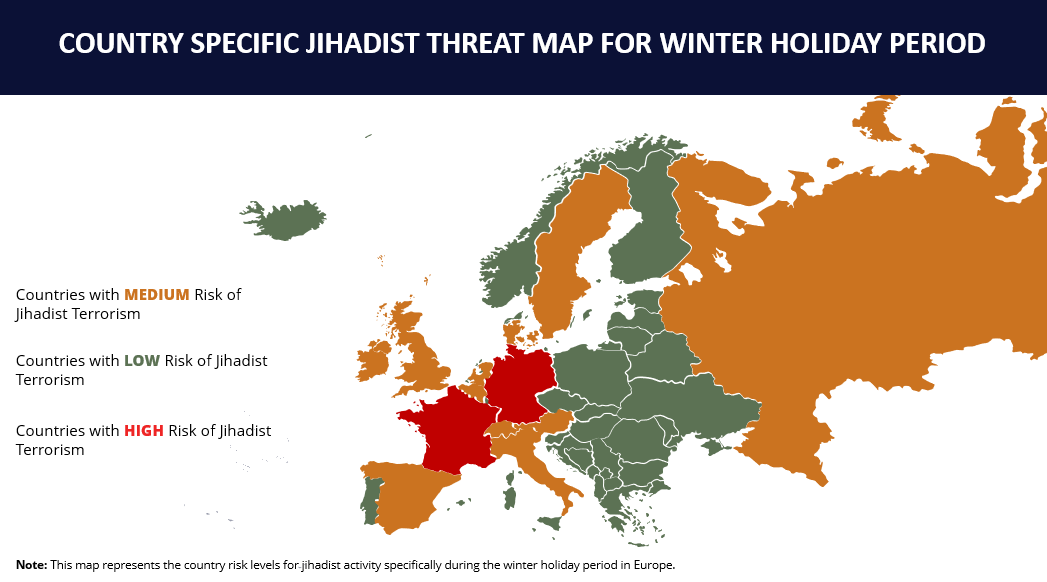
- Although jihadist activity in Europe remains geographically unpredictable, with attacks possible in any location and with little or no warning, the threat is particularly elevated in Germany and France, evidenced by repeated attacks and plots targeting Christmas markets in recent years.
- Individuals residing in or traveling to European cities are advised to maintain heightened vigilance when visiting Christmas markets and other festive gatherings during the winter holiday season. Remain alert to the potential threat of jihadist attacks, including arson, vehicle ramming, stabbing, and shooting incidents.
Current Situation
- On November 13, the US State Department issued a Europe-wide security alert warning travellers that large gatherings and public events during the upcoming winter holiday season “present a target of opportunity for terrorist groups and criminals.”
- While the USA or other European security agencies have not reported any specific plot or threat, the security alert noted that terrorists, including lone actors, could attack with little or no warning, targeting markets, transportation hubs, shopping malls, places of worship, and other public areas.
- Christmas markets across Europe, including in major cities as well as smaller municipalities, generally begin from mid-November, with most operating through December and some continuing into early January.
- Although no specific Europe-wide terrorist threat has been publicly identified for the 2026 season, national, regional, and municipal authorities are maintaining or reinforcing security arrangements around Christmas markets and other large public gatherings.
- The reported measures include expanded visible police and municipal-guard patrols, plain-clothes security officers, enhanced CCTV coverage, security staff, bag checks at some entrances, traffic restrictions around market areas, and temporary hostile-vehicle-mitigation measures such as concrete blocks, bollards, and other barriers.
Background
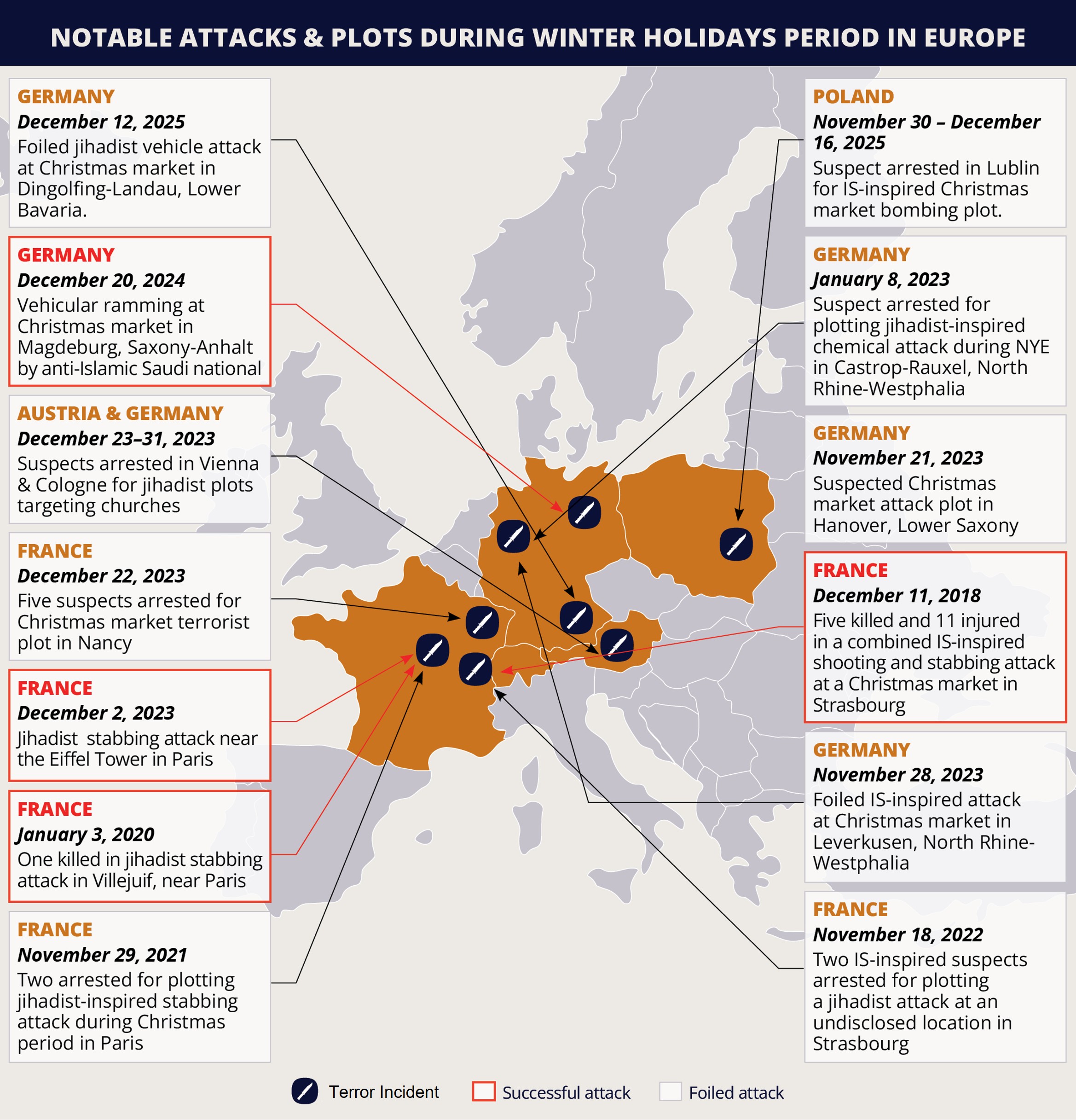
In recent years, the winter holiday period, spanning late November through early January, has seen an increased terrorist threat in Europe. Christmas markets and other large-scale public events have remained recurring targets of both successful attacks and foiled plots, predominantly from jihadist actors. Indeed, the prominence of jihadist motivation as the primary threat vector is evidenced by the fact that in the last decade, all recorded successful attacks and foiled plots during the December–January period, except the December 2024 Magdeburg attack, have involved jihadist actors, particularly individuals inspired by Islamic State (IS) propaganda.
The threat is driven by a combination of ideological, seasonal, and operational factors. Ideologically, jihadist networks, particularly IS and its supporters, repeatedly single out Christmas celebrations and other gatherings associated with Western cultural and religious identity in their propaganda, encouraging attacks against civilians during the festive period. Seasonally, the concentration of large crowds at recurring Christmas markets and public celebrations provides opportunities to cause mass casualties and attract significant public attention. Operationally, the open-access nature of many markets, limited perimeter controls, and predictable event schedules makes them relatively accessible targets for individuals seeking to conduct low-complexity attacks.
Beyond the jihadist threat, Christmas markets remain vulnerable to violence motivated by personal grievances and other extremist ideologies, evidenced by the December 20, 2024, vehicle-ramming attack at a Christmas market in Magdeburg, Germany. The attack killed six people and injured more than 300. The perpetrator, Taleb al-Abdulmohsen, a Saudi national, had expressed strong anti-Islam views and support for far-right groups online. That said, such incidents represent a secondary threat compared to jihadist attacks, given the more established pattern of jihadist attacks and propaganda specifically targeting Christmas celebrations and other festive gatherings in Europe.
Assessments & Forecast
Primary risk of successful attacks to stem from lone actors using rudimentary MOs such as arson, stabbing, and vehicular ramming
- Although no specific intelligence indicating a planned attack or publicly reported foiled plot targeting Christmas markets has emerged as of writing, these events are expected to remain attractive targets due to their high symbolic value, large visitor numbers, and open-access settings. Unlike airports, train stations, and government facilities, which benefit from established security arrangements, many Christmas markets operate in public squares and pedestrian areas where access is more difficult to control. Their fixed locations and recurring schedules also make them predictable targets, providing opportunities for individuals seeking to attack large civilian gatherings.
- FORECAST: The risk of successful attacks is likely to stem primarily from self-radicalized jihadist lone actors. This is based on the attack pattern observed across Europe, excluding Russia, since 2022, during which all recorded successful jihadist attacks were carried out by lone actors, primarily inspired by IS propaganda or expressing allegiance to the group. This trend is driven by the continued disruption of domestic extremist networks through counterterrorism operations in Europe, which has constrained the capacity of transnational groups such as IS and Al-Qaeda to establish structured cells and plan and execute complex, multi-actor or multi-pronged attacks.
- Nevertheless, sporadic cases in recent years involving suspects maintaining contact with overseas terrorist operatives through online platforms indicate that external coordination remains a latent threat. Notable examples include the March 2024 plot by two Afghan nationals to attack the Swedish Parliament in Stockholm, which German prosecutors said had been commissioned by IS’s regional affiliate, Islamic State’s Khorasan Province (ISKP), and planned in close coordination with its members, and the September 2024 case involving a teenager in Wuppertal, Germany, who was encouraged by an Islamist contact abroad to attack Jewish institutions. However, repeated disruption of such plots and the absence of successful centrally coordinated, multi-actor jihadist attacks in recent years underscore the vulnerability of such networks to detection. Communication between operatives, coordination among perpetrators, and the logistical requirements of attack planning create multiple points of exposure, which remain susceptible to being identified due to generally strong intelligence, surveillance, and counterterrorism capabilities in Europe. By contrast, lone actors often need little external support or logistical preparation, making their activities harder to detect before an attack.
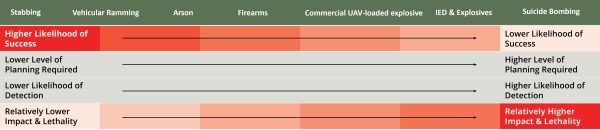
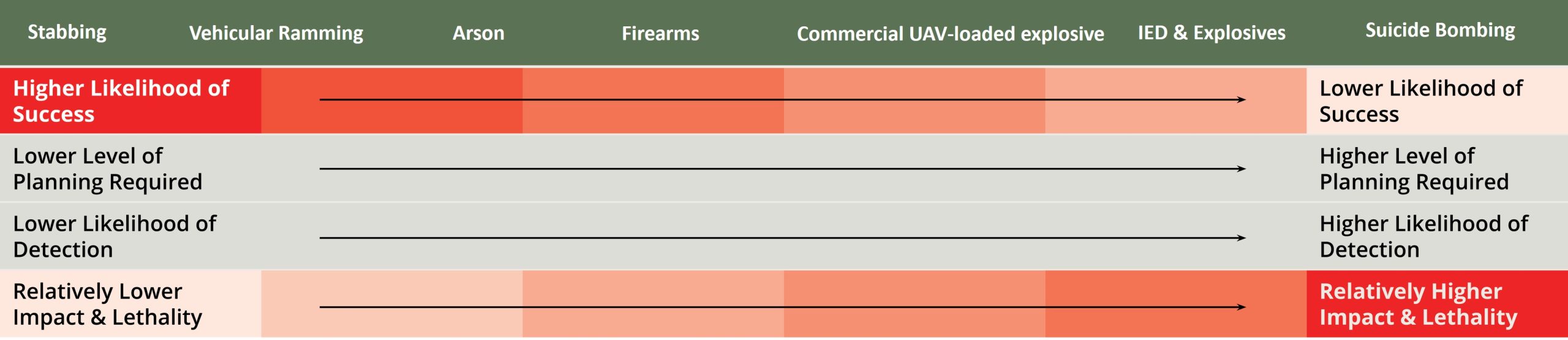
- FORECAST: Arson, stabbings, and vehicular ramming are expected to remain the preferred modus operandi (MO) among lone actors due to easy accessibility of weapons and vehicles, limited planning requirements, and minimal need for external logistical support in using them. Despite their relatively low operational complexity, both methods can cause mass casualties, particularly when used against crowded public gatherings. This is supported by the fact that, except in Russia, most successful jihadist attacks in Europe since 2024 have been carried out using stabbing and vehicular ramming. Only two exceptions to stabbing and ramming MOs include the September 2024 shooting near the Israeli Consulate in Munich, in which the perpetrator used an old Swiss military rifle, and the April 2026 IS-linked arson attack targeting a synagogue in Skopje, North Macedonia. However, both incidents relied on relatively basic means and did not demonstrate access to advanced weaponry or sophisticated attack capabilities. Nevertheless, the latent risk of attacks involving more complex methods, including firearms, improvised explosive devices (IEDs), explosives carried by commercially available UAVs, and harmful chemical substances, remains. Such methods have featured in several foiled plots, particularly in France and Germany, indicating continued interest among jihadist actors in conducting attacks beyond low-complexity methods. However, the limited operational capabilities of jihadist networks in Europe, as well as stringent weapons regulations, controls on access to potentially harmful materials, and established surveillance and counterterrorism capabilities are expected to constrain the acquisition of necessary materials and attack preparations, making the successful execution of such attacks less likely.
- FORECAST: Moreover, the overlap between Hanukkah and the Christmas holiday period is also expected to elevate the threat to Jewish and Israeli-linked targets across Europe. This is driven by persistently high anti-Semitic rhetoric and the continued leveraging of the conflict in Gaza and wider Middle East tensions by jihadist networks to incite attacks against Israeli and Jewish interests. The precedent of attacks against Jewish and Israeli-linked sites on significant religious and symbolic dates further reinforces this threat. Recent examples include the October 2025 stabbing outside a synagogue in Crumpsall, Manchester, on Yom Kippur, and the September 2024 shooting near the Israeli Consulate in Munich, which coincided with the anniversary of the 1972 Munich Olympics attack. These incidents highlight the continued appeal of religious and symbolic dates for actors seeking to maximize the ideological and psychological impact of attacks.
- Although no specific intelligence indicating a planned attack or publicly reported foiled plot targeting Christmas markets has emerged as of writing, these events are expected to remain attractive targets due to their high symbolic value, large visitor numbers, and open-access settings. Unlike airports, train stations, and government facilities, which benefit from established security arrangements, many Christmas markets operate in public squares and pedestrian areas where access is more difficult to control. Their fixed locations and recurring schedules also make them predictable targets, providing opportunities for individuals seeking to attack large civilian gatherings.
- FORECAST: The risk of successful attacks is likely to stem primarily from self-radicalized jihadist lone actors. This is based on the attack pattern observed across Europe, excluding Russia, since 2022, during which all recorded successful jihadist attacks were carried out by lone actors, primarily inspired by IS propaganda or expressing allegiance to the group. This trend is driven by the continued disruption of domestic extremist networks through counterterrorism operations in Europe, which has constrained the capacity of transnational groups such as IS and Al-Qaeda to establish structured cells and plan and execute complex, multi-actor or multi-pronged attacks.
- Nevertheless, sporadic cases in recent years involving suspects maintaining contact with overseas terrorist operatives through online platforms indicate that external coordination remains a latent threat. Notable examples include the March 2024 plot by two Afghan nationals to attack the Swedish Parliament in Stockholm, which German prosecutors said had been commissioned by IS’s regional affiliate, Islamic State’s Khorasan Province (ISKP), and planned in close coordination with its members, and the September 2024 case involving a teenager in Wuppertal, Germany, who was encouraged by an Islamist contact abroad to attack Jewish institutions. However, repeated disruption of such plots and the absence of successful centrally coordinated, multi-actor jihadist attacks in recent years underscore the vulnerability of such networks to detection. Communication between operatives, coordination among perpetrators, and the logistical requirements of attack planning create multiple points of exposure, which remain susceptible to being identified due to generally strong intelligence, surveillance, and counterterrorism capabilities in Europe. By contrast, lone actors often need little external support or logistical preparation, making their activities harder to detect before an attack.
- FORECAST: Arson, stabbings, and vehicular ramming are expected to remain the preferred modus operandi (MO) among lone actors due to easy accessibility of weapons and vehicles, limited planning requirements, and minimal need for external logistical support in using them. Despite their relatively low operational complexity, both methods can cause mass casualties, particularly when used against crowded public gatherings. This is supported by the fact that, except in Russia, most successful jihadist attacks in Europe since 2024 have been carried out using stabbing and vehicular ramming. Only two exceptions to stabbing and ramming MOs include the September 2024 shooting near the Israeli Consulate in Munich, in which the perpetrator used an old Swiss military rifle, and the April 2026 IS-linked arson attack targeting a synagogue in Skopje, North Macedonia. However, both incidents relied on relatively basic means and did not demonstrate access to advanced weaponry or sophisticated attack capabilities. Nevertheless, the latent risk of attacks involving more complex methods, including firearms, improvised explosive devices (IEDs), explosives carried by commercially available UAVs, and harmful chemical substances, remains. Such methods have featured in several foiled plots, particularly in France and Germany, indicating continued interest among jihadist actors in conducting attacks beyond low-complexity methods. However, the limited operational capabilities of jihadist networks in Europe, as well as stringent weapons regulations, controls on access to potentially harmful materials, and established surveillance and counterterrorism capabilities are expected to constrain the acquisition of necessary materials and attack preparations, making the successful execution of such attacks less likely.
- FORECAST: Moreover, the overlap between Hanukkah and the Christmas holiday period is also expected to elevate the threat to Jewish and Israeli-linked targets across Europe. This is driven by persistently high anti-Semitic rhetoric and the continued leveraging of the conflict in Gaza and wider Middle East tensions by jihadist networks to incite attacks against Israeli and Jewish interests. The precedent of attacks against Jewish and Israeli-linked sites on significant religious and symbolic dates further reinforces this threat. Recent examples include the October 2025 stabbing outside a synagogue in Crumpsall, Manchester, on Yom Kippur, and the September 2024 shooting near the Israeli Consulate in Munich, which coincided with the anniversary of the 1972 Munich Olympics attack. These incidents highlight the continued appeal of religious and symbolic dates for actors seeking to maximize the ideological and psychological impact of attacks.
Occurrence pattern of attacks to remain unpredictable across Europe, although risk is likely to be higher in Germany and France
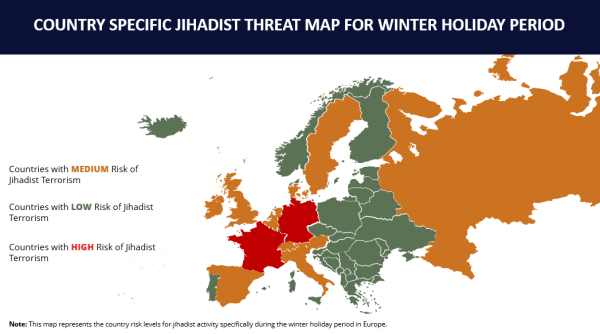
- While the overall jihadist threat remains elevated across Europe, some countries face a relatively higher risk of attacks compared to others. For example, Germany faces a high risk of attack, reflecting its higher baseline jihadist threat and repeated attacks/plots involving Christmas markets. According to MAX tracking, Germany recorded the highest number of successful jihadist attacks in Europe between 2024 and November 2026, with 12 incidents. It has also experienced repeated attempts to target Christmas markets, including the December 2016 vehicle-ramming attack at Berlin’s Breitscheidplatz market, which killed 12 people, and foiled plots involving markets in Leverkusen in November 2023, Elmshorn in November 2024, Augsburg in December 2024, and the Dingolfing-Landau area in December 2025.
- The risk also remains particularly elevated in France, which recorded the second-highest number of terrorist incidents in Europe between 2024 and November 2026, according to MAX tracking, and has a history of attacks against Christmas markets, most notably the December 2018 Strasbourg attack.
- In terms of regional exposure, other Western European countries, including the UK, Belgium, and the Netherlands, are expected to face an elevated, although comparatively lower, jihadist threat than Germany and France. Northern Europe also faces a moderately elevated threat, particularly in Sweden and Denmark. Southern Europe presents comparatively lower exposure, although Italy and Spain, which continue to report recurring jihadist-related arrests for propaganda and sporadic plots, remain vulnerable to jihadist attacks and plots. Exposure is generally lower across Central and Eastern Europe, with Austria a notable exception given its history of jihadist attacks and foiled plots targeting prominent religious and public locations, both during holiday seasons as well as in general.
- The jihadist attacks and activity in Europe do not have any predictable patterns, and attacks can occur in any location, with little or no warning. The threat is not limited to major capitals or tourist destinations. Previous plots involving Christmas markets in smaller German cities and regional areas, including Leverkusen, Elmshorn, Augsburg, and Dingolfing-Landau, demonstrate that these locations also remain viable targets. Decentralized jihadist propaganda and radicalization enable self-radicalized individuals and small groups to identify targets within their local environments without direct operational guidance from established networks. Smaller municipal markets could therefore attract opportunistic actors, particularly where protective security arrangements are perceived to be less comprehensive.
- While the overall jihadist threat remains elevated across Europe, some countries face a relatively higher risk of attacks compared to others. For example, Germany faces a high risk of attack, reflecting its higher baseline jihadist threat and repeated attacks/plots involving Christmas markets. According to MAX tracking, Germany recorded the highest number of successful jihadist attacks in Europe between 2024 and November 2026, with 12 incidents. It has also experienced repeated attempts to target Christmas markets, including the December 2016 vehicle-ramming attack at Berlin’s Breitscheidplatz market, which killed 12 people, and foiled plots involving markets in Leverkusen in November 2023, Elmshorn in November 2024, Augsburg in December 2024, and the Dingolfing-Landau area in December 2025.
- The risk also remains particularly elevated in France, which recorded the second-highest number of terrorist incidents in Europe between 2024 and November 2026, according to MAX tracking, and has a history of attacks against Christmas markets, most notably the December 2018 Strasbourg attack.
- In terms of regional exposure, other Western European countries, including the UK, Belgium, and the Netherlands, are expected to face an elevated, although comparatively lower, jihadist threat than Germany and France. Northern Europe also faces a moderately elevated threat, particularly in Sweden and Denmark. Southern Europe presents comparatively lower exposure, although Italy and Spain, which continue to report recurring jihadist-related arrests for propaganda and sporadic plots, remain vulnerable to jihadist attacks and plots. Exposure is generally lower across Central and Eastern Europe, with Austria a notable exception given its history of jihadist attacks and foiled plots targeting prominent religious and public locations, both during holiday seasons as well as in general.
- The jihadist attacks and activity in Europe do not have any predictable patterns, and attacks can occur in any location, with little or no warning. The threat is not limited to major capitals or tourist destinations. Previous plots involving Christmas markets in smaller German cities and regional areas, including Leverkusen, Elmshorn, Augsburg, and Dingolfing-Landau, demonstrate that these locations also remain viable targets. Decentralized jihadist propaganda and radicalization enable self-radicalized individuals and small groups to identify targets within their local environments without direct operational guidance from established networks. Smaller municipal markets could therefore attract opportunistic actors, particularly where protective security arrangements are perceived to be less comprehensive.
Heightened security measures unlikely to completely eliminate the risk of attacks, given the inherent difficulty of securing open public spaces
- FORECAST: Authorities across Europe are expected to maintain a heightened security posture throughout the festive period, particularly at major Christmas markets and other high-footfall public gatherings. Measures are likely to include reinforced vehicle barriers and access restrictions, increased uniformed and plainclothes police deployments, private security personnel, CCTV and crowd monitoring, bag checks, and restrictions on carrying weapons. Authorities are likely to adopt a low threshold for precautionary interventions, including increased screening, restricted access, temporary suspensions, and short-notice closures in response to potential threats or suspicious activity.
- However, heightened security does not eliminate the risk of attacks. The December 2018 Strasbourg Christmas market attack occurred despite security checks at access points to the city center. Similarly, the December 2024 Magdeburg attack demonstrated the limitations of existing security arrangements. Although a security plan was in place, subsequent assessments identified inadequately protected vehicle access routes. These incidents underscore the inherent limitations of securing Christmas markets, which are typically held in open public spaces with multiple access routes and surrounding pedestrian areas. While barriers, access controls, and increased police deployments can reduce vulnerabilities, securing every approach and preventing all unauthorized access is rarely feasible without severely restricting public access. Attackers are therefore likely to retain opportunities to exploit gaps in security arrangements, even at markets operating under extensive protective measures.
- FORECAST: The heightened security posture is expected to cause localized travel and access restrictions around major markets. These are likely to include road closures, vehicle exclusion zones, restricted parking, controlled entry points, pedestrian checks, and changes to delivery and servicing arrangements. Visitors, residents, and businesses operating near market areas are likely to face delays and access limitations, while short-notice security interventions could disrupt public transport and local traffic.
- Increased security requirements are also expected to raise operating costs, placing particular pressure on smaller markets with limited budgets. A 2026 survey of municipal Christmas markets in Germany found that security measures accounted for a median 25 percent of total market budgets in 2025. Around 70 percent of municipalities had changed their markets for financial reasons, while 74 percent expected the number of markets to decline if financial conditions did not improve. This pressure has already led to cancellations. Similar concerns have emerged in the UK, pointing to growing logistical and financial burdens of the security risks on the viability of these markets.
Recommendations
General
- Individuals residing in or traveling to European cities are advised to maintain heightened vigilance when visiting Christmas markets and other festive gatherings during the winter holiday season. Remain alert to the potential threat of jihadist attacks, including arson, vehicle ramming, stabbing, and shooting incidents.
- Remain aware of your surroundings, particularly near crowded market areas, entrances, exits, access points, and vehicle barriers. Report suspicious behavior, including individuals repeatedly surveying the area or appearing to monitor security arrangements, as well as unattended or out-of-place items such as bags and containers.
- Immediately notify police or market security personnel of suspicious behavior or items. Do not approach or handle unattended objects.
Checkpoints
- In the event that a security checkpoint is encountered, act respectfully and patiently, while cooperating fully with security personnel. Refrain from photographing security personnel or documenting events.
- If traveling with a local colleague, it is advisable to allow them to deal directly with security forces and only speak when addressed.
- Ensure when traveling that you have sufficient means of identification and can evidence, if required, exactly where you are going.
Vehicular attack
- Move away from the site of the attack immediately and as far as possible, while remaining vigilant of secondary attacks, which may come in the form of another vehicular attack, stabbing, shooting, or throwing of Molotov cocktails. When safe, alert emergency services.
- Move away from large groups to mitigate the risks of a stampede and of presenting a bigger target for a possible secondary attack.
Stabbing
- If possible, immediately leave the area and alert emergency services.
- Move away from large groups to mitigate the risks of a stampede and of presenting a bigger target.
- Remain vigilant of secondary attacks, which may come in the form of another stabbing attack, vehicular ramming, shooting, or throwing of Molotov cocktails. When safe, alert emergency services.
- If escape is impossible, hide, preferably in a place that will offer protection from gunfire, remain quiet, silence electronic devices, and attempt to contact emergency services via text messages or social media.
Active shooting
- If possible, immediately leave the area and alert emergency services. Move away from large groups to mitigate the risks of a stampede and of presenting a bigger target for a possible secondary attack.
- If escape is not possible, hide away from the shooter’s view, preferably in a place that will offer protection from gunfire.
- If possible, lock or otherwise barricade your hiding position, remain quiet, silence electronic devices, and attempt to contact emergency services via text messages or social media.
- Remain as close to the floor as possible, keep your hands visible and empty to prevent being mistakenly targeted by security forces.
Executive Summary
- In recent years, the winter holiday period has seen an increased terrorist threat in Europe, with Christmas markets and other large-scale public events remaining recurring targets of successful attacks and foiled plots, predominantly involving jihadist actors.
- The threat is driven by a combination of ideological, seasonal, and operational factors. Christmas markets remain attractive targets due to their high symbolic value, large visitor numbers, and open-access settings.
- The primary risk of successful attacks is expected to stem from jihadist lone actors using rudimentary tactics, including arson, stabbing, and vehicular ramming.
- Although jihadist activity in Europe remains geographically unpredictable, with attacks possible in any location and with little or no warning, the threat is particularly elevated in Germany and France, evidenced by repeated attacks and plots targeting Christmas markets in recent years.
- Individuals residing in or traveling to European cities are advised to maintain heightened vigilance when visiting Christmas markets and other festive gatherings during the winter holiday season. Remain alert to the potential threat of jihadist attacks, including arson, vehicle ramming, stabbing, and shooting incidents.
Current Situation
- On November 13, the US State Department issued a Europe-wide security alert warning travellers that large gatherings and public events during the upcoming winter holiday season “present a target of opportunity for terrorist groups and criminals.”
- While the USA or other European security agencies have not reported any specific plot or threat, the security alert noted that terrorists, including lone actors, could attack with little or no warning, targeting markets, transportation hubs, shopping malls, places of worship, and other public areas.
- Christmas markets across Europe, including in major cities as well as smaller municipalities, generally begin from mid-November, with most operating through December and some continuing into early January.
- Although no specific Europe-wide terrorist threat has been publicly identified for the 2026 season, national, regional, and municipal authorities are maintaining or reinforcing security arrangements around Christmas markets and other large public gatherings.
- The reported measures include expanded visible police and municipal-guard patrols, plain-clothes security officers, enhanced CCTV coverage, security staff, bag checks at some entrances, traffic restrictions around market areas, and temporary hostile-vehicle-mitigation measures such as concrete blocks, bollards, and other barriers.
Background
In recent years, the winter holiday period, spanning late November through early January, has seen an increased terrorist threat in Europe. Christmas markets and other large-scale public events have remained recurring targets of both successful attacks and foiled plots, predominantly from jihadist actors. Indeed, the prominence of jihadist motivation as the primary threat vector is evidenced by the fact that in the last decade, all recorded successful attacks and foiled plots during the December–January period, except the December 2024 Magdeburg attack, have involved jihadist actors, particularly individuals inspired by Islamic State (IS) propaganda.
The threat is driven by a combination of ideological, seasonal, and operational factors. Ideologically, jihadist networks, particularly IS and its supporters, repeatedly single out Christmas celebrations and other gatherings associated with Western cultural and religious identity in their propaganda, encouraging attacks against civilians during the festive period. Seasonally, the concentration of large crowds at recurring Christmas markets and public celebrations provides opportunities to cause mass casualties and attract significant public attention. Operationally, the open-access nature of many markets, limited perimeter controls, and predictable event schedules makes them relatively accessible targets for individuals seeking to conduct low-complexity attacks.
Beyond the jihadist threat, Christmas markets remain vulnerable to violence motivated by personal grievances and other extremist ideologies, evidenced by the December 20, 2024, vehicle-ramming attack at a Christmas market in Magdeburg, Germany. The attack killed six people and injured more than 300. The perpetrator, Taleb al-Abdulmohsen, a Saudi national, had expressed strong anti-Islam views and support for far-right groups online. That said, such incidents represent a secondary threat compared to jihadist attacks, given the more established pattern of jihadist attacks and propaganda specifically targeting Christmas celebrations and other festive gatherings in Europe.
Assessments & Forecast
Primary risk of successful attacks to stem from lone actors using rudimentary MOs such as arson, stabbing, and vehicular ramming
- Although no specific intelligence indicating a planned attack or publicly reported foiled plot targeting Christmas markets has emerged as of writing, these events are expected to remain attractive targets due to their high symbolic value, large visitor numbers, and open-access settings. Unlike airports, train stations, and government facilities, which benefit from established security arrangements, many Christmas markets operate in public squares and pedestrian areas where access is more difficult to control. Their fixed locations and recurring schedules also make them predictable targets, providing opportunities for individuals seeking to attack large civilian gatherings.
- FORECAST: The risk of successful attacks is likely to stem primarily from self-radicalized jihadist lone actors. This is based on the attack pattern observed across Europe, excluding Russia, since 2022, during which all recorded successful jihadist attacks were carried out by lone actors, primarily inspired by IS propaganda or expressing allegiance to the group. This trend is driven by the continued disruption of domestic extremist networks through counterterrorism operations in Europe, which has constrained the capacity of transnational groups such as IS and Al-Qaeda to establish structured cells and plan and execute complex, multi-actor or multi-pronged attacks.
- Nevertheless, sporadic cases in recent years involving suspects maintaining contact with overseas terrorist operatives through online platforms indicate that external coordination remains a latent threat. Notable examples include the March 2024 plot by two Afghan nationals to attack the Swedish Parliament in Stockholm, which German prosecutors said had been commissioned by IS’s regional affiliate, Islamic State’s Khorasan Province (ISKP), and planned in close coordination with its members, and the September 2024 case involving a teenager in Wuppertal, Germany, who was encouraged by an Islamist contact abroad to attack Jewish institutions. However, repeated disruption of such plots and the absence of successful centrally coordinated, multi-actor jihadist attacks in recent years underscore the vulnerability of such networks to detection. Communication between operatives, coordination among perpetrators, and the logistical requirements of attack planning create multiple points of exposure, which remain susceptible to being identified due to generally strong intelligence, surveillance, and counterterrorism capabilities in Europe. By contrast, lone actors often need little external support or logistical preparation, making their activities harder to detect before an attack.
- FORECAST: Arson, stabbings, and vehicular ramming are expected to remain the preferred modus operandi (MO) among lone actors due to easy accessibility of weapons and vehicles, limited planning requirements, and minimal need for external logistical support in using them. Despite their relatively low operational complexity, both methods can cause mass casualties, particularly when used against crowded public gatherings. This is supported by the fact that, except in Russia, most successful jihadist attacks in Europe since 2024 have been carried out using stabbing and vehicular ramming. Only two exceptions to stabbing and ramming MOs include the September 2024 shooting near the Israeli Consulate in Munich, in which the perpetrator used an old Swiss military rifle, and the April 2026 IS-linked arson attack targeting a synagogue in Skopje, North Macedonia. However, both incidents relied on relatively basic means and did not demonstrate access to advanced weaponry or sophisticated attack capabilities. Nevertheless, the latent risk of attacks involving more complex methods, including firearms, improvised explosive devices (IEDs), explosives carried by commercially available UAVs, and harmful chemical substances, remains. Such methods have featured in several foiled plots, particularly in France and Germany, indicating continued interest among jihadist actors in conducting attacks beyond low-complexity methods. However, the limited operational capabilities of jihadist networks in Europe, as well as stringent weapons regulations, controls on access to potentially harmful materials, and established surveillance and counterterrorism capabilities are expected to constrain the acquisition of necessary materials and attack preparations, making the successful execution of such attacks less likely.
- FORECAST: Moreover, the overlap between Hanukkah and the Christmas holiday period is also expected to elevate the threat to Jewish and Israeli-linked targets across Europe. This is driven by persistently high anti-Semitic rhetoric and the continued leveraging of the conflict in Gaza and wider Middle East tensions by jihadist networks to incite attacks against Israeli and Jewish interests. The precedent of attacks against Jewish and Israeli-linked sites on significant religious and symbolic dates further reinforces this threat. Recent examples include the October 2025 stabbing outside a synagogue in Crumpsall, Manchester, on Yom Kippur, and the September 2024 shooting near the Israeli Consulate in Munich, which coincided with the anniversary of the 1972 Munich Olympics attack. These incidents highlight the continued appeal of religious and symbolic dates for actors seeking to maximize the ideological and psychological impact of attacks.
Occurrence pattern of attacks to remain unpredictable across Europe, although risk is likely to be higher in Germany and France
- While the overall jihadist threat remains elevated across Europe, some countries face a relatively higher risk of attacks compared to others. For example, Germany faces a high risk of attack, reflecting its higher baseline jihadist threat and repeated attacks/plots involving Christmas markets. According to MAX tracking, Germany recorded the highest number of successful jihadist attacks in Europe between 2024 and November 2026, with 12 incidents. It has also experienced repeated attempts to target Christmas markets, including the December 2016 vehicle-ramming attack at Berlin’s Breitscheidplatz market, which killed 12 people, and foiled plots involving markets in Leverkusen in November 2023, Elmshorn in November 2024, Augsburg in December 2024, and the Dingolfing-Landau area in December 2025.
- The risk also remains particularly elevated in France, which recorded the second-highest number of terrorist incidents in Europe between 2024 and November 2026, according to MAX tracking, and has a history of attacks against Christmas markets, most notably the December 2018 Strasbourg attack.
- In terms of regional exposure, other Western European countries, including the UK, Belgium, and the Netherlands, are expected to face an elevated, although comparatively lower, jihadist threat than Germany and France. Northern Europe also faces a moderately elevated threat, particularly in Sweden and Denmark. Southern Europe presents comparatively lower exposure, although Italy and Spain, which continue to report recurring jihadist-related arrests for propaganda and sporadic plots, remain vulnerable to jihadist attacks and plots. Exposure is generally lower across Central and Eastern Europe, with Austria a notable exception given its history of jihadist attacks and foiled plots targeting prominent religious and public locations, both during holiday seasons as well as in general.
- The jihadist attacks and activity in Europe do not have any predictable patterns, and attacks can occur in any location, with little or no warning. The threat is not limited to major capitals or tourist destinations. Previous plots involving Christmas markets in smaller German cities and regional areas, including Leverkusen, Elmshorn, Augsburg, and Dingolfing-Landau, demonstrate that these locations also remain viable targets. Decentralized jihadist propaganda and radicalization enable self-radicalized individuals and small groups to identify targets within their local environments without direct operational guidance from established networks. Smaller municipal markets could therefore attract opportunistic actors, particularly where protective security arrangements are perceived to be less comprehensive.
Heightened security measures unlikely to completely eliminate the risk of attacks, given the inherent difficulty of securing open public spaces
- FORECAST: Authorities across Europe are expected to maintain a heightened security posture throughout the festive period, particularly at major Christmas markets and other high-footfall public gatherings. Measures are likely to include reinforced vehicle barriers and access restrictions, increased uniformed and plainclothes police deployments, private security personnel, CCTV and crowd monitoring, bag checks, and restrictions on carrying weapons. Authorities are likely to adopt a low threshold for precautionary interventions, including increased screening, restricted access, temporary suspensions, and short-notice closures in response to potential threats or suspicious activity.
- However, heightened security does not eliminate the risk of attacks. The December 2018 Strasbourg Christmas market attack occurred despite security checks at access points to the city center. Similarly, the December 2024 Magdeburg attack demonstrated the limitations of existing security arrangements. Although a security plan was in place, subsequent assessments identified inadequately protected vehicle access routes. These incidents underscore the inherent limitations of securing Christmas markets, which are typically held in open public spaces with multiple access routes and surrounding pedestrian areas. While barriers, access controls, and increased police deployments can reduce vulnerabilities, securing every approach and preventing all unauthorized access is rarely feasible without severely restricting public access. Attackers are therefore likely to retain opportunities to exploit gaps in security arrangements, even at markets operating under extensive protective measures.
- FORECAST: The heightened security posture is expected to cause localized travel and access restrictions around major markets. These are likely to include road closures, vehicle exclusion zones, restricted parking, controlled entry points, pedestrian checks, and changes to delivery and servicing arrangements. Visitors, residents, and businesses operating near market areas are likely to face delays and access limitations, while short-notice security interventions could disrupt public transport and local traffic.
- Increased security requirements are also expected to raise operating costs, placing particular pressure on smaller markets with limited budgets. A 2026 survey of municipal Christmas markets in Germany found that security measures accounted for a median 25 percent of total market budgets in 2025. Around 70 percent of municipalities had changed their markets for financial reasons, while 74 percent expected the number of markets to decline if financial conditions did not improve. This pressure has already led to cancellations. Similar concerns have emerged in the UK, pointing to growing logistical and financial burdens of the security risks on the viability of these markets.
- FORECAST: Authorities across Europe are expected to maintain a heightened security posture throughout the festive period, particularly at major Christmas markets and other high-footfall public gatherings. Measures are likely to include reinforced vehicle barriers and access restrictions, increased uniformed and plainclothes police deployments, private security personnel, CCTV and crowd monitoring, bag checks, and restrictions on carrying weapons. Authorities are likely to adopt a low threshold for precautionary interventions, including increased screening, restricted access, temporary suspensions, and short-notice closures in response to potential threats or suspicious activity.
- However, heightened security does not eliminate the risk of attacks. The December 2018 Strasbourg Christmas market attack occurred despite security checks at access points to the city center. Similarly, the December 2024 Magdeburg attack demonstrated the limitations of existing security arrangements. Although a security plan was in place, subsequent assessments identified inadequately protected vehicle access routes. These incidents underscore the inherent limitations of securing Christmas markets, which are typically held in open public spaces with multiple access routes and surrounding pedestrian areas. While barriers, access controls, and increased police deployments can reduce vulnerabilities, securing every approach and preventing all unauthorized access is rarely feasible without severely restricting public access. Attackers are therefore likely to retain opportunities to exploit gaps in security arrangements, even at markets operating under extensive protective measures.
- FORECAST: The heightened security posture is expected to cause localized travel and access restrictions around major markets. These are likely to include road closures, vehicle exclusion zones, restricted parking, controlled entry points, pedestrian checks, and changes to delivery and servicing arrangements. Visitors, residents, and businesses operating near market areas are likely to face delays and access limitations, while short-notice security interventions could disrupt public transport and local traffic.
- Increased security requirements are also expected to raise operating costs, placing particular pressure on smaller markets with limited budgets. A 2026 survey of municipal Christmas markets in Germany found that security measures accounted for a median 25 percent of total market budgets in 2025. Around 70 percent of municipalities had changed their markets for financial reasons, while 74 percent expected the number of markets to decline if financial conditions did not improve. This pressure has already led to cancellations. Similar concerns have emerged in the UK, pointing to growing logistical and financial burdens of the security risks on the viability of these markets.
Recommendations
General
- Individuals residing in or traveling to European cities are advised to maintain heightened vigilance when visiting Christmas markets and other festive gatherings during the winter holiday season. Remain alert to the potential threat of jihadist attacks, including arson, vehicle ramming, stabbing, and shooting incidents.
- Remain aware of your surroundings, particularly near crowded market areas, entrances, exits, access points, and vehicle barriers. Report suspicious behavior, including individuals repeatedly surveying the area or appearing to monitor security arrangements, as well as unattended or out-of-place items such as bags and containers.
- Immediately notify police or market security personnel of suspicious behavior or items. Do not approach or handle unattended objects.
Checkpoints
- In the event that a security checkpoint is encountered, act respectfully and patiently, while cooperating fully with security personnel. Refrain from photographing security personnel or documenting events.
- If traveling with a local colleague, it is advisable to allow them to deal directly with security forces and only speak when addressed.
- Ensure when traveling that you have sufficient means of identification and can evidence, if required, exactly where you are going.
Vehicular attack
- Move away from the site of the attack immediately and as far as possible, while remaining vigilant of secondary attacks, which may come in the form of another vehicular attack, stabbing, shooting, or throwing of Molotov cocktails. When safe, alert emergency services.
- Move away from large groups to mitigate the risks of a stampede and of presenting a bigger target for a possible secondary attack.
Stabbing
- If possible, immediately leave the area and alert emergency services.
- Move away from large groups to mitigate the risks of a stampede and of presenting a bigger target.
- Remain vigilant of secondary attacks, which may come in the form of another stabbing attack, vehicular ramming, shooting, or throwing of Molotov cocktails. When safe, alert emergency services.
- If escape is impossible, hide, preferably in a place that will offer protection from gunfire, remain quiet, silence electronic devices, and attempt to contact emergency services via text messages or social media.
Active shooting
- If possible, immediately leave the area and alert emergency services. Move away from large groups to mitigate the risks of a stampede and of presenting a bigger target for a possible secondary attack.
- If escape is not possible, hide away from the shooter’s view, preferably in a place that will offer protection from gunfire.
- If possible, lock or otherwise barricade your hiding position, remain quiet, silence electronic devices, and attempt to contact emergency services via text messages or social media.
- Remain as close to the floor as possible, keep your hands visible and empty to prevent being mistakenly targeted by security forces.
Related Reports
-
 Civil UnrestGlobal Special Report: Anti-wealth trends supported by political movements increase risks to corporate executives, UHNWIs
-
 Supply Chain DisruptionsGlobal Special Report: Persistent crime risk at port facilities continues to threaten cargo security, shipping reliability, compound supply chain disruptions
-
 Civil UnrestEurope Analysis: Gen-Z protests trigger major unrest in Germany, while France, Spain record decline in unrest on October 31; similar protests to continue in coming weeks
-
 TravelEurope Analysis: Overlap of youth protests, Halloween-related gatherings to sustain already heightened risk of unrest, violence, especially in France, Germany, Spain, on October 31- November 1
Related Reports
-
Civil UnrestGlobal Special Report: Anti-wealth trends supported by political movements increase risks to corporate executives, UHNWIs
-
Supply Chain DisruptionsGlobal Special Report: Persistent crime risk at port facilities continues to threaten cargo security, shipping reliability, compound supply chain disruptions
-
Civil UnrestEurope Analysis: Gen-Z protests trigger major unrest in Germany, while France, Spain record decline in unrest on October 31; similar protests to continue in coming weeks
-
TravelEurope Analysis: Overlap of youth protests, Halloween-related gatherings to sustain already heightened risk of unrest, violence, especially in France, Germany, Spain, on October 31- November 1