

GCC Analysis: Despite acceleration of workforce nationalization efforts, reliance on foreign workers, investors to continue
Executive Summary:
- The COVID-19 pandemic, which has led to financial constraints across the GCC, has also impacted the Gulf states’ workforce nationalization strategy. Several measures have been adopted since the start of the pandemic to expedite this process. The Gulf states will likely accelerate this strategy, with a focus on integrating their nationals into private labor markets.
- Simultaneously, by introducing schemes to attract “highly skilled” foreign workers and investors in exchange for long-term visas, GCC states will continue to rely on non-nationals for its economic growth. This is particularly because workforce nationalization programs have also added constraints to businesses.
- GCC states are likely to incentivize foreign companies to set up branches and hire local talent in their countries through measures to ease foreign ownership regulations, which would lead to a win-win situation for the government in pursuit of their workforce nationalization schemes.
- Given the revenue they garner and the boost to public relations and tourism, GCC states will aim to host more high-profile international events. This increased scrutiny will likely prompt these countries to portray their implementation of liberal labor policies to showcase themselves as progressive.
- Travel and operations may continue in GCC states while remaining abreast of social and economic developments due to changes to the workforce demographic.
Background:
In most GCC countries, over 50 percent of the labor force is comprised of foreign workers. Over recent years, GCC countries have increased their commitment to reducing their dependence on foreign labor and introduced measures to incorporate their nationals into the workforce. This policy was given particular focus in the wake of declining oil prices after 2014 and increased budget deficits in 2015-16. The need to shift away from oil-based revenue has forced Gulf states to recalibrate their strategies towards integrating locals into the labor market to help develop knowledge-based economies with a focus on the manufacturing and service sectors. Since then, the GCC’s blueprints for workforce nationalization have formed key parts of their mid-term economic visions, which have also been designed to appeal to global investors. These include Bahrain’s Vision 2030, Kuwait’s New Vision 2035, Oman’s Vision 2040, Qatar’s National Vision 2030, Saudi’s Vision 2030, and the UAE’s Vision 2030.
Assessments & Forecasts
Acceleration of workforce nationalization in private sector likely in short term
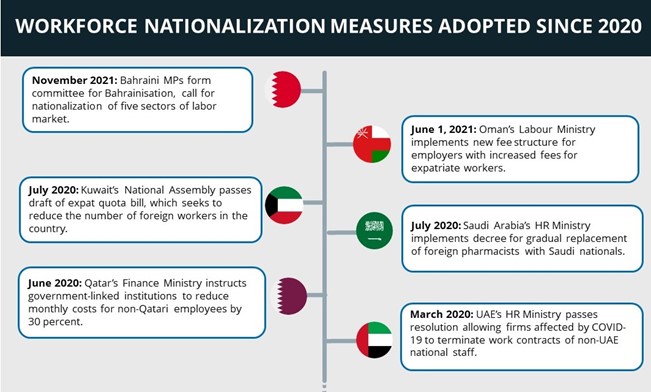
- Since 2020, COVID-19-related restrictions on travel and business operations have had an overall adverse impact on the global economy. The economic ramifications of these restrictions had a significant impact on GCC states amid a decrease in the global demand for oil, which led to a decline in oil prices. This led to financial constraints for all GCC states, which compelled authorities to slash public spending while simultaneously redirecting funds to help citizens and the private sector cope with the financial challenges resulting from the virus. In order to offset budget deficits, GCC states took measures, such as cuts to subsidies on basic amenities like fuel, electricity, and water. These actions have also impacted the Gulf states’ strategy towards workforce nationalization, with several measures being adopted since the start of the pandemic.
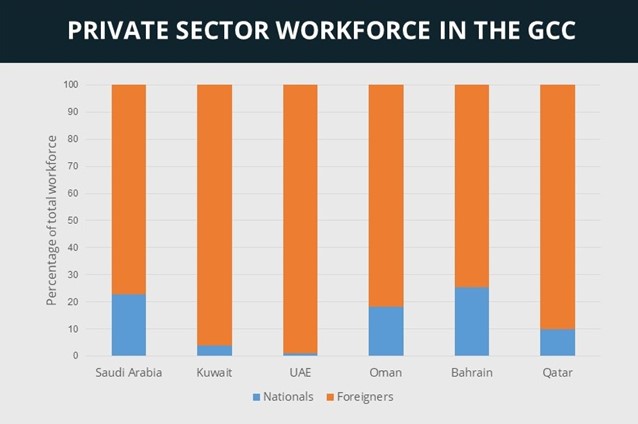
- Gulf nationals are known to favor jobs in the public sector over the private sector due to high salaries, flexible working conditions, and low productivity demands. This is further highlighted by a significant wage gap between the public and private sectors, with the International Monetary Fund (IMF) estimating it to be at 30 to 50 percent higher in favor of the former in the Gulf region. The over-dependence of nationals on public sector employment has placed enormous pressure on the government to provide for its citizens. This has prompted a re-calibration of strategy by the government, which has been expedited by the pandemic. The need to nationalize the private sector workforce has been exacerbated due to the expat exodus from the GCC since the beginning of the pandemic. Up to 12 percent of foreign workers in Oman and around eight percent in the UAE reportedly left these countries during the past two years. Given that foreign workers overwhelmingly dominate the private sector, with the average workforce made up of approximately 85 percent of foreign workers across the Gulf states, several private-sector jobs have fallen vacant due to this exodus.
- FORECAST: The Gulf states’ acceleration of workforce nationalization will thus primarily focus on integrating their nationals into the private labor market. The main aim of this will be to stave off the pressure of dedicating resources to jobs in the public sector and filling gaps in the private sector. Given the need to address shortcomings in their private sector recruitment policies, the Gulf states will likely increase initiatives to reserve jobs for their nationals. This was most recently seen in Qatar on January 30, when the Ministry of Administrative Development, Labour, and Social Affairs announced that a total of 444 jobs across various fields would be reserved for Qatari nationals in 48 private sector companies. Similar measures of reserving a fixed number of jobs for Gulf nationals across the GCC could be announced in the coming months.
- FORECAST: Gulf states will also likely aim to address the existing wage gap between the public and private sectors, in order to achieve a minimum level of consistency. This has already been seen, for instance, with Qatar’s passage of a law in March 2021 mandating a minimum wage of 1,000 Qatari Riyal (QAR) for all private-sector workers.
- The Gulf states have previously implemented measures towards encouraging the employment of citizens in the private sector, with the aim of incentivizing businesses to hire nationals. For instance, in 2011, Saudi Arabia introduced the “Nitaqat” system which requires private sector firms in Saudi to meet specific employment quotas for Saudi nationals. This program regulates all private sector firms with more than ten employees, with benefits such as unrestricted visa approvals and extensions on the submission of income tax certificates. Since its inception, the program has shown some success in increasing the hiring of Saudi workers, leading to a larger share of nationals participating in the private sector. The last publicly available figures from 2017 indicate that the share of Saudi nationals in the private sector increased from 11 to 19 percent since the start of the program. This figure is likely to have gone up since then, given the continued prioritization of the initiative. This success has likely led to incentive-based initiatives being implemented in other GCC states. In Oman, for example, the Ministry of Labour implemented a measure in June 2021 that sought to reduce fees for employees’ work permits if their companies met “Omanization” targets in technical and specialized professions. It is likely that such initiatives will successfully spur the hiring of nationals across the Gulf states in the short term.
- However, such incentive-based measures have also included provisions for penalties to be triggered automatically for firms deemed to be noncompliant in meeting workforce nationalization targets. With “Nitaqat”, for instance, sanctions have included the denial of new work visas and the non-renewal of existing visas for the companies’ expatriate employees. This has led to a significant impact in terms of several reportedly firms ceasing their operations in the country since the program’s inception, due to their inability to ensure immediate compliance with the measures. Therefore, while programs such as “Nitaqat” were implemented as a quick and visible remedy to citizens’ participation in the private sector workforce, their regulations have been potentially costly for firms, with the short-term benefits of increasing employment coming at a cost to long-term economic growth. This suggests that fixed costs on hiring have had an impact on business continuity, which could have the reverse effect on how the GCC intends to engage with its private sector, if more firms deem such regulations as hindering their operations. FORECAST: Therefore, despite the likelihood of Gulf states pushing through more such measures in the private sector in the coming months, it is likely that constraints relating to businesses’ adaptability to these measures will continue in the coming months and years. Subsequently, this may impact business continuity in the short-to-midterm.
Despite short-term workforce nationalization efforts, reliance on skilled foreign workers, investors to continue
- In recent years, several Gulf states have passed legislation centered on retaining and attracting “talented” expatriates to their countries. This has particularly been seen in the UAE, which has implemented a slew of measures, starting with the “Golden Visa” scheme in 2019, which provides ten-year visas for investors and skilled professionals. The Emirates’ plan is partly based on the estimation that population outflow will lead to economic contraction due to the share of expatriates in the country (89 percent of the population). Other Gulf countries have also recognized the benefits of such legislation and have followed suit. On February 7, for instance, Bahrain announced the introduction of a similar “Golden Visa” program, which grants “highly skilled” foreign workers with a ten-year residency permit in the country. In addition to legislation focused on “talented” expatriates, the UAE and other Gulf states have also taken measures to ease up foreign ownership regulations by allowing foreigners to invest in their local businesses and real estate. In November 2020, for instance, the UAE announced reforms to allow foreign investors to fully own companies in the country, a move that officially came into effect in June 2021.
- These measures are likely being taken due to the Gulf states’ recognition of the advantages that skilled foreign workers bring to their mid-to-long term economic visions. Primary among them is that it aids in their goal of transitioning to a knowledge-based economy by addressing the deficit of necessary skillsets in the national population due to a lack of sufficient technical education, low levels of tertiary education, and low rates of participation in vocational training programs. FORECAST: Therefore, by introducing schemes to attract highly skilled foreign workers, GCC states will likely seek to derive benefit from foreign talent by transferring skills and knowledge to the local populace, particularly in non-oil sectors. These may include sectors such as finance, manufacturing, education, and healthcare, which have so far been underdeveloped in most of the Gulf states. Successful implementation will not only contribute towards additional sources of government revenue but also aid in socio-economic development.
- FORECAST: Other Gulf states are also likely to follow the UAE’s suit by allowing increased foreign ownership of businesses and real estate. These will likely be implemented with an aim to portray themselves as encouraging the ease of doing business in the region. Mutual benefit from this can also be derived in the form of foreign direct investment (FDI), which would further aid the economic policies of these states. The GCC is also likely to incentivize foreign companies to set up branches and hire local talent through these schemes, which would lead to a win-win situation for the government in pursuit of their workforce nationalization schemes.
Labor reforms indicate desire to portray liberal image
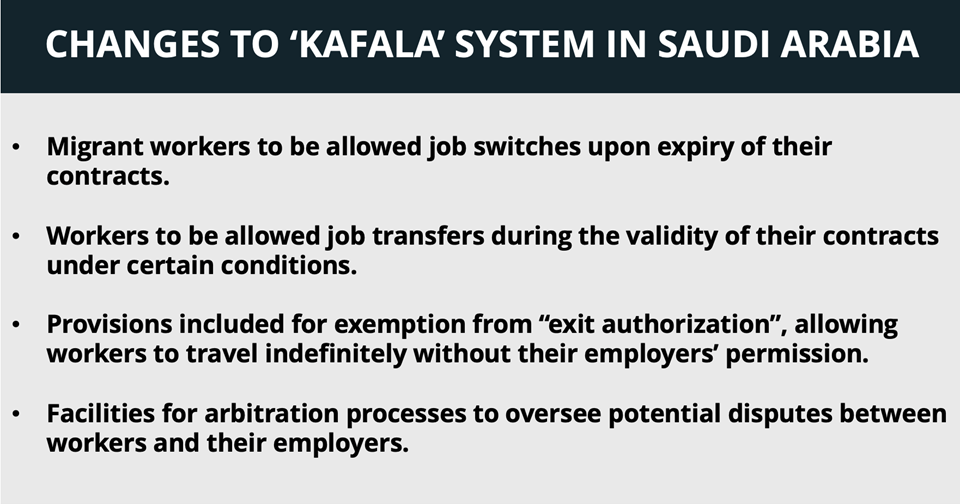
- In recent years, several Gulf states have attempted to reform their labor policies, which have long been perceived to be discriminatory against foreign workers. Criticism has particularly been levied against the “kafala” system, which is still prevalent in Kuwait, and which legally binds employees’ legal status to their employers. Under this restrictive system, workers have often been subjected to alleged abuse, such as the retention of passports, the withholding of wages, threats of deportation, restrictions on the freedom of movement, as well as sexual, mental, and physical abuse.
- In 2021, Saudi Arabia officially announced plans to reform this system, introducing provisions empowering migrant workers with enhanced rights over their employment statuses. Similar provisions were also instituted by Qatar in 2020. The UAE implemented new labor laws in February 2022, which provide migrant workers with flexibility in moving to different jobs, in addition to employee-friendly contract options and complaint redressal mechanisms. One commonality that binds these countries is that these reforms are being implemented amid heightened international scrutiny against the backdrop of their hosting of high-profile events, such as the ongoing Dubai Expo 2020 and the upcoming FIFA World Cup 2022 in Qatar. The significant international attention over these countries’ policies has therefore pushed GCC governments to showcase themselves as progressive and supportive of labor rights.
- However, despite reforms being instituted in several Gulf states, critics, particularly human rights organizations, have alleged that there are still loopholes that could prove to be a setback for the intended objectives of these legislations. In addition, certain Gulf states still continue to maintain relatively restrictive labor policies that have drawn comparison to the “kafala” system. For instance, on January 4, Bahrain’s MPs unanimously approved a draft law that doubles the period for an expatriate employee to remain with their employer from one to two years. The extension of this labor immobility has enhanced concerns over the leeway being provided to employers hiring foreign workers in Bahrain, who may misuse the law to prevent laborers from seeking alternative employment.
- FORECAST: Labor impediments such as the “kafala” system are likely to still have their remnants in the Gulf, as seen in Bahrain’s labor immobility proposal. Such practices will likely continue to attract criticism from Western bodies in the short term, particularly from non-governmental organizations. However, more GCC states will aim to play host to high-profile international events, given the significant revenue they garner, in addition to a public relations boost and opportunities for growth of their tourism sectors. Therefore, it is likely that Gulf states will seek to portray themselves as maintaining liberal labor policies in the coming months. This will likely take the form of more labor reforms. The GCC will therefore likely seek to drive the narrative towards their countries being more open and supportive of foreign workers.
Anti-expat rhetoric to play out in domestic politics
- While not the norm, there exists a discourse among the local population that has targeted the presence of expatriates in the Gulf states. Most of this discourse has previously revolved around the significant presence of expatriates in the GCC’s labor force. In recent years, this sentiment has also been triggered by the growing perception that the spread of the COVID-19 virus in some of the GCC countries has been caused by foreigners, particularly by blue-collar workers that make up a high percentage of the countries’ migrant population. This is primarily because most such workers live in low-cost, overcrowded labor camps, several of which had emerged as hotspots for the spread of the virus. This may have increased resentment among parts of the local citizenry towards the migrant population due to the pressure placed on the country’s resources and infrastructure amid the health crisis.
- The political effects of this rhetoric have most predominantly been seen in Kuwait, where MPs passed a draft bill in 2020 that radically aims to reduce foreign workers in the country. This was further promoted by Kuwait Prime Minister (PM), Sheikh Khaled Sabah al-Sabah, who emphasized the need to “resolve the demographic imbalance” prior to the bill’s passage. Such expat-focused discussion and legislation has also been seen in the Bahraini Parliament. For instance, in 2019, Bahraini MPs proposed a total ban on expatriate workers from being employed in 35 professions and further called for a substantial minimum wage increase for Bahrainis only. Although the stated intention of their proposal was to contribute to the government’s “Bahrainization” efforts, such a proposition is also likely to have been influenced by the discourse surrounding the presence of expatriates in the country. Overall, these developments indicate that local resentment vis-a-vis the expat population can influence legislation impacting foreign workers.
- FORECAST: Such rhetoric will continue to play out in domestic politics, particularly in GCC countries with electoral engagement, such as Bahrain and Kuwait. Their parliaments are likely to press for demands to nationalize particular sectors, especially those of interest to MPs’ constituencies. However, given that final legislative approval ultimately rests with the royals in these countries, it is unlikely that drastic, unilateral changes to the foreign workforce will materialize. Nonetheless, such discussions and draft legislation will continue to fuel demands for greater local representation in the workforce.
Recommendations:
- Travel and operations may continue in GCC states while remaining abreast of COVID-19-related restrictions and procedures as well as social and economic developments due to changes to the workforce demographic and reductions in state revenue.
- It is advised to take necessary measures to mitigate the potential adverse effect of these developments to ensure business continuity, while allotting for potential disruptions and service failures in these countries.
- It is also advised to maintain vigilance due to the potential for a rise in anti-foreign sentiment to some population groups in GCC states on account of the perception among some parts of the local populace that expats are a burden on their resources.
Executive Summary:
- The COVID-19 pandemic, which has led to financial constraints across the GCC, has also impacted the Gulf states’ workforce nationalization strategy. Several measures have been adopted since the start of the pandemic to expedite this process. The Gulf states will likely accelerate this strategy, with a focus on integrating their nationals into private labor markets.
- Simultaneously, by introducing schemes to attract “highly skilled” foreign workers and investors in exchange for long-term visas, GCC states will continue to rely on non-nationals for its economic growth. This is particularly because workforce nationalization programs have also added constraints to businesses.
- GCC states are likely to incentivize foreign companies to set up branches and hire local talent in their countries through measures to ease foreign ownership regulations, which would lead to a win-win situation for the government in pursuit of their workforce nationalization schemes.
- Given the revenue they garner and the boost to public relations and tourism, GCC states will aim to host more high-profile international events. This increased scrutiny will likely prompt these countries to portray their implementation of liberal labor policies to showcase themselves as progressive.
- Travel and operations may continue in GCC states while remaining abreast of social and economic developments due to changes to the workforce demographic.
Background:
In most GCC countries, over 50 percent of the labor force is comprised of foreign workers. Over recent years, GCC countries have increased their commitment to reducing their dependence on foreign labor and introduced measures to incorporate their nationals into the workforce. This policy was given particular focus in the wake of declining oil prices after 2014 and increased budget deficits in 2015-16. The need to shift away from oil-based revenue has forced Gulf states to recalibrate their strategies towards integrating locals into the labor market to help develop knowledge-based economies with a focus on the manufacturing and service sectors. Since then, the GCC’s blueprints for workforce nationalization have formed key parts of their mid-term economic visions, which have also been designed to appeal to global investors. These include Bahrain’s Vision 2030, Kuwait’s New Vision 2035, Oman’s Vision 2040, Qatar’s National Vision 2030, Saudi’s Vision 2030, and the UAE’s Vision 2030.
Assessments & Forecasts
Acceleration of workforce nationalization in private sector likely in short term
- Since 2020, COVID-19-related restrictions on travel and business operations have had an overall adverse impact on the global economy. The economic ramifications of these restrictions had a significant impact on GCC states amid a decrease in the global demand for oil, which led to a decline in oil prices. This led to financial constraints for all GCC states, which compelled authorities to slash public spending while simultaneously redirecting funds to help citizens and the private sector cope with the financial challenges resulting from the virus. In order to offset budget deficits, GCC states took measures, such as cuts to subsidies on basic amenities like fuel, electricity, and water. These actions have also impacted the Gulf states’ strategy towards workforce nationalization, with several measures being adopted since the start of the pandemic.
- Gulf nationals are known to favor jobs in the public sector over the private sector due to high salaries, flexible working conditions, and low productivity demands. This is further highlighted by a significant wage gap between the public and private sectors, with the International Monetary Fund (IMF) estimating it to be at 30 to 50 percent higher in favor of the former in the Gulf region. The over-dependence of nationals on public sector employment has placed enormous pressure on the government to provide for its citizens. This has prompted a re-calibration of strategy by the government, which has been expedited by the pandemic. The need to nationalize the private sector workforce has been exacerbated due to the expat exodus from the GCC since the beginning of the pandemic. Up to 12 percent of foreign workers in Oman and around eight percent in the UAE reportedly left these countries during the past two years. Given that foreign workers overwhelmingly dominate the private sector, with the average workforce made up of approximately 85 percent of foreign workers across the Gulf states, several private-sector jobs have fallen vacant due to this exodus.
- FORECAST: The Gulf states’ acceleration of workforce nationalization will thus primarily focus on integrating their nationals into the private labor market. The main aim of this will be to stave off the pressure of dedicating resources to jobs in the public sector and filling gaps in the private sector. Given the need to address shortcomings in their private sector recruitment policies, the Gulf states will likely increase initiatives to reserve jobs for their nationals. This was most recently seen in Qatar on January 30, when the Ministry of Administrative Development, Labour, and Social Affairs announced that a total of 444 jobs across various fields would be reserved for Qatari nationals in 48 private sector companies. Similar measures of reserving a fixed number of jobs for Gulf nationals across the GCC could be announced in the coming months.
- FORECAST: Gulf states will also likely aim to address the existing wage gap between the public and private sectors, in order to achieve a minimum level of consistency. This has already been seen, for instance, with Qatar’s passage of a law in March 2021 mandating a minimum wage of 1,000 Qatari Riyal (QAR) for all private-sector workers.
- The Gulf states have previously implemented measures towards encouraging the employment of citizens in the private sector, with the aim of incentivizing businesses to hire nationals. For instance, in 2011, Saudi Arabia introduced the “Nitaqat” system which requires private sector firms in Saudi to meet specific employment quotas for Saudi nationals. This program regulates all private sector firms with more than ten employees, with benefits such as unrestricted visa approvals and extensions on the submission of income tax certificates. Since its inception, the program has shown some success in increasing the hiring of Saudi workers, leading to a larger share of nationals participating in the private sector. The last publicly available figures from 2017 indicate that the share of Saudi nationals in the private sector increased from 11 to 19 percent since the start of the program. This figure is likely to have gone up since then, given the continued prioritization of the initiative. This success has likely led to incentive-based initiatives being implemented in other GCC states. In Oman, for example, the Ministry of Labour implemented a measure in June 2021 that sought to reduce fees for employees’ work permits if their companies met “Omanization” targets in technical and specialized professions. It is likely that such initiatives will successfully spur the hiring of nationals across the Gulf states in the short term.
- However, such incentive-based measures have also included provisions for penalties to be triggered automatically for firms deemed to be noncompliant in meeting workforce nationalization targets. With “Nitaqat”, for instance, sanctions have included the denial of new work visas and the non-renewal of existing visas for the companies’ expatriate employees. This has led to a significant impact in terms of several reportedly firms ceasing their operations in the country since the program’s inception, due to their inability to ensure immediate compliance with the measures. Therefore, while programs such as “Nitaqat” were implemented as a quick and visible remedy to citizens’ participation in the private sector workforce, their regulations have been potentially costly for firms, with the short-term benefits of increasing employment coming at a cost to long-term economic growth. This suggests that fixed costs on hiring have had an impact on business continuity, which could have the reverse effect on how the GCC intends to engage with its private sector, if more firms deem such regulations as hindering their operations. FORECAST: Therefore, despite the likelihood of Gulf states pushing through more such measures in the private sector in the coming months, it is likely that constraints relating to businesses’ adaptability to these measures will continue in the coming months and years. Subsequently, this may impact business continuity in the short-to-midterm.
Despite short-term workforce nationalization efforts, reliance on skilled foreign workers, investors to continue
- In recent years, several Gulf states have passed legislation centered on retaining and attracting “talented” expatriates to their countries. This has particularly been seen in the UAE, which has implemented a slew of measures, starting with the “Golden Visa” scheme in 2019, which provides ten-year visas for investors and skilled professionals. The Emirates’ plan is partly based on the estimation that population outflow will lead to economic contraction due to the share of expatriates in the country (89 percent of the population). Other Gulf countries have also recognized the benefits of such legislation and have followed suit. On February 7, for instance, Bahrain announced the introduction of a similar “Golden Visa” program, which grants “highly skilled” foreign workers with a ten-year residency permit in the country. In addition to legislation focused on “talented” expatriates, the UAE and other Gulf states have also taken measures to ease up foreign ownership regulations by allowing foreigners to invest in their local businesses and real estate. In November 2020, for instance, the UAE announced reforms to allow foreign investors to fully own companies in the country, a move that officially came into effect in June 2021.
- These measures are likely being taken due to the Gulf states’ recognition of the advantages that skilled foreign workers bring to their mid-to-long term economic visions. Primary among them is that it aids in their goal of transitioning to a knowledge-based economy by addressing the deficit of necessary skillsets in the national population due to a lack of sufficient technical education, low levels of tertiary education, and low rates of participation in vocational training programs. FORECAST: Therefore, by introducing schemes to attract highly skilled foreign workers, GCC states will likely seek to derive benefit from foreign talent by transferring skills and knowledge to the local populace, particularly in non-oil sectors. These may include sectors such as finance, manufacturing, education, and healthcare, which have so far been underdeveloped in most of the Gulf states. Successful implementation will not only contribute towards additional sources of government revenue but also aid in socio-economic development.
- FORECAST: Other Gulf states are also likely to follow the UAE’s suit by allowing increased foreign ownership of businesses and real estate. These will likely be implemented with an aim to portray themselves as encouraging the ease of doing business in the region. Mutual benefit from this can also be derived in the form of foreign direct investment (FDI), which would further aid the economic policies of these states. The GCC is also likely to incentivize foreign companies to set up branches and hire local talent through these schemes, which would lead to a win-win situation for the government in pursuit of their workforce nationalization schemes.
Labor reforms indicate desire to portray liberal image
- In recent years, several Gulf states have attempted to reform their labor policies, which have long been perceived to be discriminatory against foreign workers. Criticism has particularly been levied against the “kafala” system, which is still prevalent in Kuwait, and which legally binds employees’ legal status to their employers. Under this restrictive system, workers have often been subjected to alleged abuse, such as the retention of passports, the withholding of wages, threats of deportation, restrictions on the freedom of movement, as well as sexual, mental, and physical abuse.
- In 2021, Saudi Arabia officially announced plans to reform this system, introducing provisions empowering migrant workers with enhanced rights over their employment statuses. Similar provisions were also instituted by Qatar in 2020. The UAE implemented new labor laws in February 2022, which provide migrant workers with flexibility in moving to different jobs, in addition to employee-friendly contract options and complaint redressal mechanisms. One commonality that binds these countries is that these reforms are being implemented amid heightened international scrutiny against the backdrop of their hosting of high-profile events, such as the ongoing Dubai Expo 2020 and the upcoming FIFA World Cup 2022 in Qatar. The significant international attention over these countries’ policies has therefore pushed GCC governments to showcase themselves as progressive and supportive of labor rights.
- However, despite reforms being instituted in several Gulf states, critics, particularly human rights organizations, have alleged that there are still loopholes that could prove to be a setback for the intended objectives of these legislations. In addition, certain Gulf states still continue to maintain relatively restrictive labor policies that have drawn comparison to the “kafala” system. For instance, on January 4, Bahrain’s MPs unanimously approved a draft law that doubles the period for an expatriate employee to remain with their employer from one to two years. The extension of this labor immobility has enhanced concerns over the leeway being provided to employers hiring foreign workers in Bahrain, who may misuse the law to prevent laborers from seeking alternative employment.
- FORECAST: Labor impediments such as the “kafala” system are likely to still have their remnants in the Gulf, as seen in Bahrain’s labor immobility proposal. Such practices will likely continue to attract criticism from Western bodies in the short term, particularly from non-governmental organizations. However, more GCC states will aim to play host to high-profile international events, given the significant revenue they garner, in addition to a public relations boost and opportunities for growth of their tourism sectors. Therefore, it is likely that Gulf states will seek to portray themselves as maintaining liberal labor policies in the coming months. This will likely take the form of more labor reforms. The GCC will therefore likely seek to drive the narrative towards their countries being more open and supportive of foreign workers.
Anti-expat rhetoric to play out in domestic politics
- While not the norm, there exists a discourse among the local population that has targeted the presence of expatriates in the Gulf states. Most of this discourse has previously revolved around the significant presence of expatriates in the GCC’s labor force. In recent years, this sentiment has also been triggered by the growing perception that the spread of the COVID-19 virus in some of the GCC countries has been caused by foreigners, particularly by blue-collar workers that make up a high percentage of the countries’ migrant population. This is primarily because most such workers live in low-cost, overcrowded labor camps, several of which had emerged as hotspots for the spread of the virus. This may have increased resentment among parts of the local citizenry towards the migrant population due to the pressure placed on the country’s resources and infrastructure amid the health crisis.
- The political effects of this rhetoric have most predominantly been seen in Kuwait, where MPs passed a draft bill in 2020 that radically aims to reduce foreign workers in the country. This was further promoted by Kuwait Prime Minister (PM), Sheikh Khaled Sabah al-Sabah, who emphasized the need to “resolve the demographic imbalance” prior to the bill’s passage. Such expat-focused discussion and legislation has also been seen in the Bahraini Parliament. For instance, in 2019, Bahraini MPs proposed a total ban on expatriate workers from being employed in 35 professions and further called for a substantial minimum wage increase for Bahrainis only. Although the stated intention of their proposal was to contribute to the government’s “Bahrainization” efforts, such a proposition is also likely to have been influenced by the discourse surrounding the presence of expatriates in the country. Overall, these developments indicate that local resentment vis-a-vis the expat population can influence legislation impacting foreign workers.
- FORECAST: Such rhetoric will continue to play out in domestic politics, particularly in GCC countries with electoral engagement, such as Bahrain and Kuwait. Their parliaments are likely to press for demands to nationalize particular sectors, especially those of interest to MPs’ constituencies. However, given that final legislative approval ultimately rests with the royals in these countries, it is unlikely that drastic, unilateral changes to the foreign workforce will materialize. Nonetheless, such discussions and draft legislation will continue to fuel demands for greater local representation in the workforce.
Recommendations:
- Travel and operations may continue in GCC states while remaining abreast of COVID-19-related restrictions and procedures as well as social and economic developments due to changes to the workforce demographic and reductions in state revenue.
- It is advised to take necessary measures to mitigate the potential adverse effect of these developments to ensure business continuity, while allotting for potential disruptions and service failures in these countries.
- It is also advised to maintain vigilance due to the potential for a rise in anti-foreign sentiment to some population groups in GCC states on account of the perception among some parts of the local populace that expats are a burden on their resources.
Related Reports
-
 Armed ConflictMENA Analysis: Iran’s threats against American ICT/AI firms on March 31 likely represent credible threat amid Tehran’s effort to attack soft, economic targets in region
 -
 Supply Chain DisruptionsGlobal Special Report: Middle East war to sustain, increase global transportation, supply chain disruptions across various industries like manufacturing, resulting in inflationary pressures
 -
 Supply Chain DisruptionsGlobal Special Report: Increasing sanctions encourage shadow fleet expansion, resulting in disruptions to maritime supply chain amid heightened scrutiny, militarization
 -
Supply Chain DisruptionsGlobal Special Report: Maritime shipping environment in Arctic to be fragile amid regulatory hurdles, militarization along Russian coastline, around Greenland
Related Reports
-
Armed ConflictMENA Analysis: Iran’s threats against American ICT/AI firms on March 31 likely represent credible threat amid Tehran’s effort to attack soft, economic targets in region
-
Supply Chain DisruptionsGlobal Special Report: Middle East war to sustain, increase global transportation, supply chain disruptions across various industries like manufacturing, resulting in inflationary pressures
-
Supply Chain DisruptionsGlobal Special Report: Increasing sanctions encourage shadow fleet expansion, resulting in disruptions to maritime supply chain amid heightened scrutiny, militarization
-
Supply Chain DisruptionsGlobal Special Report: Maritime shipping environment in Arctic to be fragile amid regulatory hurdles, militarization along Russian coastline, around Greenland