
Iraq Analysis: Coordination Framework forms largest bloc after November 11 elections; government formation negotiations liable to protract amid competing interests
Executive Summary:
- The November 11 parliamentary elections transpired largely peacefully and attracted a relatively high turnout of 56 percent, marking a success for Iraq.
- Despite the strong performance by Prime Minister (PM) Muhammad Shia al-Sudani’s Reconstruction and Development Alliance, his prospects for a second term are reduced.
- Members of the Coordination Framework (CF), which formed the largest parliamentary bloc and is now leading government formation efforts, will oppose his candidacy in favor of a candidate aligned with the Popular Mobilization Forces (PMF) and Tehran.
- The CF will advance negotiations with Sunni and Kurdish political parties, who play a key role in determining the Parliament Speaker and the President, which must be in place for the appointment of a PM and the formation of a Cabinet.
- The sequential nature of the government formation process constitutes a potential bottleneck and may cause a prolonged deadlock, particularly given internal disagreements between the Sunni and Kurdish political parties.
- However, the risk of political tensions spilling over into widespread political violence is limited, particularly given the marginalization of Muqtada al-Sadr from politics.
Current Situation:
- On November 17, Iraq’s Independent High Electoral Commission (IHEC) released the final results of Iraq’s parliamentary elections held on November 11.
- Voter turnout reached 56.11 percent. This was reportedly based on the number of registered voters.
- Iraq’s Federal Supreme Court on November 17 reportedly ruled that the terms of the outgoing Iraqi parliament and Cabinet concluded on election day (November 11). This limits incumbent Prime Minister (PM) Mohammad Shia al-Sudani-led government’s authority to a caretaker role.
- On December 1, IHEC announced that it completed all procedures for appeals against the election results and forwarded them to the judiciary. Once the latter has reviewed all appeals, it will forward them to the Federal Supreme Court for ratification.
- On November 17, the Coordination Framework (CF), an umbrella organization of Iran-backed Shiite parties, declared itself as the largest parliamentary bloc and formed two committees to advance the government formation process.
- PM al-Sudani confirmed on November 18 that his Reconstruction and Development Party alliance had joined the CF bloc.

Source: Shafaq
Assessments & Forecast:
Relative success of election reduces prospects for political violence, unrest; bolsters Iraq’s traditional political players
- The November 11 parliamentary elections materialized largely peacefully. The absence of major disturbances during polling marks a success for Iraq, particularly as several instances of pre-election violence had signaled the underlying risk for the November 11 ballot to witness security incidents amid heightened political tensions.
- The relatively high voter turnout (56 percent) compared to the October 2021 ballot (43 percent) is somewhat notable because it defied widespread expectations that participation would be low amid broad disillusionment with the political blocs, system, and process among Iraq’s population. This is particularly given the call by Muqtada al-Sadr for the Sadrist Movement, which had won the 2021 elections but subsequently failed to establish a coalition, and its supporters to boycott the elections over the Iraqi political elite’s alleged “corruption.”
- The high turnout thus indicates that al-Sadr’s boycott strategy largely failed, which will likely lead to his movement’s marginalization in Iraqi politics in the upcoming government’s term. Together with the fact that smaller liberal parties and independent lists failed to gain traction, in part due to changes in the electoral law that favored bigger parties, this will bolster Iraq’s traditional political players, who have consolidated their position in the latest elections. This primarily pertains to parties within the Iran-backed Shiite CF.
- FORECAST: Overall, these developments reduce the risk of major political tensions erupting into violence or unrest in the coming weeks. This is due to al-Sadr’s marginalization from the political process, which removes the primary Shiite competition for the CF in determining the next PM. This also reduces the prospect of al-Sadr mobilizing protesters as a pressure tool during the government formation process. Additionally, the high participation rate will bolster the legitimacy of the political process and afford the upcoming government a stronger mandate, reducing the prospects for opposition calls to hold another ballot due to unrepresentative results in the November 11 vote.
Coordination Framework to lead government formation process
- The parliamentary elections did not yield a landslide winner. However, as anticipated, the parties within the CF performed strongly. The fact that incumbent PM al-Sudani’s Reconstruction and Development Alliance, which ran on a more pragmatic and technocratic platform, achieved 46 seats constitutes a success for him. It indicates that many voters were satisfied with al-Sudani’s governance since a CF-led majority appointed him PM in October 2022.
- That said, while his coalition performed well, reports indicate that al-Sudani’s al-Furatayn party won comparatively fewer seats within the broader coalition. It cannot be ruled out that other members of the Reconstruction and Development Party alliance could revoke their support for al-Sudani in favor of better offers from other alliances during the negotiation period. This would reduce the incumbent’s bargaining power and undermine his negotiating position overall, despite his leading role in the alliance that emerged as the largest in the elections.
- Meanwhile, the relatively strong showing of parties affiliated with the Iran-backed Popular Mobilization Forces (PMF), including Sadiqoun (the political arm of Qais al-Khazali’s Asa’ib al-Haq) and the Hadi al-Ameri-led Badr Organization, will bolster the influence of these factions within the Shiite CF. This is particularly given that, in contrast to al-Sudani’s al-Furatayn, they acquired a higher number of net seats after running as standalone parties, with Sadiqoun and Badr winning 27 and 18 seats, respectively. This strengthens their position and considerably reduces the likelihood of a future government in which Iran-backed PMF factions are excluded or marginalized.
- The decision by the Shiite CF’s constituent parties and alliances to reunite for the government formation process after running on separate lists is an expected development. This is because it enabled the CF to pool seats won by its members to claim its status as the largest parliamentary bloc, which is tasked with proposing a PM candidate by the newly elected President. In turn, this grants all constituent parties a role in the government formation negotiations and ensures that the CF can propose a candidate that will effectively implement the objectives of the alliance. In this context, al-Sudani’s decision that his alliance join the CF was likely driven by his aim to secure his influence in the government formation talks as the largest constituent party of the CF.
CF likely to co-opt al-Sudani while advocating for PM who will implement objectives
- Since the elections, the CF has moved quickly to spearhead government formation efforts as the leading political bloc and has created a committee to review PM nominations. Despite this unified front, reports indicate that a split has emerged within the bloc, which incorporates a range of Shiite parties, including those closely affiliated with Iran, on whether to back a renewed candidacy for PM al-Sudani or to isolate him within the CF.
- PMF-affiliated CF components are likely to oppose al-Sudani’s nomination. This is because they perceive al-Sudani as willing to curtail the PMF’s influence in favor of maintaining Baghdad’s strategically important relationship with the US. These grievances were likely aggravated by al-Sudani’s outspoken rejection of the legitimacy of independent armed groups, his pledge to disarm such actors after the US troop withdrawal from Iraq, his withdrawal of the PMF bill amid US pressure, and the dismissal of two Kataib Hezbollah (KH)-affiliated PMF Commanders who were involved in clashes with government forces at Baghdad’s Ministry of Agriculture in August.
- This renders it likely that PMF-linked CF components will advocate for other PM candidates who they believe will align with or at least advance their interests and those of Iran. At the same time, such factions may be reticent to nominate a PM candidate directly affiliated with the PMF, such as Sadiqoun leader Qais al-Khazali, who is under sanctions by the US Department of the Treasury’s Office of Foreign Assets Control (OFAC), despite his strong performance in the elections. This is because more centrist parties are unlikely to support such a nomination, which could trigger an escalation of punitive measures against Baghdad by the US government.
- Nonetheless, the CF will likely maintain an interest in co-opting al-Sudani in some capacity other than a PM role, given his popularity and the fact that his Reconstruction and Development Alliance currently commands 46 seats. This will aim to prevent al-Sudani from leaving the CF and attempting to form an obstructionist bloc with other parties that could prevent the two-thirds majority vote required to nominate a PM, thereby blocking the government formation. Such a scenario is not unprecedented. Following the October 2021 elections, the CF successfully employed such a strategy to foil attempts by Muqtada al-Sadr to form a government excluding Iran-backed CF factions, causing a lengthy political deadlock that resulted in the Sadrist Movement’s withdrawal from parliament, and the CF-backed premiership of al-Sudani in October 2022.
- That said, the Reconstruction and Development Alliance contains a relatively broad spectrum of parties, which likely joined his alliance due to al-Sudani’s expected success rather than loyalty to the incumbent. As previously mentioned, this weakens al-Sudani’s negotiating position, and the uncertainty over their loyalty will reduce his willingness to defect from the CF in favor of forming an obstructionist bloc with other parties.
Sunni, Kurdish blocs to play important role in bargaining process
- The CF’s consolidation following the elections places it in a strong position to advance negotiations with Sunni and Kurdish political parties, who will play a key role in determining the Parliament Speaker (traditionally a Sunni candidate) and the President (typically a Kurdish candidate) that must be in place for the appointment of the Shiite PM. This is underscored by Nouri al-Maliki’s visit to the KRG to discuss government formation efforts, shortly after he was nominated by the Islamic Dawa Party as their PM candidate on November 22.
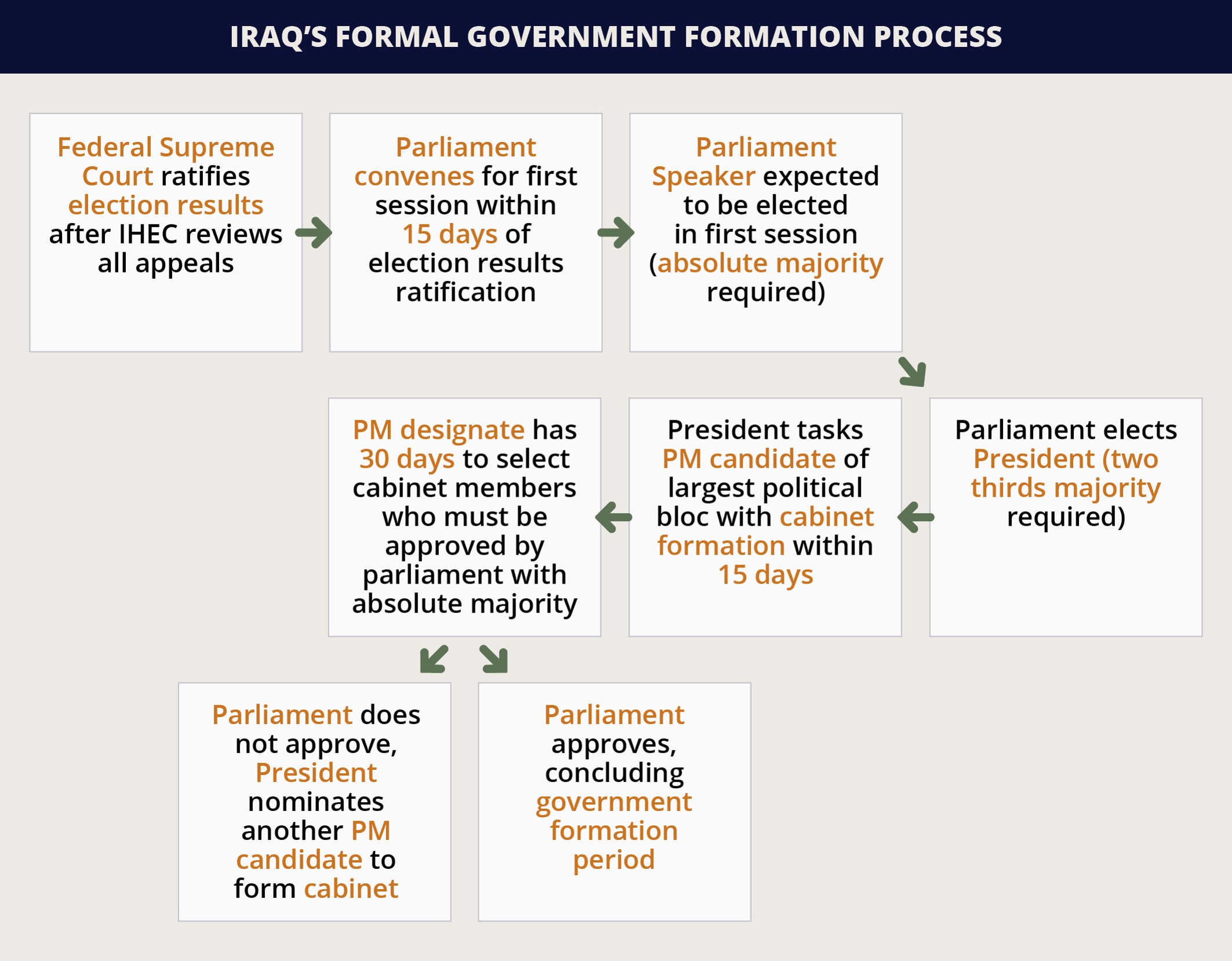
- On November 23, the leaders of major Sunni parties, including Taqadum, the Azm Alliance, and the Sovereignty Alliance, announced the formation of the National Political Council (NPC), designed as an umbrella group for the entire Sunni bloc. This mirrors the Shiite CF umbrella and shows the Sunni parties’ objective to maximize their bargaining power by coordinating their demands and conditions for their participation in a government coalition.
- FORECAST: That said, disagreements within this bloc, including over which Sunni party will nominate the Parliament Speaker, are liable to impair the emergence of a unified position, as indicated by precedent. Following the Federal Supreme Court’s ouster of Parliament Speaker and Taqadum Party leader Mohammad al-Halbousi in November 2023, Taqadum, the Azm Alliance, and the Sovereignty Alliance failed to reach a consensus on a new candidate, which led to scuffles in a parliamentary session dedicated to voting for al-Halbousi’s replacement in May 2024. These tensions and diverging interests of the parties may impede the selection of a joint Sunni candidate.
- Similarly, politics in the KRG have been characterized by a long-standing rivalry between the Kurdistan Democratic Party (KDP) and the Patriotic Union of Kurdistan (PUK). This has also impacted government formation talks in the past. For instance, in the aftermath of the October 2021 elections, the KDP initially backed Rebar Ahmed as President, and the PUK Barham Salih as Presidential candidate, contributing to the prolonged political deadlock before a CF-led majority eventually elected Abdul Latif Rashid as President in October 2022.
- These tensions have continued between the KDP and PUK, as indicated by the ongoing impasse in the Cabinet formation process in the KRG following parliamentary elections in October 2024 due to power-sharing disagreements between the two. FORECAST: This will constitute a hurdle to the parties forming a joint Kurdish position on a candidate, which could constitute a bottleneck in the government formation process, preventing the election of a PM who must be appointed by the President.
- Overall, the fact that political parties largely desisted from outlining clear policies ahead of the November 11 elections, instead relying on mobilization via patronage networks and sectarian or tribal loyalties, will facilitate negotiators to engage in a bargaining process that is not characterized by very clear-cut red lines in terms of policy. This will increase the maneuverability of key players, with progress likely to depend on the parties’ readiness to make power-sharing concessions to their prospective coalition partners.
Sequential nature of government formation process increases risk of bottlenecks, protracted negotiations
- Despite the relative success of the ballot itself, and the reduced prospects for an eruption of political violence in its aftermath, the aforementioned factors underscore that there are several potential bottlenecks that are liable to result in a protracted negotiation process. This includes internal disagreements within the Sunni, Kurdish, and Shiite blocs on the nomination of candidates for the Parliament Speaker, President, and PM, respectively.
- The sequential nature of the government formation process will compound this, with delays in one step resulting in delays to others. As seen in 2021, and given the unresolved differences between the KDP and PUK, the Presidential nominee represents a more likely bottleneck. This is particularly given that the candidate requires a two-thirds majority to be elected, with parties and larger political blocs liable to exploit this stipulation by conditioning their support on concessions from other parties.
- Against this backdrop, it cannot be entirely ruled out that negotiations will result in a prolonged deadlock, which could increase tensions that spill over into political violence. That said, al-Sadr’s marginalization in particular will reduce the prospects of this being widespread, as recorded in 2021-22.
- FORECAST: In the coming weeks, negotiations will intensify, with the pace determined by the capacity of rivals to overcome discord and unify behind common positions and goals. The CF is in a strong position to achieve this, and will likely attempt to co-opt PM al-Sudani, while reaching a power-sharing agreement with Sunni and Kurdish blocs to ensure the continuation of its interests in the upcoming government.
Recommendations:
Iraqi Federal Government
Travel
- Avoid nonessential travel to Iraq due to the threat of armed conflict, militancy, and civil unrest.
- Those conducting essential operations are advised to refresh and retain business contingency plans (BCPs) and security protocols. Train personnel on emergency procedures for escalation scenarios, with an emphasis on aerial attacks.
- Avoid nonessential travel to Baghdad due to the threat of armed conflict, militancy, and civil unrest. Contact us at [email protected] or +44 20-3540-0434 for itinerary and contingency support.
- For those conducting essential operations in Baghdad, restrict travel to the Green Zone. Ensure that contingency and emergency evacuation plans are updated.
- Avoid nonessential travel to Basra due to the risk of civil unrest, crime, armed tribal clashes, as well as the underlying potential during periods of tensions for rocket attacks by Shiite militias against US-linked and Western targets.
- Travel to Anbar, Nineveh, Salahuddin, Kirkuk, and Diyala provinces should be avoided due to persistent Islamic State (IS) activity in these areas. Remain vigilant of the risk of roadside IED and landmine explosions in the region.
- Any travel, particularly in outlying areas, ought to be conducted in armored vehicles, with trained security escorts and coordination with authorities. This is due to the prevalence of remaining landmines and the risk of roadside IEDs planted by Shiite militias. If possible, travel by air between Iraqi cities to minimize risks associated with militancy and crime.
- While traveling, regularly alter itinerary routes and avoid disclosing sensitive information to strangers, including your affiliation with foreign-based firms as your response could attract a negative reaction from locals.
Kurdistan Regional Government (KRG)
- Maintain heightened vigilance in the cities of Erbil and Sulaymaniyah while adhering to security precautions regarding protest activity and militant attacks.
- Avoid nonessential travel to outlying areas beyond the cities of Erbil and Sulaymaniyah, including KRG-administered territory in the Iraq-Turkey border region and the vicinity of the Iraq-Iran border due to militant activity and periodic Iranian attacks.
Executive Summary:
- The November 11 parliamentary elections transpired largely peacefully and attracted a relatively high turnout of 56 percent, marking a success for Iraq.
- Despite the strong performance by Prime Minister (PM) Muhammad Shia al-Sudani’s Reconstruction and Development Alliance, his prospects for a second term are reduced.
- Members of the Coordination Framework (CF), which formed the largest parliamentary bloc and is now leading government formation efforts, will oppose his candidacy in favor of a candidate aligned with the Popular Mobilization Forces (PMF) and Tehran.
- The CF will advance negotiations with Sunni and Kurdish political parties, who play a key role in determining the Parliament Speaker and the President, which must be in place for the appointment of a PM and the formation of a Cabinet.
- The sequential nature of the government formation process constitutes a potential bottleneck and may cause a prolonged deadlock, particularly given internal disagreements between the Sunni and Kurdish political parties.
- However, the risk of political tensions spilling over into widespread political violence is limited, particularly given the marginalization of Muqtada al-Sadr from politics.
Current Situation:
- On November 17, Iraq’s Independent High Electoral Commission (IHEC) released the final results of Iraq’s parliamentary elections held on November 11.
- Voter turnout reached 56.11 percent. This was reportedly based on the number of registered voters.
- Iraq’s Federal Supreme Court on November 17 reportedly ruled that the terms of the outgoing Iraqi parliament and Cabinet concluded on election day (November 11). This limits incumbent Prime Minister (PM) Mohammad Shia al-Sudani-led government’s authority to a caretaker role.
- On December 1, IHEC announced that it completed all procedures for appeals against the election results and forwarded them to the judiciary. Once the latter has reviewed all appeals, it will forward them to the Federal Supreme Court for ratification.
- On November 17, the Coordination Framework (CF), an umbrella organization of Iran-backed Shiite parties, declared itself as the largest parliamentary bloc and formed two committees to advance the government formation process.
- PM al-Sudani confirmed on November 18 that his Reconstruction and Development Party alliance had joined the CF bloc.
Source: Shafaq
Assessments & Forecast:
Relative success of election reduces prospects for political violence, unrest; bolsters Iraq’s traditional political players
- The November 11 parliamentary elections materialized largely peacefully. The absence of major disturbances during polling marks a success for Iraq, particularly as several instances of pre-election violence had signaled the underlying risk for the November 11 ballot to witness security incidents amid heightened political tensions.
- The relatively high voter turnout (56 percent) compared to the October 2021 ballot (43 percent) is somewhat notable because it defied widespread expectations that participation would be low amid broad disillusionment with the political blocs, system, and process among Iraq’s population. This is particularly given the call by Muqtada al-Sadr for the Sadrist Movement, which had won the 2021 elections but subsequently failed to establish a coalition, and its supporters to boycott the elections over the Iraqi political elite’s alleged “corruption.”
- The high turnout thus indicates that al-Sadr’s boycott strategy largely failed, which will likely lead to his movement’s marginalization in Iraqi politics in the upcoming government’s term. Together with the fact that smaller liberal parties and independent lists failed to gain traction, in part due to changes in the electoral law that favored bigger parties, this will bolster Iraq’s traditional political players, who have consolidated their position in the latest elections. This primarily pertains to parties within the Iran-backed Shiite CF.
- FORECAST: Overall, these developments reduce the risk of major political tensions erupting into violence or unrest in the coming weeks. This is due to al-Sadr’s marginalization from the political process, which removes the primary Shiite competition for the CF in determining the next PM. This also reduces the prospect of al-Sadr mobilizing protesters as a pressure tool during the government formation process. Additionally, the high participation rate will bolster the legitimacy of the political process and afford the upcoming government a stronger mandate, reducing the prospects for opposition calls to hold another ballot due to unrepresentative results in the November 11 vote.
Coordination Framework to lead government formation process
- The parliamentary elections did not yield a landslide winner. However, as anticipated, the parties within the CF performed strongly. The fact that incumbent PM al-Sudani’s Reconstruction and Development Alliance, which ran on a more pragmatic and technocratic platform, achieved 46 seats constitutes a success for him. It indicates that many voters were satisfied with al-Sudani’s governance since a CF-led majority appointed him PM in October 2022.
- That said, while his coalition performed well, reports indicate that al-Sudani’s al-Furatayn party won comparatively fewer seats within the broader coalition. It cannot be ruled out that other members of the Reconstruction and Development Party alliance could revoke their support for al-Sudani in favor of better offers from other alliances during the negotiation period. This would reduce the incumbent’s bargaining power and undermine his negotiating position overall, despite his leading role in the alliance that emerged as the largest in the elections.
- Meanwhile, the relatively strong showing of parties affiliated with the Iran-backed Popular Mobilization Forces (PMF), including Sadiqoun (the political arm of Qais al-Khazali’s Asa’ib al-Haq) and the Hadi al-Ameri-led Badr Organization, will bolster the influence of these factions within the Shiite CF. This is particularly given that, in contrast to al-Sudani’s al-Furatayn, they acquired a higher number of net seats after running as standalone parties, with Sadiqoun and Badr winning 27 and 18 seats, respectively. This strengthens their position and considerably reduces the likelihood of a future government in which Iran-backed PMF factions are excluded or marginalized.
- The decision by the Shiite CF’s constituent parties and alliances to reunite for the government formation process after running on separate lists is an expected development. This is because it enabled the CF to pool seats won by its members to claim its status as the largest parliamentary bloc, which is tasked with proposing a PM candidate by the newly elected President. In turn, this grants all constituent parties a role in the government formation negotiations and ensures that the CF can propose a candidate that will effectively implement the objectives of the alliance. In this context, al-Sudani’s decision that his alliance join the CF was likely driven by his aim to secure his influence in the government formation talks as the largest constituent party of the CF.
CF likely to co-opt al-Sudani while advocating for PM who will implement objectives
- Since the elections, the CF has moved quickly to spearhead government formation efforts as the leading political bloc and has created a committee to review PM nominations. Despite this unified front, reports indicate that a split has emerged within the bloc, which incorporates a range of Shiite parties, including those closely affiliated with Iran, on whether to back a renewed candidacy for PM al-Sudani or to isolate him within the CF.
- PMF-affiliated CF components are likely to oppose al-Sudani’s nomination. This is because they perceive al-Sudani as willing to curtail the PMF’s influence in favor of maintaining Baghdad’s strategically important relationship with the US. These grievances were likely aggravated by al-Sudani’s outspoken rejection of the legitimacy of independent armed groups, his pledge to disarm such actors after the US troop withdrawal from Iraq, his withdrawal of the PMF bill amid US pressure, and the dismissal of two Kataib Hezbollah (KH)-affiliated PMF Commanders who were involved in clashes with government forces at Baghdad’s Ministry of Agriculture in August.
- This renders it likely that PMF-linked CF components will advocate for other PM candidates who they believe will align with or at least advance their interests and those of Iran. At the same time, such factions may be reticent to nominate a PM candidate directly affiliated with the PMF, such as Sadiqoun leader Qais al-Khazali, who is under sanctions by the US Department of the Treasury’s Office of Foreign Assets Control (OFAC), despite his strong performance in the elections. This is because more centrist parties are unlikely to support such a nomination, which could trigger an escalation of punitive measures against Baghdad by the US government.
- Nonetheless, the CF will likely maintain an interest in co-opting al-Sudani in some capacity other than a PM role, given his popularity and the fact that his Reconstruction and Development Alliance currently commands 46 seats. This will aim to prevent al-Sudani from leaving the CF and attempting to form an obstructionist bloc with other parties that could prevent the two-thirds majority vote required to nominate a PM, thereby blocking the government formation. Such a scenario is not unprecedented. Following the October 2021 elections, the CF successfully employed such a strategy to foil attempts by Muqtada al-Sadr to form a government excluding Iran-backed CF factions, causing a lengthy political deadlock that resulted in the Sadrist Movement’s withdrawal from parliament, and the CF-backed premiership of al-Sudani in October 2022.
- That said, the Reconstruction and Development Alliance contains a relatively broad spectrum of parties, which likely joined his alliance due to al-Sudani’s expected success rather than loyalty to the incumbent. As previously mentioned, this weakens al-Sudani’s negotiating position, and the uncertainty over their loyalty will reduce his willingness to defect from the CF in favor of forming an obstructionist bloc with other parties.
Sunni, Kurdish blocs to play important role in bargaining process
- The CF’s consolidation following the elections places it in a strong position to advance negotiations with Sunni and Kurdish political parties, who will play a key role in determining the Parliament Speaker (traditionally a Sunni candidate) and the President (typically a Kurdish candidate) that must be in place for the appointment of the Shiite PM. This is underscored by Nouri al-Maliki’s visit to the KRG to discuss government formation efforts, shortly after he was nominated by the Islamic Dawa Party as their PM candidate on November 22.
- On November 23, the leaders of major Sunni parties, including Taqadum, the Azm Alliance, and the Sovereignty Alliance, announced the formation of the National Political Council (NPC), designed as an umbrella group for the entire Sunni bloc. This mirrors the Shiite CF umbrella and shows the Sunni parties’ objective to maximize their bargaining power by coordinating their demands and conditions for their participation in a government coalition.
- FORECAST: That said, disagreements within this bloc, including over which Sunni party will nominate the Parliament Speaker, are liable to impair the emergence of a unified position, as indicated by precedent. Following the Federal Supreme Court’s ouster of Parliament Speaker and Taqadum Party leader Mohammad al-Halbousi in November 2023, Taqadum, the Azm Alliance, and the Sovereignty Alliance failed to reach a consensus on a new candidate, which led to scuffles in a parliamentary session dedicated to voting for al-Halbousi’s replacement in May 2024. These tensions and diverging interests of the parties may impede the selection of a joint Sunni candidate.
- Similarly, politics in the KRG have been characterized by a long-standing rivalry between the Kurdistan Democratic Party (KDP) and the Patriotic Union of Kurdistan (PUK). This has also impacted government formation talks in the past. For instance, in the aftermath of the October 2021 elections, the KDP initially backed Rebar Ahmed as President, and the PUK Barham Salih as Presidential candidate, contributing to the prolonged political deadlock before a CF-led majority eventually elected Abdul Latif Rashid as President in October 2022.
- These tensions have continued between the KDP and PUK, as indicated by the ongoing impasse in the Cabinet formation process in the KRG following parliamentary elections in October 2024 due to power-sharing disagreements between the two. FORECAST: This will constitute a hurdle to the parties forming a joint Kurdish position on a candidate, which could constitute a bottleneck in the government formation process, preventing the election of a PM who must be appointed by the President.
- Overall, the fact that political parties largely desisted from outlining clear policies ahead of the November 11 elections, instead relying on mobilization via patronage networks and sectarian or tribal loyalties, will facilitate negotiators to engage in a bargaining process that is not characterized by very clear-cut red lines in terms of policy. This will increase the maneuverability of key players, with progress likely to depend on the parties’ readiness to make power-sharing concessions to their prospective coalition partners.
Sequential nature of government formation process increases risk of bottlenecks, protracted negotiations
- Despite the relative success of the ballot itself, and the reduced prospects for an eruption of political violence in its aftermath, the aforementioned factors underscore that there are several potential bottlenecks that are liable to result in a protracted negotiation process. This includes internal disagreements within the Sunni, Kurdish, and Shiite blocs on the nomination of candidates for the Parliament Speaker, President, and PM, respectively.
- The sequential nature of the government formation process will compound this, with delays in one step resulting in delays to others. As seen in 2021, and given the unresolved differences between the KDP and PUK, the Presidential nominee represents a more likely bottleneck. This is particularly given that the candidate requires a two-thirds majority to be elected, with parties and larger political blocs liable to exploit this stipulation by conditioning their support on concessions from other parties.
- Against this backdrop, it cannot be entirely ruled out that negotiations will result in a prolonged deadlock, which could increase tensions that spill over into political violence. That said, al-Sadr’s marginalization in particular will reduce the prospects of this being widespread, as recorded in 2021-22.
- FORECAST: In the coming weeks, negotiations will intensify, with the pace determined by the capacity of rivals to overcome discord and unify behind common positions and goals. The CF is in a strong position to achieve this, and will likely attempt to co-opt PM al-Sudani, while reaching a power-sharing agreement with Sunni and Kurdish blocs to ensure the continuation of its interests in the upcoming government.
Recommendations:
Iraqi Federal Government
Travel
- Avoid nonessential travel to Iraq due to the threat of armed conflict, militancy, and civil unrest.
- Those conducting essential operations are advised to refresh and retain business contingency plans (BCPs) and security protocols. Train personnel on emergency procedures for escalation scenarios, with an emphasis on aerial attacks.
- Avoid nonessential travel to Baghdad due to the threat of armed conflict, militancy, and civil unrest. Contact us at [email protected] or +44 20-3540-0434 for itinerary and contingency support.
- For those conducting essential operations in Baghdad, restrict travel to the Green Zone. Ensure that contingency and emergency evacuation plans are updated.
- Avoid nonessential travel to Basra due to the risk of civil unrest, crime, armed tribal clashes, as well as the underlying potential during periods of tensions for rocket attacks by Shiite militias against US-linked and Western targets.
- Travel to Anbar, Nineveh, Salahuddin, Kirkuk, and Diyala provinces should be avoided due to persistent Islamic State (IS) activity in these areas. Remain vigilant of the risk of roadside IED and landmine explosions in the region.
- Any travel, particularly in outlying areas, ought to be conducted in armored vehicles, with trained security escorts and coordination with authorities. This is due to the prevalence of remaining landmines and the risk of roadside IEDs planted by Shiite militias. If possible, travel by air between Iraqi cities to minimize risks associated with militancy and crime.
- While traveling, regularly alter itinerary routes and avoid disclosing sensitive information to strangers, including your affiliation with foreign-based firms as your response could attract a negative reaction from locals.
Kurdistan Regional Government (KRG)
- Maintain heightened vigilance in the cities of Erbil and Sulaymaniyah while adhering to security precautions regarding protest activity and militant attacks.
- Avoid nonessential travel to outlying areas beyond the cities of Erbil and Sulaymaniyah, including KRG-administered territory in the Iraq-Turkey border region and the vicinity of the Iraq-Iran border due to militant activity and periodic Iranian attacks.
Related Reports
-
 Supply Chain DisruptionsGlobal Special Report: Increasing sanctions encourage shadow fleet expansion, resulting in disruptions to maritime supply chain amid heightened scrutiny, militarization
 -
Supply Chain DisruptionsGlobal Special Report: Maritime shipping environment in Arctic to be fragile amid regulatory hurdles, militarization along Russian coastline, around Greenland
-
 Armed ConflictSyria Analysis: Four-day truce announced on January 20 after major government offensive diminishes Kurdish control in northeastern Syria; avoid all travel
Related Reports
-
Supply Chain DisruptionsGlobal Special Report: Increasing sanctions encourage shadow fleet expansion, resulting in disruptions to maritime supply chain amid heightened scrutiny, militarization
-
Supply Chain DisruptionsGlobal Special Report: Maritime shipping environment in Arctic to be fragile amid regulatory hurdles, militarization along Russian coastline, around Greenland
-
Armed ConflictSyria Analysis: Four-day truce announced on January 20 after major government offensive diminishes Kurdish control in northeastern Syria; avoid all travel