

23
Mar 2022
12:30 UTC
Israel & Palestinian Territories Analysis: Lethal militant attack by IS supporter in Beer Sheva on March 22 to increase already heightened tensions, particularly in Jerusalem, ahead of Ramadan
Executive Summary:
- On March 22, a Bedouin citizen of Israel killed four Israeli civilians at a commercial center in Beer Sheva in the most lethal act of militancy targeting civilians within Israel’s Green Line since 2016.
- The incident illustrates the continued threat of militant attacks targeting civilians within the country, which have become rare in recent years.
- There is a somewhat elevated risk over the coming days of copycat stabbing and vehicle-ramming attacks within Israel inspired by this act of militancy, although the overall strategic threat of militancy in the country currently remains low.
- The assailant was formerly imprisoned on militancy charges for attempts to join the Islamic State (IS) in Syria and recruit others. This points to the possibility of more widespread radicalization in the Negev Bedouin community.
- The incident follows multiple recent stabbing attacks in Jerusalem and clashes in the West Bank, which indicate that nationalistic tensions between Palestinians and Israelis in the region are currently high.
- All these recent events are additional drivers for violence in Israel amid the forthcoming month of Ramadan, despite de-escalatory measures implemented by Israeli authorities. There is a high likelihood of additional attempted acts of militancy in Jerusalem over the coming weeks.
- Maintain vigilance over the coming weeks in Jerusalem, particularly near the Old City, and restrict travel to the Jaffa Gate and Jewish Quarter. Avoid nonessential travel to the Muslim Quarter, Damascus Gate, and East Jerusalem. In Israeli cities, remain vigilant in crowded commercial areas or public transport hubs.
Current Situation
Militant attack in Beer Sheva
- On March 22, a militant killed four Israeli civilians and wounded two others at a commercial center in Beer Sheva before being shot to death by armed civilians.
- He first stabbed a woman to death at a gas station, before ramming a cyclist with his vehicle, and thereafter stabbing several others.
- The militant, a Bedouin citizen of Israel and former teacher from Hura in the Negev region, was previously convicted to a four-year prison sentence for plotting to join and recruit others to the Islamic State (IS) in Syria. He was released from prison in 2019.
- The Israel Police stated that two suspects, relatives of the militant, were arrested on March 22-23 for failing to prevent an act of militancy.
- Hamas and the Palestinian Islamic Jihad (PIJ) praised the attack. The former stated that alleged Israeli crimes will be met with “stabbings, rammings, and shootings,” while the Palestinian Authority (PA) reportedly conveyed its denunciation of the attack in messages to Israel.
- On March 22, a militant killed four Israeli civilians and wounded two others at a commercial center in Beer Sheva before being shot to death by armed civilians.
- He first stabbed a woman to death at a gas station, before ramming a cyclist with his vehicle, and thereafter stabbing several others.
- The militant, a Bedouin citizen of Israel and former teacher from Hura in the Negev region, was previously convicted to a four-year prison sentence for plotting to join and recruit others to the Islamic State (IS) in Syria. He was released from prison in 2019.
- The Israel Police stated that two suspects, relatives of the militant, were arrested on March 22-23 for failing to prevent an act of militancy.
- Hamas and the Palestinian Islamic Jihad (PIJ) praised the attack. The former stated that alleged Israeli crimes will be met with “stabbings, rammings, and shootings,” while the Palestinian Authority (PA) reportedly conveyed its denunciation of the attack in messages to Israel.
Recent Events in Jerusalem, West Bank
- On March 20, a Palestinian stabbed an Israeli police officer in a militant attack in East Jerusalem’s Ras al-Amud.
- On March 19, a Palestinian assailant from the East Jerusalem neighborhood of Abu Tor stabbed an Israeli civilian at the intersection of David Remez Street and Hebron Road in Jerusalem while the latter was jogging.
- On March 7, a Palestinian assailant stabbed two Israeli police officers at the Cotton Merchants (al-Qattanin) Gate in Jerusalem’s Old City. Hamas later claimed that one of the assailants was a member of the movement.
- On March 6, a Palestinian stabbed an Israeli police officer near the Old City’s Forgiveness Gate.
- In the past weeks, ten Palestinians have been killed in either violent confrontations with Israeli forces or during attempted attacks.
- On March 20, a Palestinian stabbed an Israeli police officer in a militant attack in East Jerusalem’s Ras al-Amud.
- On March 19, a Palestinian assailant from the East Jerusalem neighborhood of Abu Tor stabbed an Israeli civilian at the intersection of David Remez Street and Hebron Road in Jerusalem while the latter was jogging.
- On March 7, a Palestinian assailant stabbed two Israeli police officers at the Cotton Merchants (al-Qattanin) Gate in Jerusalem’s Old City. Hamas later claimed that one of the assailants was a member of the movement.
- On March 6, a Palestinian stabbed an Israeli police officer near the Old City’s Forgiveness Gate.
- In the past weeks, ten Palestinians have been killed in either violent confrontations with Israeli forces or during attempted attacks.
Militant Attack in Beer Sheva
- The stabbing and vehicle-ramming attack in Beer Sheva was the most lethal act of militancy targeting civilians within Israel’s Green Line since June 2016 when two militants shot and killed four Israelis at Tel Aviv’s Sarona Market. Although increasingly rare in recent years as Israel has successfully and persistently thwarted militant plots, it illustrates the continued risk of militancy targeting civilians within Israel’s Green Line. The militant’s seemingly indiscriminate stabbing and ramming of civilians at the commercial center indicates that a similar attack could have also targeted foreign nationals or those perceived to be Israeli or Jewish. The threat is therefore not limited to Israeli security forces or civilians. In more central parts of Israel, particularly outside of Jerusalem, response times are longer as there are fewer security forces trained to deal with militants deployed to these areas. In this context, the vigilance and possession of arms by some Israeli civilians can help mitigate this risk. However, and as almost occurred in this instance, it increases the potential risk of misfire and additional civilian casualties.
- At the current time, and as bolstered by the Israel Police’s assessment, it appears that the militant was not acting upon orders by more organized militant factions but operated as a lone-wolf actor without instruction or coordination. This is indicated by his chosen rudimentary modus operandi, namely stabbing and vehicular ramming rather than a shooting or bombing, which would have likely required external logistical support. It is also indicated by the statements by prominent Palestinian militant groups to praise but not claim responsibility for the attack. Finally, it is also shown by his previous failed attempts to join IS in Syria. This suggests that his primary motivation was jihadist, with Palestinian nationalism likely being a secondary motive. This reinforces the assessment that the attack was not coordinated with Hamas or the PIJ, but was based on inspiration taken from IS, which does not have a foothold in Israel.
- His support for IS is indicative of a broader trend of radicalization of some elements within the Bedouin community in southern Israel’s Negev region. Large parts of this demographic group feel marginalized by Israeli authorities and mainstream Israeli society. This was illustrated by violent protests and acts of vandalism by members of the community in January in denunciation of Jewish National Fund (JNF) forestation operations in the region. The fact that a member of this community was radicalized to the extent that they sought to travel to a conflict zone and join a global jihadist organization, as well as the fact that he was a teacher and thus had a level of influence within his community, points to the potential that additional fringe elements of this community have similarly been radicalized. This radicalization is likely facilitated by allowing individuals such as the recent militant to reach positions of influence and disseminating radical Islamist and jihadist ideologies, and their subsequent consumption online of such propaganda.
- Although he was arrested by Israeli authorities, the fact that he was a teacher when initially indicted on militancy charges and the fact that he was released from prison in 2019 and was still evidently radicalized, shows gaps in the vetting process in educational institutions on the first count and the monitoring of militant convicts in the second. Given the recent militant attack that he carried out, it is highly likely that he continued to consume jihadist material online and potentially share it with others through various digital communication channels. This therefore points to gaps in Israeli security protocols and the surveillance of released militants. FORECAST: Israeli authorities will likely increase surveillance activities of released militant convicts in order to thwart future potential attacks. Within the education system, particularly in the Bedouin community, changes may be made to the vetting process in order to prevent individuals suspected of extreme or hardline views from being appointed as teachers. This may in fact increase tensions between the community and the Israeli government as it will be perceived as an unjustified interference.
- Even though he had plotted to join IS and has no ostensible ties to Palestinian militant groups, as shown by Hamas’ and the PIJ’s statements, these organizations will take advantage of the successful attack to bolster their militant activities and dissemination of propaganda perceived to be incitement by Israel. FORECAST: In addition to the already heightened risk of copycat attacks following the act of militancy in Beer Sheva, which has put Israeli authorities on maximum alert, the Palestinian militant groups’ calls to conduct similar attacks will likely serve as inspiration for already radicalized Palestinians. The risk of a similar act of militancy within Israel’s Green Line over the coming days and weeks remains somewhat elevated, particularly in Jerusalem, as will be discussed in the second part of this analysis.
Tensions in Jerusalem, West Bank ahead of Ramadan
Recent stabbing attacks in Jerusalem, tensions in West Bank region
- The marked increase in stabbing attacks in Jerusalem over the past weeks, including the notable and rare incident near David Ramez Street on March 19 in a more central part of Jerusalem against a civilian, showcases the currently elevated nationalistic tensions in the capital. This heightened nationalist sentiment is compounded by several additional attacks against Israelis in the West Bank, a marked increase in the number of Palestinians killed in attempted attacks or violent confrontations with Israeli security forces, and most recently the highly notable attack in Beer Sheva. These incidents have partially been motivated by localized tensions and security dynamics in Jerusalem and the West Bank that have spread to other parts of the region and likely increased the motivation to conduct attacks in these areas. This pattern of lone-wolf attacks, the IDF’s perceived excessive response, and subsequent unrest highlights the perpetual cycle of violence between Israeli security forces and Palestinians that elevates the security risk in the region.
- The modus operandi of the latest attacks is consistent with the general trend of low-sophistication, lone-wolf Palestinian-perpetrated acts of militancy. It is therefore not indicative of an increase in Palestinian militant groups’ plots or activities or bolstering of their capabilities, although these factions remain capable of operating in Jerusalem and using more sophisticated means. Lone-wolf attacks, usually involving vehicle-rammings or stabbings, are difficult to prevent as they often occur spontaneously and do not require the establishment of online communication channels or through cellular means between operatives, which the Israeli authorities can otherwise track and intercept. This showcases the challenges posed to Israeli security forces in preventing similar militant acts, despite their continuous vigilance in areas such as the Old City.
Profile of recent assailants
- Most of the perpetrators of the recent incidents in Jerusalem were youth. This reflects the anti-Israel sentiments within this segment of Palestinian society and their susceptibility to carrying out acts of violence. Hamas often describes these assailants as “martyrs” and calls for additional attacks. This underscores Palestinian militant groups’ encouragement of such violence by celebrating the perpetrators as heroes, which therefore incentivizes copycats and further attacks. Hamas and the PIJ also regularly encourage such violence as part of its strategy in the West Bank aimed at undermining the PA and fueling unrest in the region.
- Hamas claimed that the perpetrator of the March 7 stabbing attack at the Cotton Merchants’ Gate, a Palestinian from the Jalazone Refugee Camp near Ramallah, was a member of the group. It is likely that the assailant was inspired by the March 6 stabbing, as well as Hamas’ routine use of rhetoric against Israel. The group’s highlighting of his membership in the movement demonstrates an effort to take credit for the violence, thereby bolstering Hamas’ profile among the Palestinian populace. This is similarly reflected in the frequent praise of Palestinian-perpetrated acts of militancy circulated on Palestinian-run social media. FORECAST: The publication of successful attacks against Israeli citizens and security personnel is liable to inspire other militants and lone wolf actors to conduct further attacks.
Risk of attacks to be elevated over coming weeks amid holy month of Ramadan, despite de-escalatory measures taken by Israel
- As illustrated by the Israeli authorities’ decision to increase the security presence around Jerusalem’s Old City following the recent attacks, there remains an elevated risk of militancy over the coming weeks. Alongside the rise in tensions and uptick in attacks, this is because the holy Islamic month of Ramadan is slated to begin on April 2, which is traditionally a period when religious, ethnic, and nationalist sentiments are elevated among Palestinians. The commencement of Ramadan also marks a year (in the Islamic calendar) since the occurrence of large-scale hostilities between Israel and Hamas in May 2021. Violent clashes at the al-Aqsa Mosque/Temple Mount Compound and at the Damascus Gate entrance to the Old City between Israeli security forces and Palestinians during Ramadan served as a major focal point for the larger escalation in the Gaza Strip. Israeli authorities already announced on March 18 the indictment of four Palestinian residents of East Jerusalem who had undergone weapons training and been in contact with Turkey-based Hamas operatives. These suspects had allegedly plotted attacks in Jerusalem during the forthcoming month of Ramadan. This shows that individuals linked to militant groups also have an interest in conducting attacks during this period and taking advantage of heightened tensions in the region.
- This year, various symbolic and religious dates coincide, which could be a driver for tensions. The Jewish holiday of Passover will be observed in Israel between April 15-22, wherein Jewish worshippers will also hold services within the Old City. Easter will also be observed by the Palestinian Christian community on April 17. This increases the overall potential for friction to materialize between Jewish, Christian, and Muslim communities carrying out religious services, in which authorities will be further challenged to effectively maintain security conditions as there will be a large influx of worshippers in Jerusalem’s Old City. Eid al-Fitr, the culmination of Ramadan and a time of celebration, will likely be marked on May 2-3 while the Israeli Memorial Day for fallen soldiers and victims of terror will be observed on May 3-4. Both of these events are sources of religious and nationalistic tension, respectively. Local and regional actors are also anticipating the potential for violence and acting accordingly. For instance, reports from March 22 indicate that Jordanian King Abdullah II will visit Ramallah in the coming days for the first time in almost five years in order to reduce the tensions in the region ahead of Ramadan. Meanwhile, per reports from March 13, the Israeli Security Agency (Shin Bet) leader Ronen Bar reportedly traveled to Washington in order to warn of the potential for flare-up in tensions amid the confluence of religious holidays over the coming weeks. This underscores the perception of influential stakeholders that the coming period carries a risk of violence.
- To mitigate the risk of a repeat of events recorded in 2021 and reduce tensions, Israel has implemented multiple de-escalatory measures in both Jerusalem and the West Bank over the past months. Israeli authorities reportedly recently decided not to erect crowd-control barriers opposite the Old City’s Damascus Gate during Ramadan, which led to violent clashes in 2021 as Palestinian Jerusalemites perceived it as a violation of their local customs to gather at the plaza of the Damascus Gate during the evening hours of Ramadan. Additional measures include a ruling by the Israeli High Court on March 1 that four Palestinian families that were subject to a potential eviction from properties in the flashpoint neighborhood of Sheikh Jarrah will not be evicted, at least temporarily. The potential eviction of Palestinians from homes in Sheikh Jarrah also served as a catalyst for violence in May 2021. Lastly, Israel has recently increased the number of work permits granted to Palestinians from the Gaza Strip by another 2,000, bringing the total to 12,000. As well as a gesture towards the Palestinian populace in Gaza, this increases Jerusalem’s leverage over Hamas as it can cancel these permits in the event of an escalation.
- Taken as a whole, this demonstrates Israeli authorities’ efforts to ease tensions ahead of and during Ramadan. However, particularly following the more notable attack in Beer Sheva, an increase in the number of roadblocks and security checkpoints is still likely in the Old City, Palestinian-populated eastern parts of the city, as well as the West Bank. FORECAST: This mobilization and deployment of troops in public spaces frequented by Palestinians during Ramadan will add to grievances as it will be considered an encroachment on religious and cultural gatherings. The heightened presence of security forces also increases the number of potential targets for Palestinian lone-wolf assailants.
- FORECAST: Israeli security forces are also likely to conduct an increasing number of counter-militancy operations in the West Bank, particularly in the immediate vicinity of Jerusalem. Such operations will likely add to currently elevated tensions and prompt clashes between Palestinian residents and Israeli security forces, with a high likelihood of further Palestinian fatalities. This will grant Hamas and the PIJ with further propaganda opportunities by glorifying these perceived heroes/martyrs and calling for additional attacks.
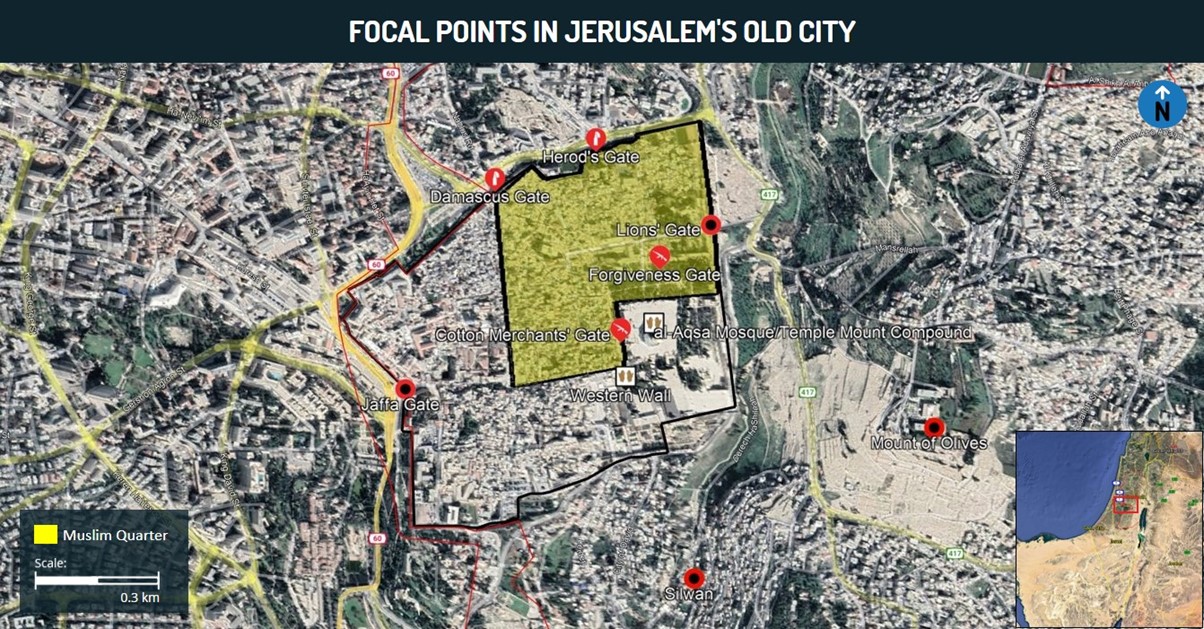
- Overall, given the heightened tensions in the region and recent successful attacks serving as inspiration for radicalized individuals and lone-wolf actors, further attempted attacks and unrest in Jerusalem are very likely over the coming weeks. Within the Old City, the risk is generally lower for civilians than security forces, whose uniformed personnel and posts are often the target of attacks. The probability of attacks is also lower within the Jewish Quarter and by entering the area via Jaffa Gate. Given precedent and with recent incidents in mind, the risk is higher nearer to entrances to the Muslim Quarter of the Old City, such as Damascus Gate, Herod’s Gate, Lions’ Gate and Cotton Merchants’ Gate, especially as these areas are closer to the flashpoint al-Aqsa Mosque/Temple Mount Compound.
Recommendations:
- Travel to Israel may continue at this time, while adhering to security precautions regarding militant attacks and civil unrest.
- It is advised to be particularly vigilant over the coming weeks in the vicinity of Jerusalem’s Old City, especially near the Damascus Gate, Herod’s Gate, Lion’s Gate, and the al-Aqsa Mosque/Temple Mount Compound. Avoid nonessential travel to Palestinian-populated neighborhoods in East Jerusalem. This is due to the currently increased potential for acts of militancy and unrest.
- In Israeli cities, remain vigilant in crowded commercial areas or public transport hubs, as these locations have been targeted by militants in the past. Alert authorities to suspicious, unattended packages in these areas.
- Avoid nonessential travel to the West Bank at this time given the currently heightened threat of militancy and civil unrest.
- If an attack unfolds within your vicinity, immediately seek cover, and try to safely disengage from the area as quickly as possible. This is given the risk of secondary attacks and shooting towards assailants by security forces and armed civilians, which could cause collateral damage.
- MAX Security has strong on-ground capabilities in Israel, including contingency consultation and planning. Contact us at [email protected] or +44 20-3540-0434.
Executive Summary:
- On March 22, a Bedouin citizen of Israel killed four Israeli civilians at a commercial center in Beer Sheva in the most lethal act of militancy targeting civilians within Israel’s Green Line since 2016.
- The incident illustrates the continued threat of militant attacks targeting civilians within the country, which have become rare in recent years.
- There is a somewhat elevated risk over the coming days of copycat stabbing and vehicle-ramming attacks within Israel inspired by this act of militancy, although the overall strategic threat of militancy in the country currently remains low.
- The assailant was formerly imprisoned on militancy charges for attempts to join the Islamic State (IS) in Syria and recruit others. This points to the possibility of more widespread radicalization in the Negev Bedouin community.
- The incident follows multiple recent stabbing attacks in Jerusalem and clashes in the West Bank, which indicate that nationalistic tensions between Palestinians and Israelis in the region are currently high.
- All these recent events are additional drivers for violence in Israel amid the forthcoming month of Ramadan, despite de-escalatory measures implemented by Israeli authorities. There is a high likelihood of additional attempted acts of militancy in Jerusalem over the coming weeks.
- Maintain vigilance over the coming weeks in Jerusalem, particularly near the Old City, and restrict travel to the Jaffa Gate and Jewish Quarter. Avoid nonessential travel to the Muslim Quarter, Damascus Gate, and East Jerusalem. In Israeli cities, remain vigilant in crowded commercial areas or public transport hubs.
Current Situation
Militant attack in Beer Sheva
- On March 22, a militant killed four Israeli civilians and wounded two others at a commercial center in Beer Sheva before being shot to death by armed civilians.
- He first stabbed a woman to death at a gas station, before ramming a cyclist with his vehicle, and thereafter stabbing several others.
- The militant, a Bedouin citizen of Israel and former teacher from Hura in the Negev region, was previously convicted to a four-year prison sentence for plotting to join and recruit others to the Islamic State (IS) in Syria. He was released from prison in 2019.
- The Israel Police stated that two suspects, relatives of the militant, were arrested on March 22-23 for failing to prevent an act of militancy.
- Hamas and the Palestinian Islamic Jihad (PIJ) praised the attack. The former stated that alleged Israeli crimes will be met with “stabbings, rammings, and shootings,” while the Palestinian Authority (PA) reportedly conveyed its denunciation of the attack in messages to Israel.
- On March 22, a militant killed four Israeli civilians and wounded two others at a commercial center in Beer Sheva before being shot to death by armed civilians.
- He first stabbed a woman to death at a gas station, before ramming a cyclist with his vehicle, and thereafter stabbing several others.
- The militant, a Bedouin citizen of Israel and former teacher from Hura in the Negev region, was previously convicted to a four-year prison sentence for plotting to join and recruit others to the Islamic State (IS) in Syria. He was released from prison in 2019.
- The Israel Police stated that two suspects, relatives of the militant, were arrested on March 22-23 for failing to prevent an act of militancy.
- Hamas and the Palestinian Islamic Jihad (PIJ) praised the attack. The former stated that alleged Israeli crimes will be met with “stabbings, rammings, and shootings,” while the Palestinian Authority (PA) reportedly conveyed its denunciation of the attack in messages to Israel.
Recent Events in Jerusalem, West Bank
- On March 20, a Palestinian stabbed an Israeli police officer in a militant attack in East Jerusalem’s Ras al-Amud.
- On March 19, a Palestinian assailant from the East Jerusalem neighborhood of Abu Tor stabbed an Israeli civilian at the intersection of David Remez Street and Hebron Road in Jerusalem while the latter was jogging.
- On March 7, a Palestinian assailant stabbed two Israeli police officers at the Cotton Merchants (al-Qattanin) Gate in Jerusalem’s Old City. Hamas later claimed that one of the assailants was a member of the movement.
- On March 6, a Palestinian stabbed an Israeli police officer near the Old City’s Forgiveness Gate.
- In the past weeks, ten Palestinians have been killed in either violent confrontations with Israeli forces or during attempted attacks.
- On March 20, a Palestinian stabbed an Israeli police officer in a militant attack in East Jerusalem’s Ras al-Amud.
- On March 19, a Palestinian assailant from the East Jerusalem neighborhood of Abu Tor stabbed an Israeli civilian at the intersection of David Remez Street and Hebron Road in Jerusalem while the latter was jogging.
- On March 7, a Palestinian assailant stabbed two Israeli police officers at the Cotton Merchants (al-Qattanin) Gate in Jerusalem’s Old City. Hamas later claimed that one of the assailants was a member of the movement.
- On March 6, a Palestinian stabbed an Israeli police officer near the Old City’s Forgiveness Gate.
- In the past weeks, ten Palestinians have been killed in either violent confrontations with Israeli forces or during attempted attacks.
Militant Attack in Beer Sheva
- The stabbing and vehicle-ramming attack in Beer Sheva was the most lethal act of militancy targeting civilians within Israel’s Green Line since June 2016 when two militants shot and killed four Israelis at Tel Aviv’s Sarona Market. Although increasingly rare in recent years as Israel has successfully and persistently thwarted militant plots, it illustrates the continued risk of militancy targeting civilians within Israel’s Green Line. The militant’s seemingly indiscriminate stabbing and ramming of civilians at the commercial center indicates that a similar attack could have also targeted foreign nationals or those perceived to be Israeli or Jewish. The threat is therefore not limited to Israeli security forces or civilians. In more central parts of Israel, particularly outside of Jerusalem, response times are longer as there are fewer security forces trained to deal with militants deployed to these areas. In this context, the vigilance and possession of arms by some Israeli civilians can help mitigate this risk. However, and as almost occurred in this instance, it increases the potential risk of misfire and additional civilian casualties.
- At the current time, and as bolstered by the Israel Police’s assessment, it appears that the militant was not acting upon orders by more organized militant factions but operated as a lone-wolf actor without instruction or coordination. This is indicated by his chosen rudimentary modus operandi, namely stabbing and vehicular ramming rather than a shooting or bombing, which would have likely required external logistical support. It is also indicated by the statements by prominent Palestinian militant groups to praise but not claim responsibility for the attack. Finally, it is also shown by his previous failed attempts to join IS in Syria. This suggests that his primary motivation was jihadist, with Palestinian nationalism likely being a secondary motive. This reinforces the assessment that the attack was not coordinated with Hamas or the PIJ, but was based on inspiration taken from IS, which does not have a foothold in Israel.
- His support for IS is indicative of a broader trend of radicalization of some elements within the Bedouin community in southern Israel’s Negev region. Large parts of this demographic group feel marginalized by Israeli authorities and mainstream Israeli society. This was illustrated by violent protests and acts of vandalism by members of the community in January in denunciation of Jewish National Fund (JNF) forestation operations in the region. The fact that a member of this community was radicalized to the extent that they sought to travel to a conflict zone and join a global jihadist organization, as well as the fact that he was a teacher and thus had a level of influence within his community, points to the potential that additional fringe elements of this community have similarly been radicalized. This radicalization is likely facilitated by allowing individuals such as the recent militant to reach positions of influence and disseminating radical Islamist and jihadist ideologies, and their subsequent consumption online of such propaganda.
- Although he was arrested by Israeli authorities, the fact that he was a teacher when initially indicted on militancy charges and the fact that he was released from prison in 2019 and was still evidently radicalized, shows gaps in the vetting process in educational institutions on the first count and the monitoring of militant convicts in the second. Given the recent militant attack that he carried out, it is highly likely that he continued to consume jihadist material online and potentially share it with others through various digital communication channels. This therefore points to gaps in Israeli security protocols and the surveillance of released militants. FORECAST: Israeli authorities will likely increase surveillance activities of released militant convicts in order to thwart future potential attacks. Within the education system, particularly in the Bedouin community, changes may be made to the vetting process in order to prevent individuals suspected of extreme or hardline views from being appointed as teachers. This may in fact increase tensions between the community and the Israeli government as it will be perceived as an unjustified interference.
- Even though he had plotted to join IS and has no ostensible ties to Palestinian militant groups, as shown by Hamas’ and the PIJ’s statements, these organizations will take advantage of the successful attack to bolster their militant activities and dissemination of propaganda perceived to be incitement by Israel. FORECAST: In addition to the already heightened risk of copycat attacks following the act of militancy in Beer Sheva, which has put Israeli authorities on maximum alert, the Palestinian militant groups’ calls to conduct similar attacks will likely serve as inspiration for already radicalized Palestinians. The risk of a similar act of militancy within Israel’s Green Line over the coming days and weeks remains somewhat elevated, particularly in Jerusalem, as will be discussed in the second part of this analysis.
Tensions in Jerusalem, West Bank ahead of Ramadan
Recent stabbing attacks in Jerusalem, tensions in West Bank region
- The marked increase in stabbing attacks in Jerusalem over the past weeks, including the notable and rare incident near David Ramez Street on March 19 in a more central part of Jerusalem against a civilian, showcases the currently elevated nationalistic tensions in the capital. This heightened nationalist sentiment is compounded by several additional attacks against Israelis in the West Bank, a marked increase in the number of Palestinians killed in attempted attacks or violent confrontations with Israeli security forces, and most recently the highly notable attack in Beer Sheva. These incidents have partially been motivated by localized tensions and security dynamics in Jerusalem and the West Bank that have spread to other parts of the region and likely increased the motivation to conduct attacks in these areas. This pattern of lone-wolf attacks, the IDF’s perceived excessive response, and subsequent unrest highlights the perpetual cycle of violence between Israeli security forces and Palestinians that elevates the security risk in the region.
- The modus operandi of the latest attacks is consistent with the general trend of low-sophistication, lone-wolf Palestinian-perpetrated acts of militancy. It is therefore not indicative of an increase in Palestinian militant groups’ plots or activities or bolstering of their capabilities, although these factions remain capable of operating in Jerusalem and using more sophisticated means. Lone-wolf attacks, usually involving vehicle-rammings or stabbings, are difficult to prevent as they often occur spontaneously and do not require the establishment of online communication channels or through cellular means between operatives, which the Israeli authorities can otherwise track and intercept. This showcases the challenges posed to Israeli security forces in preventing similar militant acts, despite their continuous vigilance in areas such as the Old City.
Profile of recent assailants
- Most of the perpetrators of the recent incidents in Jerusalem were youth. This reflects the anti-Israel sentiments within this segment of Palestinian society and their susceptibility to carrying out acts of violence. Hamas often describes these assailants as “martyrs” and calls for additional attacks. This underscores Palestinian militant groups’ encouragement of such violence by celebrating the perpetrators as heroes, which therefore incentivizes copycats and further attacks. Hamas and the PIJ also regularly encourage such violence as part of its strategy in the West Bank aimed at undermining the PA and fueling unrest in the region.
- Hamas claimed that the perpetrator of the March 7 stabbing attack at the Cotton Merchants’ Gate, a Palestinian from the Jalazone Refugee Camp near Ramallah, was a member of the group. It is likely that the assailant was inspired by the March 6 stabbing, as well as Hamas’ routine use of rhetoric against Israel. The group’s highlighting of his membership in the movement demonstrates an effort to take credit for the violence, thereby bolstering Hamas’ profile among the Palestinian populace. This is similarly reflected in the frequent praise of Palestinian-perpetrated acts of militancy circulated on Palestinian-run social media. FORECAST: The publication of successful attacks against Israeli citizens and security personnel is liable to inspire other militants and lone wolf actors to conduct further attacks.
Risk of attacks to be elevated over coming weeks amid holy month of Ramadan, despite de-escalatory measures taken by Israel
- As illustrated by the Israeli authorities’ decision to increase the security presence around Jerusalem’s Old City following the recent attacks, there remains an elevated risk of militancy over the coming weeks. Alongside the rise in tensions and uptick in attacks, this is because the holy Islamic month of Ramadan is slated to begin on April 2, which is traditionally a period when religious, ethnic, and nationalist sentiments are elevated among Palestinians. The commencement of Ramadan also marks a year (in the Islamic calendar) since the occurrence of large-scale hostilities between Israel and Hamas in May 2021. Violent clashes at the al-Aqsa Mosque/Temple Mount Compound and at the Damascus Gate entrance to the Old City between Israeli security forces and Palestinians during Ramadan served as a major focal point for the larger escalation in the Gaza Strip. Israeli authorities already announced on March 18 the indictment of four Palestinian residents of East Jerusalem who had undergone weapons training and been in contact with Turkey-based Hamas operatives. These suspects had allegedly plotted attacks in Jerusalem during the forthcoming month of Ramadan. This shows that individuals linked to militant groups also have an interest in conducting attacks during this period and taking advantage of heightened tensions in the region.
- This year, various symbolic and religious dates coincide, which could be a driver for tensions. The Jewish holiday of Passover will be observed in Israel between April 15-22, wherein Jewish worshippers will also hold services within the Old City. Easter will also be observed by the Palestinian Christian community on April 17. This increases the overall potential for friction to materialize between Jewish, Christian, and Muslim communities carrying out religious services, in which authorities will be further challenged to effectively maintain security conditions as there will be a large influx of worshippers in Jerusalem’s Old City. Eid al-Fitr, the culmination of Ramadan and a time of celebration, will likely be marked on May 2-3 while the Israeli Memorial Day for fallen soldiers and victims of terror will be observed on May 3-4. Both of these events are sources of religious and nationalistic tension, respectively. Local and regional actors are also anticipating the potential for violence and acting accordingly. For instance, reports from March 22 indicate that Jordanian King Abdullah II will visit Ramallah in the coming days for the first time in almost five years in order to reduce the tensions in the region ahead of Ramadan. Meanwhile, per reports from March 13, the Israeli Security Agency (Shin Bet) leader Ronen Bar reportedly traveled to Washington in order to warn of the potential for flare-up in tensions amid the confluence of religious holidays over the coming weeks. This underscores the perception of influential stakeholders that the coming period carries a risk of violence.
- To mitigate the risk of a repeat of events recorded in 2021 and reduce tensions, Israel has implemented multiple de-escalatory measures in both Jerusalem and the West Bank over the past months. Israeli authorities reportedly recently decided not to erect crowd-control barriers opposite the Old City’s Damascus Gate during Ramadan, which led to violent clashes in 2021 as Palestinian Jerusalemites perceived it as a violation of their local customs to gather at the plaza of the Damascus Gate during the evening hours of Ramadan. Additional measures include a ruling by the Israeli High Court on March 1 that four Palestinian families that were subject to a potential eviction from properties in the flashpoint neighborhood of Sheikh Jarrah will not be evicted, at least temporarily. The potential eviction of Palestinians from homes in Sheikh Jarrah also served as a catalyst for violence in May 2021. Lastly, Israel has recently increased the number of work permits granted to Palestinians from the Gaza Strip by another 2,000, bringing the total to 12,000. As well as a gesture towards the Palestinian populace in Gaza, this increases Jerusalem’s leverage over Hamas as it can cancel these permits in the event of an escalation.
- Taken as a whole, this demonstrates Israeli authorities’ efforts to ease tensions ahead of and during Ramadan. However, particularly following the more notable attack in Beer Sheva, an increase in the number of roadblocks and security checkpoints is still likely in the Old City, Palestinian-populated eastern parts of the city, as well as the West Bank. FORECAST: This mobilization and deployment of troops in public spaces frequented by Palestinians during Ramadan will add to grievances as it will be considered an encroachment on religious and cultural gatherings. The heightened presence of security forces also increases the number of potential targets for Palestinian lone-wolf assailants.
- FORECAST: Israeli security forces are also likely to conduct an increasing number of counter-militancy operations in the West Bank, particularly in the immediate vicinity of Jerusalem. Such operations will likely add to currently elevated tensions and prompt clashes between Palestinian residents and Israeli security forces, with a high likelihood of further Palestinian fatalities. This will grant Hamas and the PIJ with further propaganda opportunities by glorifying these perceived heroes/martyrs and calling for additional attacks.
- Overall, given the heightened tensions in the region and recent successful attacks serving as inspiration for radicalized individuals and lone-wolf actors, further attempted attacks and unrest in Jerusalem are very likely over the coming weeks. Within the Old City, the risk is generally lower for civilians than security forces, whose uniformed personnel and posts are often the target of attacks. The probability of attacks is also lower within the Jewish Quarter and by entering the area via Jaffa Gate. Given precedent and with recent incidents in mind, the risk is higher nearer to entrances to the Muslim Quarter of the Old City, such as Damascus Gate, Herod’s Gate, Lions’ Gate and Cotton Merchants’ Gate, especially as these areas are closer to the flashpoint al-Aqsa Mosque/Temple Mount Compound.
Recommendations:
- Travel to Israel may continue at this time, while adhering to security precautions regarding militant attacks and civil unrest.
- It is advised to be particularly vigilant over the coming weeks in the vicinity of Jerusalem’s Old City, especially near the Damascus Gate, Herod’s Gate, Lion’s Gate, and the al-Aqsa Mosque/Temple Mount Compound. Avoid nonessential travel to Palestinian-populated neighborhoods in East Jerusalem. This is due to the currently increased potential for acts of militancy and unrest.
- In Israeli cities, remain vigilant in crowded commercial areas or public transport hubs, as these locations have been targeted by militants in the past. Alert authorities to suspicious, unattended packages in these areas.
- Avoid nonessential travel to the West Bank at this time given the currently heightened threat of militancy and civil unrest.
- If an attack unfolds within your vicinity, immediately seek cover, and try to safely disengage from the area as quickly as possible. This is given the risk of secondary attacks and shooting towards assailants by security forces and armed civilians, which could cause collateral damage.
- MAX Security has strong on-ground capabilities in Israel, including contingency consultation and planning. Contact us at [email protected] or +44 20-3540-0434.
Related Reports
Israel
-
 Supply Chain DisruptionsGlobal Special Report: Irregular global cryptocurrency regulations to result in persisting strategic risks to private companies
 -
 Air StrikeLebanon & Israel Analysis: Assassination of Hezbollah’s Chief of Staff on November 23 signals Israel’s openness to escalation amid effort to derail Hezbollah's regrouping efforts
Related Reports
Israel
-
Supply Chain DisruptionsGlobal Special Report: Irregular global cryptocurrency regulations to result in persisting strategic risks to private companies
-
Air StrikeLebanon & Israel Analysis: Assassination of Hezbollah’s Chief of Staff on November 23 signals Israel’s openness to escalation amid effort to derail Hezbollah's regrouping efforts