

23
Nov 2022
17:41 UTC
Israel & Palestinian Territories Analysis: Two IED attacks in Jerusalem on November 23 highlight persistent risk of militancy in capital
Executive Summary:
- Two IED attacks occurred in Jerusalem on November 23. The characteristics of the attacks suggest they were perpetrated by an established and relatively sophisticated militant cell.
- This points to gaps in Israel’s intelligence-gathering capabilities and the risk of militancy in the capital.
- Aerial and ground search operations are ongoing, and the Israel Police has asked civilians to remain vigilant of suspicious packages. Due to current gaps in the intelligence picture from this incident and the nationalistic euphoria among some Palestinians, additional attempted acts of militancy in Jerusalem and the West Bank are likely over the coming days.
- The perpetrators potentially breached gaps in the security barrier to enter Jerusalem from the West Bank. It is also feasible that a militant cell established in Palestinian-populated East Jerusalem conducted the attack.
- Palestinian militant groups have praised the attack and will encourage further acts of militancy, including low-sophistication attacks such as stabbings and ramming attempts.
- Given elevated Israeli intelligence and operational capabilities, a surge in similar sophisticated bombing attacks within central Jerusalem and Israel’s 1967 borders is unlikely to materialize.
- MAX Security has strong on-ground capabilities in Israel and the West Bank. Contact us at [email protected] or +44 20-3540-0434.
Please be advised:
- The Israel Police stated that a dual attack occurred in Jerusalem during the early morning hours (local time) of November 23.
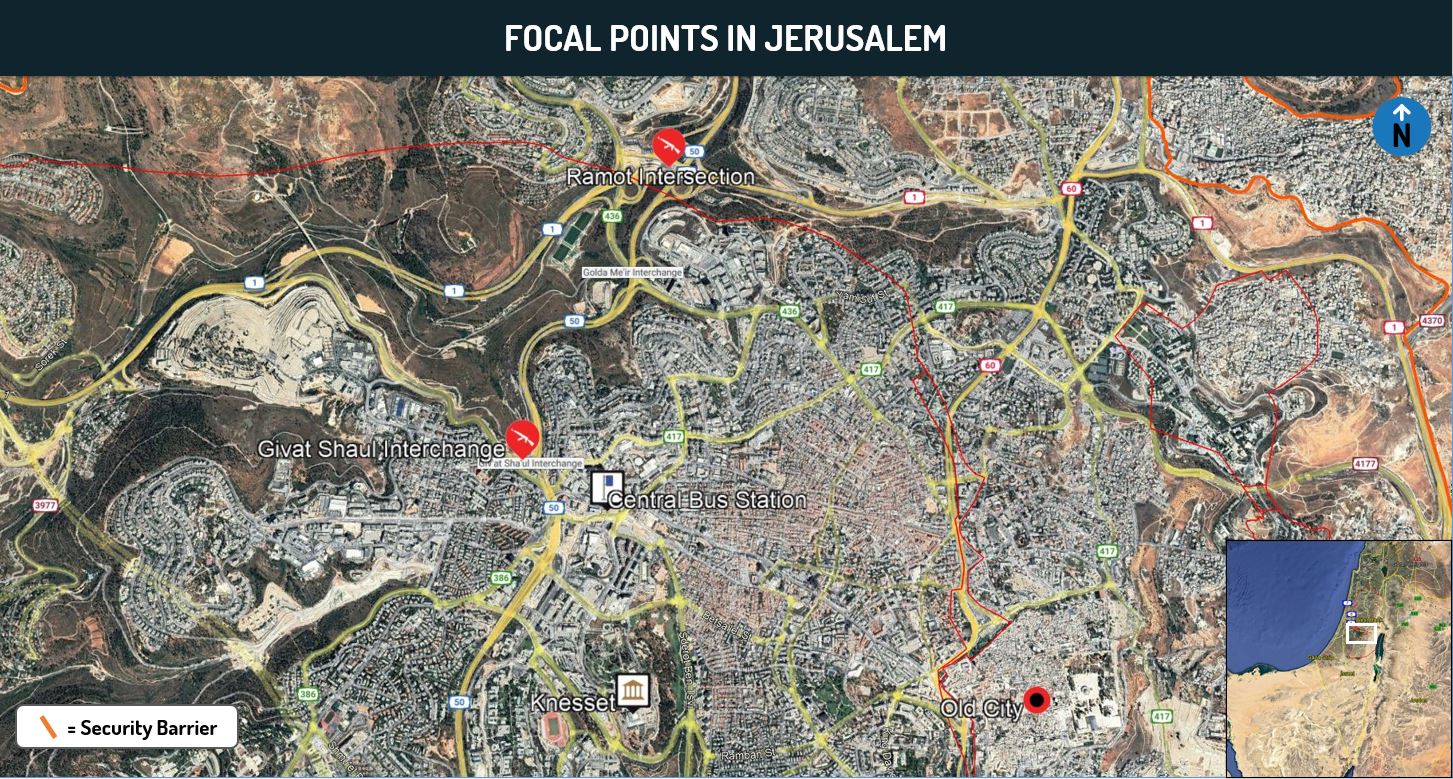
- At approximately 07:00 (local time), an explosive device detonated at a bus stop near the Givat Shaul interchange at the western entrance to Jerusalem, wounding 11 civilians. One subsequently died of his wounds and is reportedly a 16-years old Canadian national.
- A second explosion occurred approximately 30 minutes later near a bus stop at the Ramot Intersection in northern Jerusalem, located two kilometers north of the initial attack site, wounding several others.
- Pictures from the scene depict shrapnel marks on the front shield of a public bus.
- A report citing a Police official indicates that the Israel Police’s assessment is that the IEDs contained a significant number of shrapnel and that they were placed in bags left at the bus stops, before being detonated remotely via mobile phones.
- Video footage released by Israel Police indicated that extensive aerial and ground search operations are ongoing in Jerusalem as security personnel scan for other possible explosive devices and seek to locate the perpetrators and accomplices of the attack.
- Israel Police officials asked civilians to remain vigilant of suspicious packages. The Israel Police chief stated that, at the current juncture, it is unknown if the perpetrator of the attacks is one individual or a group of people that operated simultaneously.
- The same report indicated that Israel Police had prior intelligence indications on a militant attack, but no specific information was available.
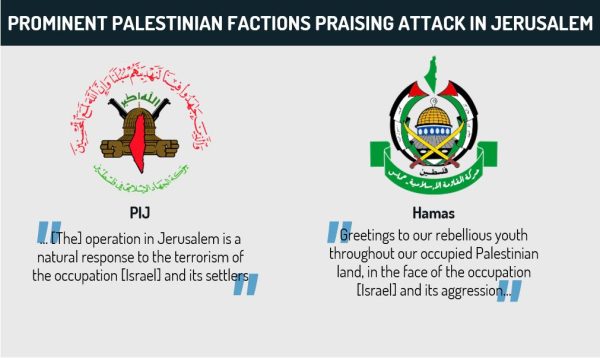
- No group has claimed responsibility for the attack, although Hamas lauded the incidents as a response to alleged “crimes” against the Palestinian population and the al-Aqsa Mosque. Palestinian Islamic Jihad (PIJ), and other militant factions, have also praised the attack.
Assessments & Forecast:
Sophistication of modus operandi points towards involvement of established militant cell with sophisticated means
- This modus operandi, namely the detonation of sophisticated IEDs, has not been successfully utilized in militant attacks in Jerusalem in recent years. The ability to detonate two explosive devices in quick succession and inflict multiple casualties renders the incidents highly notable. The sophistication of the modus operandi points to the involvement of an established militant cell with the infrastructure to successfully evade Israeli intelligence and security measures and execute the attacks, including at a major entry point to the capital and another central location.
- Rudimentary explosive devices, such as pipe bombs, have been used in low-sophistication acts of militancy in recent months in the West Bank, although they are rarely of elevated quality and rarely inflict significant numbers of casualties. The IEDs used in the latest attacks are of greater sophistication. Firstly, they were reportedly remotely detonated, which requires greater sophistication in terms of assembling the IEDs. Secondly, due to their capacity to inflict significant casualties, which can be partially attributed to the amount of shrapnel, as was also highlighted in the pictures depicting the damage on the bus. Such shrapnel, which can be created with nails or screws, is intended to increase the range of impact and maximize casualties. This is an indication that the militant(s) involved were able not only to acquire explosives but also to assemble relatively sophisticated explosive devices, pointing to elevated capabilities.
- The continued search operations across Jerusalem, the significant deployment of personnel and resources, and the officials’ comments on the current unknowns regarding whether the perpetrator acted alone or as a group point to significant continued gaps in the intelligence picture. FORECAST: This also increases the potential that additional attacks will occur due to the authorities’ ostensible gaps in knowledge. This reiterates the currently elevated risk of militant attacks in Jerusalem. That said, the Israeli security establishment has been able to demonstrate significant capabilities and successfully thwart hundreds of attacks over the past months. This is reflected in reported statistics of thwarted militant attacks since the beginning of 2022, which include 330 shootings, 54 stabbings, 34 IED attacks, three kidnapping attacks, and two suicide bombing attacks. In this context, while militants have attempted and failed to execute such attacks throughout 2022, such acts of militancy are likely to remain rare amid a persistent and highly effective counter-militancy campaign.
Perpetrators may have established cells in either East Jerusalem or West Bank
- It is possible that the perpetrators breached gaps in the security barrier to enter Jerusalem’s municipal boundaries from the West Bank, where several Palestinian militant groups are entrenched. The IEDs could have been assembled in the West Bank and delivered to the militants in Jerusalem. This assessment is supported by recent indications that Israeli security forces are still struggling to close breaches in the security barrier through which Palestinians are illegally infiltrating into Israeli territory. This is despite extensive efforts by Israeli security forces to close such gaps following a wave of militant attacks within Israel’s 1967 borders between March and early May. This risk was highlighted on September 8, when an illegal Palestinian resident originating from Nablus was detained in central Israel’s Jaffa with IEDs and a makeshift rifle.
- It is also feasible that the militant(s) that perpetrated the latest attacks was/were based in East Jerusalem. This is especially feasible in the current period of tensions whereby large segments of the populace in these parts of the city harbor extensive anti-Israel sentiments. This has prompted both militant attacks and large-scale civil unrest and/or celebrations in support of militant attacks in recent months. For example, an East Jerusalem resident conducted a shooting attack wounding eight civilians on a bus near King David’s Tomb on August 14. In addition, prominent Palestinian militant factions, particularly Hamas, have dedicated efforts to establish militant cells in East Jerusalem. For instance, Israeli security forces arrested a five-man Hamas cell in Jerusalem’s Old City in April, which operated under the leadership of a senior Hamas operative. They planned to target Jerusalem’s light rail in addition to other unspecified shooting or suicide bombing attacks.
- The desire of militant movements based outside of Israel to establish operational cells in East Jerusalem is likely aimed at capitalizing upon anti-Israel sentiments in the area and exploiting East Jerusalemites’ residency within Jerusalem’s municipal boundary which provides for access to western parts of the city compared to the West Bank. In this context, it cannot be ruled out that the latest attack was perpetrated by an East-Jerusalem-based cell that potentially received guidance from prominent militant factions. This would align with the strategic goal of groups like Hamas and PIJ to destabilize the West Bank and East Jerusalem. FORECAST: Regardless of whether or not the current perpetrators were affiliated with or supported by a prominent Palestinian faction, the development will likely inspire them to attempt, direct, or instigate similar attacks over the coming months. They have likely become demoralized over recent months by Israel’s persistent ability to thwart such attack plots and their resources may also have been depleted. However, this incident will likely inspire them to persist with these operations, or at the very least, incite Palestinians throughout the region to do so.
Surge in similar sophisticated bombing attacks within central Jerusalem, Israel’s 1967 borders unlikely to materialize
- FORECAST: In the immediate-to-short term, security operations will continue as the Israeli security apparatus seeks to identify the perpetrators and establish whether there are additional attack plots. This will likely manifest in an increased presence of security personnel across Jerusalem, including elevated security protocols, particularly in the vicinity of public transportation facilities such as Jerusalem’s Central Bus station, and other bus and light rail stations across the capital. Similar measures will likely be implemented at popular tourist sites in central and western parts of Jerusalem as well as central parts of Israel. Civilians will likely also be on heightened alert for suspicious objects or individuals, which may prompt hysteria and social unrest. There is a heightened risk of sudden evacuations of crowded areas over the coming weeks as civilians’ and security forces’ heightened suspicions and state of alert prompt false alarms.
- FORECAST: Extensive security operations are likely to be recorded in parts of East Jerusalem and the West Bank over the coming hours and potentially days in search for the perpetrators of the attack and their logistical accomplices. This could materialize in sudden road closures or travel restrictions between East Jerusalem and the West Bank as authorities both seek to gather intelligence and obtain intelligence leads pertaining to the incident.
- FORECAST: While it remains to be seen whether a claim of responsibility will be made, the incident will nonetheless be widely lauded by Palestinian militant groups to encourage further acts of militancy, even of lone wolf low-sophistication attacks such as stabbings and ramming attempts over the coming days and weeks. These are particularly likely in the West Bank and to a lesser extent in East Jerusalem. However, the threat will likely continue to be largely mitigated by Israeli security forces and will not lead to a significant increase in sophisticated militant attacks within Israel’s 1967 borders.
Recommendations:
- Those operating or residing in Jerusalem on November 23 and over the coming days are advised to avoid non-essential travel to central public transportation stations and remain vigilant at any crowded commercial areas in light of the ongoing security operations and elevated risk of militancy. Alert authorities to unattended packages or suspicious individuals.
- In other Israeli cities, remain vigilant in crowded commercial areas or public transport hubs, as these locations have been targeted by militants in the past.
- Avoid nonessential travel to the West Bank at this time given the currently heightened threat of militancy and civil unrest. Remain extra vigilant at Israeli crossing points and other security installations given the elevated potential for militant attacks against such facilities.
- If an attack unfolds within your vicinity, immediately seek cover, and try to safely disengage from the area as quickly as possible. This is given the risk of secondary attacks and shooting toward assailants by security forces and armed civilians, which could cause collateral damage.
- MAX Security has strong on-ground capabilities in Israel and the West Bank. Contact us at [email protected] or +44 20-3540-0434.
Executive Summary:
- Two IED attacks occurred in Jerusalem on November 23. The characteristics of the attacks suggest they were perpetrated by an established and relatively sophisticated militant cell.
- This points to gaps in Israel’s intelligence-gathering capabilities and the risk of militancy in the capital.
- Aerial and ground search operations are ongoing, and the Israel Police has asked civilians to remain vigilant of suspicious packages. Due to current gaps in the intelligence picture from this incident and the nationalistic euphoria among some Palestinians, additional attempted acts of militancy in Jerusalem and the West Bank are likely over the coming days.
- The perpetrators potentially breached gaps in the security barrier to enter Jerusalem from the West Bank. It is also feasible that a militant cell established in Palestinian-populated East Jerusalem conducted the attack.
- Palestinian militant groups have praised the attack and will encourage further acts of militancy, including low-sophistication attacks such as stabbings and ramming attempts.
- Given elevated Israeli intelligence and operational capabilities, a surge in similar sophisticated bombing attacks within central Jerusalem and Israel’s 1967 borders is unlikely to materialize.
- MAX Security has strong on-ground capabilities in Israel and the West Bank. Contact us at [email protected] or +44 20-3540-0434.
Please be advised:
- The Israel Police stated that a dual attack occurred in Jerusalem during the early morning hours (local time) of November 23.
- At approximately 07:00 (local time), an explosive device detonated at a bus stop near the Givat Shaul interchange at the western entrance to Jerusalem, wounding 11 civilians. One subsequently died of his wounds and is reportedly a 16-years old Canadian national.
- A second explosion occurred approximately 30 minutes later near a bus stop at the Ramot Intersection in northern Jerusalem, located two kilometers north of the initial attack site, wounding several others.
- Pictures from the scene depict shrapnel marks on the front shield of a public bus.
- A report citing a Police official indicates that the Israel Police’s assessment is that the IEDs contained a significant number of shrapnel and that they were placed in bags left at the bus stops, before being detonated remotely via mobile phones.
- Video footage released by Israel Police indicated that extensive aerial and ground search operations are ongoing in Jerusalem as security personnel scan for other possible explosive devices and seek to locate the perpetrators and accomplices of the attack.
- Israel Police officials asked civilians to remain vigilant of suspicious packages. The Israel Police chief stated that, at the current juncture, it is unknown if the perpetrator of the attacks is one individual or a group of people that operated simultaneously.
- The same report indicated that Israel Police had prior intelligence indications on a militant attack, but no specific information was available.
- No group has claimed responsibility for the attack, although Hamas lauded the incidents as a response to alleged “crimes” against the Palestinian population and the al-Aqsa Mosque. Palestinian Islamic Jihad (PIJ), and other militant factions, have also praised the attack.
Assessments & Forecast:
Sophistication of modus operandi points towards involvement of established militant cell with sophisticated means
- This modus operandi, namely the detonation of sophisticated IEDs, has not been successfully utilized in militant attacks in Jerusalem in recent years. The ability to detonate two explosive devices in quick succession and inflict multiple casualties renders the incidents highly notable. The sophistication of the modus operandi points to the involvement of an established militant cell with the infrastructure to successfully evade Israeli intelligence and security measures and execute the attacks, including at a major entry point to the capital and another central location.
- Rudimentary explosive devices, such as pipe bombs, have been used in low-sophistication acts of militancy in recent months in the West Bank, although they are rarely of elevated quality and rarely inflict significant numbers of casualties. The IEDs used in the latest attacks are of greater sophistication. Firstly, they were reportedly remotely detonated, which requires greater sophistication in terms of assembling the IEDs. Secondly, due to their capacity to inflict significant casualties, which can be partially attributed to the amount of shrapnel, as was also highlighted in the pictures depicting the damage on the bus. Such shrapnel, which can be created with nails or screws, is intended to increase the range of impact and maximize casualties. This is an indication that the militant(s) involved were able not only to acquire explosives but also to assemble relatively sophisticated explosive devices, pointing to elevated capabilities.
- The continued search operations across Jerusalem, the significant deployment of personnel and resources, and the officials’ comments on the current unknowns regarding whether the perpetrator acted alone or as a group point to significant continued gaps in the intelligence picture. FORECAST: This also increases the potential that additional attacks will occur due to the authorities’ ostensible gaps in knowledge. This reiterates the currently elevated risk of militant attacks in Jerusalem. That said, the Israeli security establishment has been able to demonstrate significant capabilities and successfully thwart hundreds of attacks over the past months. This is reflected in reported statistics of thwarted militant attacks since the beginning of 2022, which include 330 shootings, 54 stabbings, 34 IED attacks, three kidnapping attacks, and two suicide bombing attacks. In this context, while militants have attempted and failed to execute such attacks throughout 2022, such acts of militancy are likely to remain rare amid a persistent and highly effective counter-militancy campaign.
Perpetrators may have established cells in either East Jerusalem or West Bank
- It is possible that the perpetrators breached gaps in the security barrier to enter Jerusalem’s municipal boundaries from the West Bank, where several Palestinian militant groups are entrenched. The IEDs could have been assembled in the West Bank and delivered to the militants in Jerusalem. This assessment is supported by recent indications that Israeli security forces are still struggling to close breaches in the security barrier through which Palestinians are illegally infiltrating into Israeli territory. This is despite extensive efforts by Israeli security forces to close such gaps following a wave of militant attacks within Israel’s 1967 borders between March and early May. This risk was highlighted on September 8, when an illegal Palestinian resident originating from Nablus was detained in central Israel’s Jaffa with IEDs and a makeshift rifle.
- It is also feasible that the militant(s) that perpetrated the latest attacks was/were based in East Jerusalem. This is especially feasible in the current period of tensions whereby large segments of the populace in these parts of the city harbor extensive anti-Israel sentiments. This has prompted both militant attacks and large-scale civil unrest and/or celebrations in support of militant attacks in recent months. For example, an East Jerusalem resident conducted a shooting attack wounding eight civilians on a bus near King David’s Tomb on August 14. In addition, prominent Palestinian militant factions, particularly Hamas, have dedicated efforts to establish militant cells in East Jerusalem. For instance, Israeli security forces arrested a five-man Hamas cell in Jerusalem’s Old City in April, which operated under the leadership of a senior Hamas operative. They planned to target Jerusalem’s light rail in addition to other unspecified shooting or suicide bombing attacks.
- The desire of militant movements based outside of Israel to establish operational cells in East Jerusalem is likely aimed at capitalizing upon anti-Israel sentiments in the area and exploiting East Jerusalemites’ residency within Jerusalem’s municipal boundary which provides for access to western parts of the city compared to the West Bank. In this context, it cannot be ruled out that the latest attack was perpetrated by an East-Jerusalem-based cell that potentially received guidance from prominent militant factions. This would align with the strategic goal of groups like Hamas and PIJ to destabilize the West Bank and East Jerusalem. FORECAST: Regardless of whether or not the current perpetrators were affiliated with or supported by a prominent Palestinian faction, the development will likely inspire them to attempt, direct, or instigate similar attacks over the coming months. They have likely become demoralized over recent months by Israel’s persistent ability to thwart such attack plots and their resources may also have been depleted. However, this incident will likely inspire them to persist with these operations, or at the very least, incite Palestinians throughout the region to do so.
Surge in similar sophisticated bombing attacks within central Jerusalem, Israel’s 1967 borders unlikely to materialize
- FORECAST: In the immediate-to-short term, security operations will continue as the Israeli security apparatus seeks to identify the perpetrators and establish whether there are additional attack plots. This will likely manifest in an increased presence of security personnel across Jerusalem, including elevated security protocols, particularly in the vicinity of public transportation facilities such as Jerusalem’s Central Bus station, and other bus and light rail stations across the capital. Similar measures will likely be implemented at popular tourist sites in central and western parts of Jerusalem as well as central parts of Israel. Civilians will likely also be on heightened alert for suspicious objects or individuals, which may prompt hysteria and social unrest. There is a heightened risk of sudden evacuations of crowded areas over the coming weeks as civilians’ and security forces’ heightened suspicions and state of alert prompt false alarms.
- FORECAST: Extensive security operations are likely to be recorded in parts of East Jerusalem and the West Bank over the coming hours and potentially days in search for the perpetrators of the attack and their logistical accomplices. This could materialize in sudden road closures or travel restrictions between East Jerusalem and the West Bank as authorities both seek to gather intelligence and obtain intelligence leads pertaining to the incident.
- FORECAST: While it remains to be seen whether a claim of responsibility will be made, the incident will nonetheless be widely lauded by Palestinian militant groups to encourage further acts of militancy, even of lone wolf low-sophistication attacks such as stabbings and ramming attempts over the coming days and weeks. These are particularly likely in the West Bank and to a lesser extent in East Jerusalem. However, the threat will likely continue to be largely mitigated by Israeli security forces and will not lead to a significant increase in sophisticated militant attacks within Israel’s 1967 borders.
Recommendations:
- Those operating or residing in Jerusalem on November 23 and over the coming days are advised to avoid non-essential travel to central public transportation stations and remain vigilant at any crowded commercial areas in light of the ongoing security operations and elevated risk of militancy. Alert authorities to unattended packages or suspicious individuals.
- In other Israeli cities, remain vigilant in crowded commercial areas or public transport hubs, as these locations have been targeted by militants in the past.
- Avoid nonessential travel to the West Bank at this time given the currently heightened threat of militancy and civil unrest. Remain extra vigilant at Israeli crossing points and other security installations given the elevated potential for militant attacks against such facilities.
- If an attack unfolds within your vicinity, immediately seek cover, and try to safely disengage from the area as quickly as possible. This is given the risk of secondary attacks and shooting toward assailants by security forces and armed civilians, which could cause collateral damage.
- MAX Security has strong on-ground capabilities in Israel and the West Bank. Contact us at [email protected] or +44 20-3540-0434.
Related Reports
Israel
-
 Supply Chain DisruptionsGlobal Special Report: Irregular global cryptocurrency regulations to result in persisting strategic risks to private companies
 -
 Air StrikeLebanon & Israel Analysis: Assassination of Hezbollah’s Chief of Staff on November 23 signals Israel’s openness to escalation amid effort to derail Hezbollah's regrouping efforts
 -
 ProtestGlobal Special Report: Environmental activism to continue to pose operational challenges, legal as well as regulatory scrutiny for impacted businesses
Related Reports
Israel
-
Supply Chain DisruptionsGlobal Special Report: Irregular global cryptocurrency regulations to result in persisting strategic risks to private companies
-
Air StrikeLebanon & Israel Analysis: Assassination of Hezbollah’s Chief of Staff on November 23 signals Israel’s openness to escalation amid effort to derail Hezbollah's regrouping efforts
-
ProtestGlobal Special Report: Environmental activism to continue to pose operational challenges, legal as well as regulatory scrutiny for impacted businesses