

MENA Weekly Summary – November 26 – December 2, 2025
Highlights of the Week
This report reviews notable events in the Middle East and North Africa this week. These include the voiding of some parliamentary election results in Egypt, Supreme Leader Ayatollah Ali Khamenei’s denial that Iran had reached out to the US for talks, a UAV attack targeting the Khor Mor gas field in northern Iraq, Israeli and US counter-militancy operations in Syria, the final court ruling in the “Conspiracy Against the State” case in Tunisia, and the Hadhramaut Tribal Alliance’s seizure of the PetroMasila oil fields in Yemen.
Egypt
Current Situation
- According to November 30 reports, the Supreme Administrative Court annulled the results of individual-seat elections in 29 districts from the first phase of the House of Representatives elections, in addition to the 19 districts previously voided by the National Elections Authority (NEA). Reruns will now be held in 48 of the 70 districts from the first phase.
- On December 2, the NEA reportedly announced the preliminary results for the second phase of the parliamentary elections. Only the results from two polling stations, located in the Belqas and Daqahlia districts, were cancelled.
Assessments & Forecast: This verdict comes amid extensive reports of voter bribery, violations of campaign silence, physical assaults on candidates, and campaigning outside polling stations during the first phase of the election in Giza, Beheira, Minya, Assiut, Alexandria, Cairo, and Port Said. This resulted in the filing of more than twice as many appeals as in the 2020 elections. It also prompted a rare public statement from President Abdel Fattah al Sisi, who on November 17 called on the NEA to thoroughly investigate the violations and to make the right decision, even if this required cancelling the results and holding reruns. The rulings are likely to deepen tensions between judicial bodies and the NEA over perceived shortcomings in election management. These tensions are compounded by the significance of the 2026 parliamentary sessions, which may feature attempts to amend the constitution, including potentially removing presidential term limits for President Sisi. In this context, the authorities are likely taking all possible measures to present the elections as legitimate, free, and fair, especially to Egypt’s international partners. Overall, these developments will heighten pressure on the NEA to reassess its electoral procedures, although the reruns are unlikely to alter the anticipated pro-government outcome.
Source: National Elections Authority
Iran
Current Situation
- On November 28, Iran’s Supreme Leader Ayatollah Ali Khamenei publicly denied claims that Tehran had reached out to Washington through intermediaries, calling such reports “pure lies” and asserting that the US was “not worthy” of communication or cooperation.
- On November 26, Iranian Foreign Minister (FM) Abbas Araghchi met with his French counterpart Jean-Noel Barrot in Paris.
Assessments & Forecast: Khamenei’s remarks followed reports that President Masoud Pezeshkian had sent a letter to Saudi Crown Prince Mohammad bin Salman on November 17, ahead of the latter’s state visit to the US. The disclosure raised speculation that Tehran was seeking Saudi mediation to revive stalled nuclear talks. Khamenei’s intervention swiftly dispelled any perception of indirect engagement with Washington and reaffirmed a hardline posture, signaling that current diplomatic avenues remain closed. This coincides with an unconfirmed November 28 report that Washington has reiterated its three preconditions for negotiations, namely halting uranium enrichment, ending support for regional proxies, and accepting restrictions on Iran’s ballistic missile program. Tehran likely views these demands as undermining its core leverage amid heightened regional and economic pressures. In parallel, FM Araghchi’s talks with France reflect Tehran’s strategy of maintaining limited European channels of dialogue. Iranian officials continue to insist that negotiations will be restricted to the nuclear file, excluding both regional allies and the missile program. Even within this domain, Tehran emphasized in Paris that any cooperation, including with the IAEA, must occur under a “new framework.” These signals underscore Iran’s intent to define the terms of any future engagement with the West. Overall, this points to a persistent diplomatic impasse, with Tehran unlikely to accept the three US preconditions.
Source: IRNA
Iraq
Current Situation
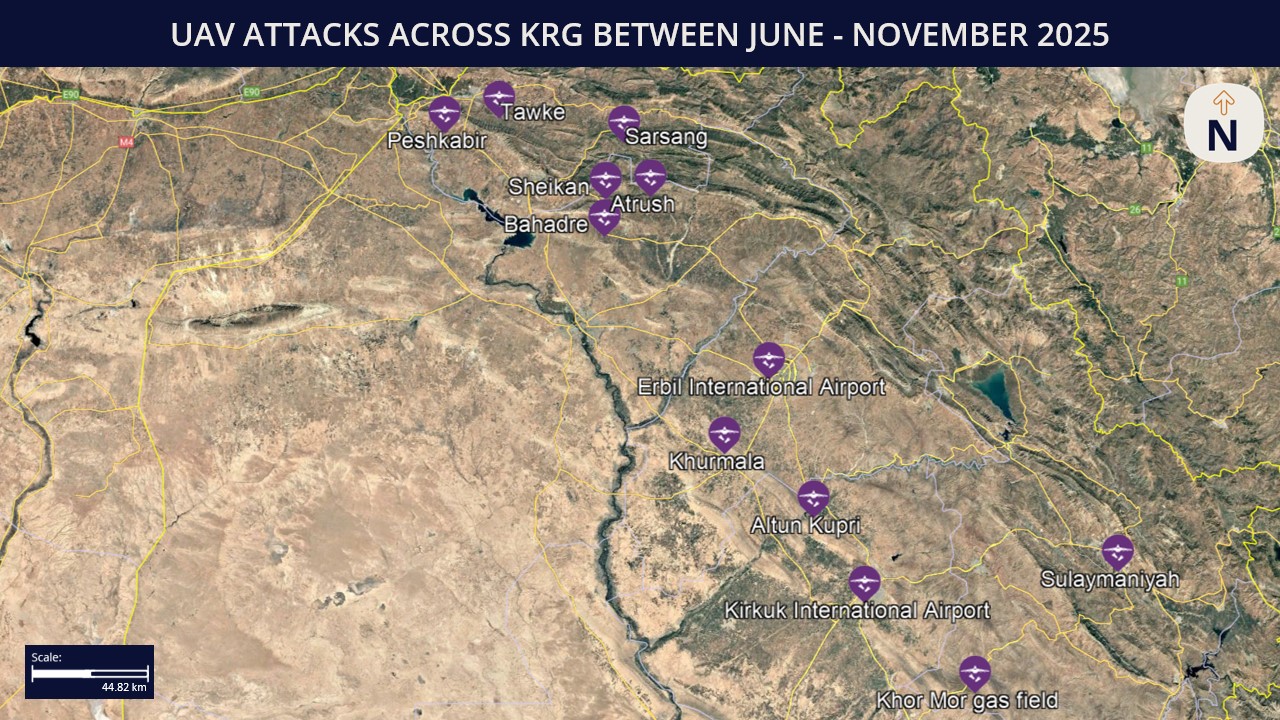
- In the overnight hours of November 26-27, an unmanned aerial vehicle (UAV) struck the Khor Mor gas field in Sulaymaniyah, triggering widespread disruptions to electricity and halting production until November 29.
- On November 29, Kurdistan Regional Government (KRG) security forces clashed with Herki tribe members in Khabat District, near the Erbil-Gwer road and Lanaz Refinery. This followed a demonstration by tribe members demanding employment at the site.
- On December 1, Herki tribe members and security forces clashed in the area again.
Assessments & Forecast: The attack against the Khor Mor facility follows multiple effective attacks against the gas field since 2022, highlighting its vulnerability and prominence as a recurring target. The attack was likely perpetrated by hardline Iran-backed militias who possess UAVs. Given the attack’s timing, in conjunction with the recent elections and ongoing government formation negotiations, it may stem from political motivations seeking to coerce and pressure Kurdish parties or specifically intimidate the site’s Emirati consortium leader. Meanwhile, the extensive civil unrest around the Lanaz oil Refinery further underscores current sensitivities and the vulnerabilities of energy infrastructure, with the unruly behavior of members of the Herki Tribe, which is a Kurdish tribe, reflecting significant socioeconomic grievances related to employment in the strategic energy sector. Given the sector’s centrality to the KRG’s economy, authorities will likely enhance security protocols for strategic infrastructure. However, without substantial concessions by the KRG, deep-seated local grievances are liable to trigger further political violence. Additionally, further UAV attacks targeting the Khor Mor gas field remain plausible in the near term, with authorities having minimal capabilities in defending against such indirect aerial attacks.
Source: Security Media Cell
Syria
Current Situation
- 20 individuals were killed during an Israel Defense Forces (IDF) raid against Jamaa al-Islamiyah-linked militants in southern Syria’s Beit Jinn on November 27-28. IDF airstrikes were employed in the ensuing clashes, in which six IDF soldiers were wounded.
- The US Central Command (CENTCOM) confirmed on November 30 that it coordinated with the Syrian Ministry of Interior (MoI) to identify and destroy more than 15 Islamic State (IS) weapons caches in Rif Dimashq Province.
Assessments & Forecast: The IDF campaign against Jamaa al-Islamiyah near the Israel-Syria buffer zone is notable due to the intensity of clashes and high casualty count. The operation underscores ongoing arms proliferation in the area and the capacity and resolve of local militants to resist Israeli raids, increasing the risk of friction between the IDF and armed groups. The scale of casualties will likely heighten tensions between Jerusalem and Damascus, further hindering prospects for a potential security understanding in the near term. Nevertheless, Israel will likely retain a proactive and forceful approach against the backdrop of continued attempts by Iran-backed factions to build operational capabilities in the area. Meanwhile, the counter-IS operations in Syria follow Damascus’ agreement to join the US-led anti-IS coalition. CENTCOM’s statement acknowledging cooperation with the Syrian MoI is significant, indicating renewed joint efforts to counter jihadist activity and growing US confidence in the Syrian government. The location of these raids, in Damascus’ environs and outside CENTCOM’s usual theater, also highlights the militants’ ability to acquire military-grade arms, likely from collapsed Syrian army stockpiles. Hence, they also underscore the threat posed by such jihadist networks in areas surrounding the Syrian capital.
Source: Ynet
Tunisia
Current Situation
- On November 28, the Court of Appeal issued its final verdict in the “conspiracy against the state” case, imposing prison terms of ten to 45 years. Some convicted individuals have already left the country, while others have remained in detention since 2023.
- On November 29, authorities arrested prominent opposition figure Chaima Issa during a protest in Tunis.
Assessments & Forecast: Chaima Issa was arrested one day after the Court of Appeal sentenced her to 20 years in prison, along with similarly lengthy sentences for others accused of plotting against state security. This development follows the April ruling that imposed prison terms on 40 opposition figures, lawyers, and business leaders, widely viewed as politically motivated. These actions indicate an ongoing effort by authorities to suppress dissent through judicial measures aligned with government objectives. The mass sentencing of defendants, including terms of up to 45 years, is likely to further weaken opposition to President Kais Saied. Prolonged sentences and Issa’s detention also signal a broader strategy aimed at deterring anti-government activism. The characterization of the case as “conspiracy against the state” appears intended to portray opposition figures as acting maliciously against national interests and undermine their credibility. Human-rights organizations and foreign governments are expected to denounce the trial and arrests, demanding the release of political activists. Although further protests are anticipated, they are unlikely to intensify significantly due to mounting state pressure. Additional arrests of critics and activists remain likely in the coming months.
Source: TAP Mosaique FM
Yemen
Current Situation:
- On November 29, Hadhramaut Tribal Alliance (HTA) leader Amr Bin Habrish announced that HTA-aligned Hadhramaut Protection Forces had taken control of the PetroMasila oil fields to protect “national wealth” and prevent external interference.
- The following day, the Second Military Command of the Presidential Command Council (PCC) reportedly ordered preparations for a military operation against HTA forces.
- Separately, clashes were reported in al-Mukalla between Southern Transitional Council (STC)-linked Security Support Force units and HTA-affiliated fighters.
- According to December 2 reports, forces affiliated with the STC reached the Sah village of Hadhramaut and were moving toward the Mukalla district capital, Seiyun.
- On the same day, Hadhramaut Governor Salem Ahmed al-Khanbashi met with a mediation committee to discuss the demands of HTA.
Assessments & Forecast: Tensions between the HTA and the PCC/STC have remained elevated throughout the year, driven by HTA accusations that PCC-aligned authorities control the governorate’s oil resources and divert revenues away from local needs. The decision to seize the PetroMasila oil fields marks an escalation, reflecting entrenched grievances that can escalate into high-impact actions targeting strategic infrastructure. This is underscored by the subsequent shutdown of 85 percent of electricity production at the PetroMasila plant following the HTA’s seizure. The decision to escalate may have constituted a pre-emptive action to assert the HTA’s control. The subsequent mobilization of STC-related forces in the region highlights a credible risk of armed confrontations amid heightened tensions. While mediation efforts are underway, the risk of an outbreak of violence will remain elevated in the coming days.
Source: Amr bin Habrish; al-Jazeera
Other Developments
- Iran: Australian Foreign Minister Penny Wong announced on November 27 the designation of the Islamic Revolutionary Guard Corps (IRGC) as a state sponsor of terrorism, citing IRGC-orchestrated attacks against Jewish institutions in the country.
- Iran: In a November 30 interview, an IRGC-Navy (IRGC-N) commander confirmed that the IRGC-N seized an Eswatini-flagged vessel suspected of transporting 350,000 tons of smuggled fuel.
- Israel & Lebanon: On November 27, the IDF carried out a wave of airstrikes in southern Lebanon targeting rocket launching sites, weapons storage facilities, and military posts belonging to Hezbollah.
- Israel & PT: The Israel Defense Forces (IDF) launched a major counter-militancy operation across five towns in the northern West Bank’s Tubas region. On November 29, the IDF stated that it seized explosives and arrested over ten militants.
- Libya: Protests were recorded across cities in eastern and central Libya to demand immediate Presidential elections on November 28. These followed Libyan National Army (LNA) Chief Khalifa Haftar’s call for a “peaceful movement” earlier in the month.
- Turkey: The Turkish Defense Industries Presidency (SSB) announced on November 26 that it signed new contracts worth 6.5 billion USD aimed at advancing Turkey’s “Steel Dome” air defense system.
The Upcoming Week
- December 4-7: The UAE is set to host the Formula One Abu Dhabi Grand Prix 2025 at Yas Marina Circuit on Yas Island, Abu Dhabi.
- December 5: The Ironman 70.3 triathlon will be held in Bahrain’s Manama. The event is slated to commence at Reef Island at 06:20. Maps depicting each leg of the course can be found here.
- December 5: The Red Sea Half Marathon will occur in Jordan’s Aqaba. It begins at the Hyatt Regency Hotel Ayla at 06:50 (local time) and ends at the entrance to the Great Arab Revolt Square. Maps showing the race routes are available here.
- December 5: Qatar will host the Qatar East to West Ultra Marathon. The race will begin in Doha at Sheraton Park at 05:00 and conclude in Dukhan Beach by 19:00. A map depicting the run course can be accessed here.
- December 8: Syria will celebrate Liberation Day to mark the first anniversary of the fall of the Bashar al-Assad government on December 8, 2024.
- December 10: Iraq will celebrate Victory Day, commemorating the Iraqi government’s liberation of all of its territory from Islamic State (IS) control in December 2017.
- December 10: Tunisia’s General Federation of Food, Tourism, Trade, and Handicraft Industries is planning to hold a sector-wide general strike to demand better work conditions.
Highlights of the Week
This report reviews notable events in the Middle East and North Africa this week. These include the voiding of some parliamentary election results in Egypt, Supreme Leader Ayatollah Ali Khamenei’s denial that Iran had reached out to the US for talks, a UAV attack targeting the Khor Mor gas field in northern Iraq, Israeli and US counter-militancy operations in Syria, the final court ruling in the “Conspiracy Against the State” case in Tunisia, and the Hadhramaut Tribal Alliance’s seizure of the PetroMasila oil fields in Yemen.
Egypt
Current Situation
- According to November 30 reports, the Supreme Administrative Court annulled the results of individual-seat elections in 29 districts from the first phase of the House of Representatives elections, in addition to the 19 districts previously voided by the National Elections Authority (NEA). Reruns will now be held in 48 of the 70 districts from the first phase.
- On December 2, the NEA reportedly announced the preliminary results for the second phase of the parliamentary elections. Only the results from two polling stations, located in the Belqas and Daqahlia districts, were cancelled.
Assessments & Forecast: This verdict comes amid extensive reports of voter bribery, violations of campaign silence, physical assaults on candidates, and campaigning outside polling stations during the first phase of the election in Giza, Beheira, Minya, Assiut, Alexandria, Cairo, and Port Said. This resulted in the filing of more than twice as many appeals as in the 2020 elections. It also prompted a rare public statement from President Abdel Fattah al Sisi, who on November 17 called on the NEA to thoroughly investigate the violations and to make the right decision, even if this required cancelling the results and holding reruns. The rulings are likely to deepen tensions between judicial bodies and the NEA over perceived shortcomings in election management. These tensions are compounded by the significance of the 2026 parliamentary sessions, which may feature attempts to amend the constitution, including potentially removing presidential term limits for President Sisi. In this context, the authorities are likely taking all possible measures to present the elections as legitimate, free, and fair, especially to Egypt’s international partners. Overall, these developments will heighten pressure on the NEA to reassess its electoral procedures, although the reruns are unlikely to alter the anticipated pro-government outcome.
Source: National Elections Authority
Iran
Current Situation
- On November 28, Iran’s Supreme Leader Ayatollah Ali Khamenei publicly denied claims that Tehran had reached out to Washington through intermediaries, calling such reports “pure lies” and asserting that the US was “not worthy” of communication or cooperation.
- On November 26, Iranian Foreign Minister (FM) Abbas Araghchi met with his French counterpart Jean-Noel Barrot in Paris.
Assessments & Forecast: Khamenei’s remarks followed reports that President Masoud Pezeshkian had sent a letter to Saudi Crown Prince Mohammad bin Salman on November 17, ahead of the latter’s state visit to the US. The disclosure raised speculation that Tehran was seeking Saudi mediation to revive stalled nuclear talks. Khamenei’s intervention swiftly dispelled any perception of indirect engagement with Washington and reaffirmed a hardline posture, signaling that current diplomatic avenues remain closed. This coincides with an unconfirmed November 28 report that Washington has reiterated its three preconditions for negotiations, namely halting uranium enrichment, ending support for regional proxies, and accepting restrictions on Iran’s ballistic missile program. Tehran likely views these demands as undermining its core leverage amid heightened regional and economic pressures. In parallel, FM Araghchi’s talks with France reflect Tehran’s strategy of maintaining limited European channels of dialogue. Iranian officials continue to insist that negotiations will be restricted to the nuclear file, excluding both regional allies and the missile program. Even within this domain, Tehran emphasized in Paris that any cooperation, including with the IAEA, must occur under a “new framework.” These signals underscore Iran’s intent to define the terms of any future engagement with the West. Overall, this points to a persistent diplomatic impasse, with Tehran unlikely to accept the three US preconditions.
Source: IRNA
Iraq
Current Situation
- In the overnight hours of November 26-27, an unmanned aerial vehicle (UAV) struck the Khor Mor gas field in Sulaymaniyah, triggering widespread disruptions to electricity and halting production until November 29.
- On November 29, Kurdistan Regional Government (KRG) security forces clashed with Herki tribe members in Khabat District, near the Erbil-Gwer road and Lanaz Refinery. This followed a demonstration by tribe members demanding employment at the site.
- On December 1, Herki tribe members and security forces clashed in the area again.
Assessments & Forecast: The attack against the Khor Mor facility follows multiple effective attacks against the gas field since 2022, highlighting its vulnerability and prominence as a recurring target. The attack was likely perpetrated by hardline Iran-backed militias who possess UAVs. Given the attack’s timing, in conjunction with the recent elections and ongoing government formation negotiations, it may stem from political motivations seeking to coerce and pressure Kurdish parties or specifically intimidate the site’s Emirati consortium leader. Meanwhile, the extensive civil unrest around the Lanaz oil Refinery further underscores current sensitivities and the vulnerabilities of energy infrastructure, with the unruly behavior of members of the Herki Tribe, which is a Kurdish tribe, reflecting significant socioeconomic grievances related to employment in the strategic energy sector. Given the sector’s centrality to the KRG’s economy, authorities will likely enhance security protocols for strategic infrastructure. However, without substantial concessions by the KRG, deep-seated local grievances are liable to trigger further political violence. Additionally, further UAV attacks targeting the Khor Mor gas field remain plausible in the near term, with authorities having minimal capabilities in defending against such indirect aerial attacks.
Source: Security Media Cell
Syria
Current Situation
- 20 individuals were killed during an Israel Defense Forces (IDF) raid against Jamaa al-Islamiyah-linked militants in southern Syria’s Beit Jinn on November 27-28. IDF airstrikes were employed in the ensuing clashes, in which six IDF soldiers were wounded.
- The US Central Command (CENTCOM) confirmed on November 30 that it coordinated with the Syrian Ministry of Interior (MoI) to identify and destroy more than 15 Islamic State (IS) weapons caches in Rif Dimashq Province.
Assessments & Forecast: The IDF campaign against Jamaa al-Islamiyah near the Israel-Syria buffer zone is notable due to the intensity of clashes and high casualty count. The operation underscores ongoing arms proliferation in the area and the capacity and resolve of local militants to resist Israeli raids, increasing the risk of friction between the IDF and armed groups. The scale of casualties will likely heighten tensions between Jerusalem and Damascus, further hindering prospects for a potential security understanding in the near term. Nevertheless, Israel will likely retain a proactive and forceful approach against the backdrop of continued attempts by Iran-backed factions to build operational capabilities in the area. Meanwhile, the counter-IS operations in Syria follow Damascus’ agreement to join the US-led anti-IS coalition. CENTCOM’s statement acknowledging cooperation with the Syrian MoI is significant, indicating renewed joint efforts to counter jihadist activity and growing US confidence in the Syrian government. The location of these raids, in Damascus’ environs and outside CENTCOM’s usual theater, also highlights the militants’ ability to acquire military-grade arms, likely from collapsed Syrian army stockpiles. Hence, they also underscore the threat posed by such jihadist networks in areas surrounding the Syrian capital.
Source: Ynet
Tunisia
Current Situation
- On November 28, the Court of Appeal issued its final verdict in the “conspiracy against the state” case, imposing prison terms of ten to 45 years. Some convicted individuals have already left the country, while others have remained in detention since 2023.
- On November 29, authorities arrested prominent opposition figure Chaima Issa during a protest in Tunis.
Assessments & Forecast: Chaima Issa was arrested one day after the Court of Appeal sentenced her to 20 years in prison, along with similarly lengthy sentences for others accused of plotting against state security. This development follows the April ruling that imposed prison terms on 40 opposition figures, lawyers, and business leaders, widely viewed as politically motivated. These actions indicate an ongoing effort by authorities to suppress dissent through judicial measures aligned with government objectives. The mass sentencing of defendants, including terms of up to 45 years, is likely to further weaken opposition to President Kais Saied. Prolonged sentences and Issa’s detention also signal a broader strategy aimed at deterring anti-government activism. The characterization of the case as “conspiracy against the state” appears intended to portray opposition figures as acting maliciously against national interests and undermine their credibility. Human-rights organizations and foreign governments are expected to denounce the trial and arrests, demanding the release of political activists. Although further protests are anticipated, they are unlikely to intensify significantly due to mounting state pressure. Additional arrests of critics and activists remain likely in the coming months.
Source: TAP Mosaique FM
Yemen
Current Situation:
- On November 29, Hadhramaut Tribal Alliance (HTA) leader Amr Bin Habrish announced that HTA-aligned Hadhramaut Protection Forces had taken control of the PetroMasila oil fields to protect “national wealth” and prevent external interference.
- The following day, the Second Military Command of the Presidential Command Council (PCC) reportedly ordered preparations for a military operation against HTA forces.
- Separately, clashes were reported in al-Mukalla between Southern Transitional Council (STC)-linked Security Support Force units and HTA-affiliated fighters.
- According to December 2 reports, forces affiliated with the STC reached the Sah village of Hadhramaut and were moving toward the Mukalla district capital, Seiyun.
- On the same day, Hadhramaut Governor Salem Ahmed al-Khanbashi met with a mediation committee to discuss the demands of HTA.
Assessments & Forecast: Tensions between the HTA and the PCC/STC have remained elevated throughout the year, driven by HTA accusations that PCC-aligned authorities control the governorate’s oil resources and divert revenues away from local needs. The decision to seize the PetroMasila oil fields marks an escalation, reflecting entrenched grievances that can escalate into high-impact actions targeting strategic infrastructure. This is underscored by the subsequent shutdown of 85 percent of electricity production at the PetroMasila plant following the HTA’s seizure. The decision to escalate may have constituted a pre-emptive action to assert the HTA’s control. The subsequent mobilization of STC-related forces in the region highlights a credible risk of armed confrontations amid heightened tensions. While mediation efforts are underway, the risk of an outbreak of violence will remain elevated in the coming days.
Source: Amr bin Habrish; al-Jazeera
Other Developments
- Iran: Australian Foreign Minister Penny Wong announced on November 27 the designation of the Islamic Revolutionary Guard Corps (IRGC) as a state sponsor of terrorism, citing IRGC-orchestrated attacks against Jewish institutions in the country.
- Iran: In a November 30 interview, an IRGC-Navy (IRGC-N) commander confirmed that the IRGC-N seized an Eswatini-flagged vessel suspected of transporting 350,000 tons of smuggled fuel.
- Israel & Lebanon: On November 27, the IDF carried out a wave of airstrikes in southern Lebanon targeting rocket launching sites, weapons storage facilities, and military posts belonging to Hezbollah.
- Israel & PT: The Israel Defense Forces (IDF) launched a major counter-militancy operation across five towns in the northern West Bank’s Tubas region. On November 29, the IDF stated that it seized explosives and arrested over ten militants.
- Libya: Protests were recorded across cities in eastern and central Libya to demand immediate Presidential elections on November 28. These followed Libyan National Army (LNA) Chief Khalifa Haftar’s call for a “peaceful movement” earlier in the month.
- Turkey: The Turkish Defense Industries Presidency (SSB) announced on November 26 that it signed new contracts worth 6.5 billion USD aimed at advancing Turkey’s “Steel Dome” air defense system.
The Upcoming Week
- December 4-7: The UAE is set to host the Formula One Abu Dhabi Grand Prix 2025 at Yas Marina Circuit on Yas Island, Abu Dhabi.
- December 5: The Ironman 70.3 triathlon will be held in Bahrain’s Manama. The event is slated to commence at Reef Island at 06:20. Maps depicting each leg of the course can be found here.
- December 5: The Red Sea Half Marathon will occur in Jordan’s Aqaba. It begins at the Hyatt Regency Hotel Ayla at 06:50 (local time) and ends at the entrance to the Great Arab Revolt Square. Maps showing the race routes are available here.
- December 5: Qatar will host the Qatar East to West Ultra Marathon. The race will begin in Doha at Sheraton Park at 05:00 and conclude in Dukhan Beach by 19:00. A map depicting the run course can be accessed here.
- December 8: Syria will celebrate Liberation Day to mark the first anniversary of the fall of the Bashar al-Assad government on December 8, 2024.
- December 10: Iraq will celebrate Victory Day, commemorating the Iraqi government’s liberation of all of its territory from Islamic State (IS) control in December 2017.
- December 10: Tunisia’s General Federation of Food, Tourism, Trade, and Handicraft Industries is planning to hold a sector-wide general strike to demand better work conditions.
