

Turkey, Iraq & Syria Analysis: Decline in PKK activity in Turkey due in part to Turkish military’s expansion of operations in Iraq, Syria
Executive Summary
- There has been a major decline in Kurdistan Workers’ Party (PKK) attacks in Turkey in recent years following an escalation between 2015-2017.
- In the initial years following a PKK-Turkey ceasefire that collapsed in 2015, this downtick was a result of a large-scale Turkish military crackdown in the group’s strongholds in southeastern Turkey that diminished the PKK’s operational capabilities.
- The Turkish Armed Forces’ (TSK) current domestic counter-militancy campaign against the PKK remains focused on southeastern Turkey, although the group retains operatives and supporters in major Turkish cities. The threat posed by the group in the Turkish interior will likely remain low.
- Since 2018 especially, the TSK has expanded its campaign to northern Iraq and Syria through a series of large-scale air and ground operations against PKK militants and their affiliates.
- This has been a significant contributing factor to the further decline of the group as it has disrupted its supply chains and organizational structures.
- The PKK and its affiliates will remain to some extent entrenched in southeastern Turkey, northern Syria, and northern Iraq, which will prompt additional large-scale TSK operations to dislodge the group. This is liable to include an imminent operation in northern Syria.
- Avoid all travel to the vicinity of the Turkey-Iraq and Turkey-Syria border regions due to persistent hostilities between PKK militants and the TSK.
Background: Evolution of PKK militancy within Turkey (2015-present)
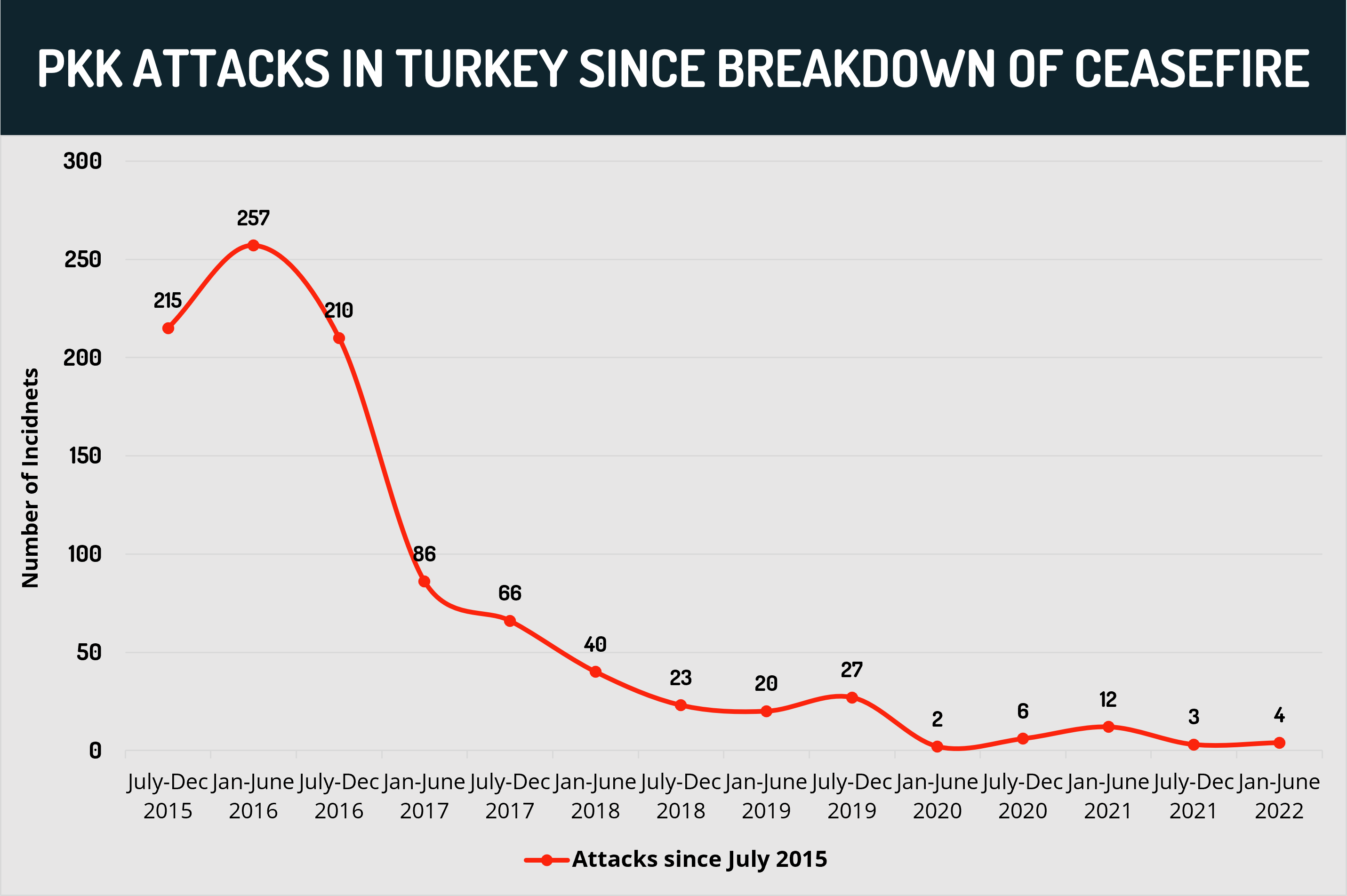
- In July 2015, the PKK announced the end of a ceasefire with the Turkish government and resumed its campaign of militant attacks across southeastern Turkey. From the collapse of the ceasefire until the end of 2016, the PKK conducted 682 attacks, which predominantly targeted security forces in Diyarbakir, Hakari, Mardin, and Sirnak provinces.
- The TSK, in turn, launched a large-scale counter-militancy campaign. Between 2015-2017, the focus of armed confrontations between TSK and PKK was in urban areas of the Kurdish group’s strongholds in southeastern Turkey. By 2017, as the TSK succeeded in diminishing the PKK’s capabilities within the region’s cities, the hostilities gradually moved to more rural areas.
- Since mid-2017, the number of PKK attacks across Turkey has gradually declined, with 203 attacks recorded from June 2017 until June 2022. This shows that the TSK’s campaign has diminished the Kurdish militant group’s capabilities on Turkish soil and their ability to conduct successful attacks in the country.
- As will be discussed below, the domestic campaign is not the sole reason for this downtick – since 2018, the TSK has majorly increased the scale of its operations in northern Iraq and Syria.
Current PKK Threat in Turkey
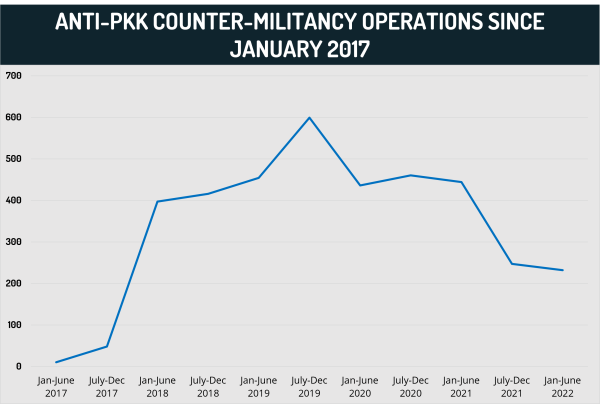
- The TSK’s current anti-PKK counter-militancy campaign in Turkey primarily occurs in the Kurdish-populated southeast. However, the group retains a network of operatives and supporters in major Turkish cities. Security forces routinely conduct arrests of suspected PKK members in urban centers, although the seizure of weapons or the foiling of militant plots is more seldom. The rarity of PKK attacks in major cities serves as an indication of the authorities’ success in curtailing the group’s operational capabilities. That said, Turkish authorities hold PKK-linked militants responsible for an April 2022 IED attack in Bursa’s Osmangazi, which targeted a bus carrying prison guards. This incident came after the launch of the TSK’s anti-PKK Operation “Claw-Lock” in northern Iraq and followed a threat by Duran Kalkan, a member of the PKK’s central committee, that the group would “carry the war to Turkish cities”. This shows the continued link between events outside of Turkey and within the country, especially as the number of violent incidents involving the PKK since 2019, when the counter-militancy campaign peaked, is now significantly greater in northern Iraq than in Turkey.
- This constituted the first lethal attack by Kurdish militants in a major Turkish city since a January 2017 car bomb and shooting attack at Izmir Courthouse, attributed to the Kurdistan Freedom Falcons (TAK). In 2016-2017, this group claimed several large-scale attacks in Turkish cities but has been dormant since 2017. Although the rarity of successful PKK attacks is an indication of the group’s reduced capabilities in Turkey’s interior, Turkish forces have occasionally arrested armed PKK operatives plotting acts of militancy. This includes in August 2020 in Adana and Izmir, as well as in February 2020 in Istanbul. These incidents demonstrate that the PKK’s desire to remain operational in Turkish cities has not dwindled and that they retain the means to conduct attacks.
- Kalkan’s statement shows that perceived Turkish escalations, such as the launch of major anti-PKK operations, are likely to further instigate such efforts. FORECAST: That said, as also evidenced by the absence of further incidents following the attack in Bursa, the PKK’s ability to stage successful attacks in Turkish cities is currently reduced. It is unlikely that this will change over the coming months. Notwithstanding, the presence of PKK operatives in urban centers and the militant group’s well-established organizational structures and military capabilities pose an underlying risk of attacks. These are most likely to target security forces or other government-linked facilities. While such incidents carry a risk of collateral damage, it is unlikely that PKK militants will stage indiscriminate attacks.
Decline of PKK activity in Turkey
TSK’s cross-border operations in Syria and Iraq constitute key contributing factor in PKK’s decline
Since 2018, the TSK has launched several systematic cross-border ground operations into Syria and Iraq. This represents a broader strategic shift in Turkey’s counter-militancy doctrine that overlapped with the intensified crackdown on the PKK’s infrastructure in southeastern Turkey. This strategy aims to dislodge the PKK and its Syrian affiliate, the People’s Protection Units (YPG), by establishing control of multiple buffer zones along Turkey’s frontiers with Syria and Iraq. This is part of a Turkish strategy to expand its counter-militancy campaign from Turkish soil to areas where Kurdish militants are entrenched in Iraq and Syria.
Syria
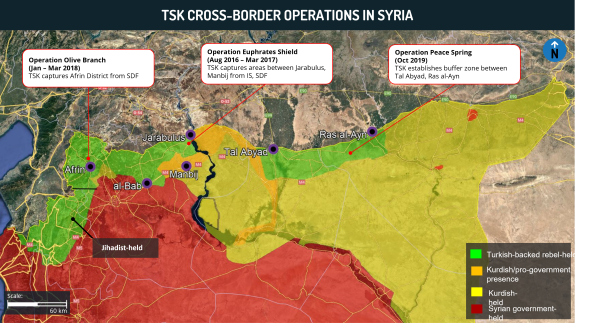
- In northern Syria, the TSK has carried out several large-scale operations against Kurdish militants that resulted in the seizure of territorial control and the establishment of buffer zones along the border. These include Operation Euphrates Shield (August 2016), Operation Olive Branch (January 2018), wherein the TSK seized Aleppo Province’s Afrin District, and Operation Peace Spring (October 2019), which resulted in the TSK and Turkish-backed rebel forces’ capture of a 30-km deep buffer zone between northern Syria’s Tal Abyad and Ras al-Ayn.
- Ankara considers the YPG, the main component of the US-backed Syrian Democratic Forces (SDF), to be the Syrian branch of the PKK. The YPG and PKK share broad ideological underpinnings and organizational ties. Many of the YPG’s fighters were reportedly trained in PKK camps in northern Iraq and the YPG’s leadership maintains organizational and logistical ties with the PKK. PKK operatives have also reportedly increased their influence on decision-making in YPG-controlled territories and stepped up the recruitment of Syrian Kurds into PKK ranks. This is partially based on data that the proportion of Syrian nationals among PKK militants killed in Iraq and Turkey has risen from two percent (before 2020) to 14 percent in 2020-2021. There have also been periodic cross-border hostilities emanating from Syria into Turkey. For instance, in August 2021, Turkish security forces neutralized an alleged PKK-linked Syrian wearing an explosive belt in Mardin’s Nusaybin and Kurdish militants have rarely carried out cross-border attacks from Syria. This includes rocket attacks and shootings into Turkey.
- Although these incidents provide a pretext for Turkish operations in Syria and elevate Ankara’s perception of the PKK/YPG threat along the Turkey-Syria border, there is no indication at the current juncture that the YPG seeks to use its controlled territory in Syria to systematically carry out attacks in Turkey. Rather, the SDF prioritizes the consolidation of Kurdish autonomy in northeastern Syria. Most cross-border hostilities are more likely a tactical response to Turkish military operations aimed at retaliation and deterrence as well as overstretching the TSK as it operates in three arenas against Kurdish fighters. This is also shown by the downtick in reported infiltrations by armed Kurdish militants since a brief trend in 2021.
- Overall, in light of the PKK’s strong operational ties with and influence over the YPG, Turkey’s establishment of two major buffer zones along its border in areas where the SDF is entrenched has likely had a significant impact on the Turkish-based PKK’s ability to operate. This includes the disruption of key supply chains for the movement of fighters, weapons, and logistical goods as well as the ability to carry out cross-border surveillance and the sharing of intelligence. The encircling of the Kurdish-controlled territories by Turkish and its affiliated rebels has also likely shifted major resources from the YPG’s support for the PKK towards defensive preparations and administrative consolidation of areas in Syria. This therefore underlines the success of Ankara’s decision to expand its operations from Turkey beyond its borders.
Iraq
- The PKK has been entrenched along northern Iraq’s Kurdistan Regional Government (KRG)-controlled mountainous border area with Turkey for decades. In contrast to Syria, the group has regularly used its bases in the region as a launchpad for attacks in Turkey. Since the 1990s, the TSK has periodically conducted cross-border raids. However, the TSK maintained only a temporary presence in the form of a small number of bases in the KRG, aimed at monitoring PKK movements, and periodically conducted airstrikes on PKK positions. This strategy failed to significantly weaken the PKK’s entrenchment along the border.
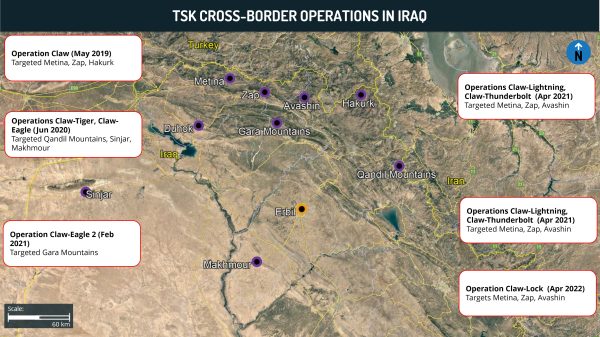
- In May 2019, coinciding with the peak of its domestic anti-PKK operations, the TSK launched the first of several ground operations into northern Iraq, codenamed “Claw”, supplemented by an expansion of TSK bases on KRG territory. This strategic shift signals Ankara’s decision to partially mirror the buffer zone approach that it implemented in Syria. However, while Turkey has aimed to seize territory and gain political and administrative influence in northern Syria, it acts in unofficial coordination with the KRG in northern Iraq. For instance, on April 17, the TSK launched Operation “Claw Lock”, which commenced after an April 15 meeting between President Erdogan and the KRG’s Prime Minister, Masrour Barzani, indicating it was coordinated with the KRG. This bolstered reports that the Kurdistan Democratic Party (KDP), the largest political party in the KRG, has shared intelligence with Turkey on PKK positions and movements and allowed Turkey to establish military positions in the KRG largely uninhibited as well as providing operational support to the TSK. By 2020, according to the Turkish government, the TSK had already established 40 bases in northern Iraq.
- The KDP’s opposition to the PKK is likely partially based on economic interests. Turkey’s Ceyhan Port is the sole conduit through which the KRG sells oil, the authority’s main source of revenue. The PKK has carried out several attacks on the Kirkuk-Ceyhan pipeline in recent years. Most recently, an October 2020 attack on the pipeline in Turkey’s Mardin Province forced the KRG to temporarily suspend oil exports. In recent years, the PKK has also demonstrated its readiness to carry out acts of militancy within the KRG itself. Most notably, in July 2019, a Turkish PKK militant shot and killed two staff members of the Turkish consulate in a shooting attack at a restaurant in Erbil. Given that this came only weeks after the TSK’s launch of its first “Claw” Operation in May 2019, the attack was likely a retaliatory effort. Although rare, these incidents highlight the potential impact of the TSK’s focus on northern Iraq in terms of retaliatory attacks by the PKK that can destabilize the security environment and cause major economic damage within the region through the suspension of oil exports.
- The TSK’s operations in northern Iraq predominantly rely on air and drone strikes, especially using Turkey’s advanced Bayraktar TB2 unmanned aerial vehicle (UAV). This allows the TSK to target the PKK’s militant infrastructure while minimizing troop exposure and engagement with militants. Nevertheless, since the launch of the operations in 2019, the number of hostilities between TSK personnel and PKK militants on Iraqi soil has exceeded those within Turkey. This has also included an increase in direct armed clashes and a reduction in air or drone strikes as a proportion of the hostilities. The hostilities have also occurred in areas deeper into KRG territory, which carries additional operational risks due to the distance from Turkish soil. Both facts highlight that the TSK is willing to take risks by exposing its personnel and dislodging the root of PKK militancy in northern Iraq, rather than relying solely on aerial attacks. Thus, since 2019, northern Iraq has become the main arena of hostilities between Turkey and the PKK, which has likely had a significant impact on the PKK’s ability to operate in Turkey itself.
Outlook
Turkey
- The significant downtick in PKK attacks in Turkey over the past years demonstrates that, in addition to the domestic campaign, the TSK’s counter-militancy operations in Iraq and Syria have succeeded in diminishing the PKK’s capabilities. The TSK’s “Claw” operations along the Turkey-Iraq border have likely compromised the group’s ability to move fighters and militant supplies between the PKK’s bases in northern Iraq and Turkey, thus cutting a vital supply line.
- That said, the group’s motivation to conduct acts of militancy in Turkey remains high. The Turkish government’s determination to use military force against the PKK and arrest its supporters as well as the perception among large parts of the Kurdish community that it is politically marginalized by President Erdogan’s policies will further fuel the PKK’s readiness to use violence. President Erdogan’s persistent depiction of the pro-Kurdish Peoples’ People’s Democratic Party (HDP) as linked to the PKK, coupled with frequent arrests of HDP politicians due to alleged involvement in militancy, will particularly increase long-standing grievances among Turkey’s Kurdish minority and will increase some Kurds’ susceptibility to support the PKK. The Peoples’ United Revolutionary Movement (HBDH), a Marxist-Leninist umbrella group, which includes the PKK, claimed responsibility for the April 20 IED attack against prison guards in Bursa’s Osmangazi, specifically describing it as revenge for the authorities’ alleged mistreatment of Kurdish inmates. This shows militant groups’ attempt to appeal to existing political grievances. Overall, as it remains possible that Turkish government officials will escalate perceived anti-Kurdish measures in the run-up to the slated general elections in 2023, the PKK’s motivation to carry out acts of militancy in Turkey is liable to increase further.
- The long-standing downtick in successful attacks indicates that the group’s operational capabilities in Turkey are in decline. Thus, overall, the risk of successful PKK attacks within Turkey is unlikely to increase significantly above its current level. In southeastern Turkey, IED attacks, or armed clashes during counter-militancy operations, are liable to occur occasionally. The PKK is unlikely to be able to stage high-profile attacks in major Turkish cities. However, lone wolves sympathizing with Kurdish militant groups may attempt unsophisticated attacks on government-linked organizations or bodies, such as the April 21 stun grenade attack at the offices of a pro-government NGO in Istanbul’s Gaziosmanpasa. It cannot be excluded that the PKK will seek to carry out sabotage attacks against key infrastructure, such as the Ceyhan-Kirkuk pipeline. That said, the overall rarity of such incidents over the past years indicates that the likelihood of such incidents is relatively low. Overall, the PKK is unlikely to present a significant threat to the business operations of foreign corporations or business travelers in Turkey over the medium term.
Iraq
- Turkey will likely intensify offensive operations against PKK bases along the Turkey-Syria border. Persistent airstrikes and ground incursions will further diminish the PKK’s entrenchment, which will also reduce the threat level of PKK militancy within Turkey. This will likely prompt PKK operatives to increase their resistance in northern Iraq by stepping up attacks against ground forces. The fact that Turkey has regularly reported on casualties to TSK troops since the commencement of Operation “Claw-Lock” highlights that PKK fighters continue to present a challenge to the TSK, which is likely facilitated by the fact that TSK ground troops are required to operate in unfamiliar mountainous terrain.
- Meanwhile, to slow down the TSK’s progress, the PKK will likely increase its efforts to plant IEDs in the vicinity of its militant bases. The May 5 killing of a Danish cyclist who lost his way and triggered a PKK-planted IED in Duhok Governorate, highlights the risk of collateral damage. That said, the PKK’s entrenchment areas in northern Iraq are located at a distance from facilities or infrastructure relevant to foreign nationals or businesses. Thus, armed conflict between the PKK and TSK is unlikely to endanger the interests of corporations or foreign business travelers in the KRG.
Syria
- Erdogan’s announcement in June 2022 of another imminent cross-border operation into northern Syria is credible as it would facilitate the TSK’s long-standing objective to clear the entire Syria-Turkey border from Kurdish territorial control. The success of the previous operations is a strong indication that another operation will eventually materialize. The risk of a cross-border operation is also suggested by Erdogan’s need to shore up domestic support. A successful cross-border operation into northern Syria would bolster President Erdogan’s popularity among some voters ahead of the 2023 general elections. Russia’s operation in Ukraine will likely reduce Moscow’s resolve to prevent such an operation. That said, the US is unlikely to withdraw its support for the SDF, which serves as the US’s on-ground partner against the Islamic State (IS) in Syria. This will complicate the prospect of a Turkish ground operation.
- The Kurdish authorities’ July 6 declaration of a state of emergency in its administered territories indicates that it assesses a TSK operation may feasibly materialize over the coming weeks. Should a large-scale cross-border operation materialize, there is a substantial risk of cross-border rocket or shooting attacks into Turkish territory. Such action will remain contained to the immediate vicinity of the border and remains unlikely to impact the threat level of militancy in Turkey proper.
Recommendations
Recommendations: Turkey
- Travel to Turkey may continue while remaining cognizant of the underlying threat of militancy and frequent protest activity. Contact us at [email protected] or +44 20-3540-0434 for itinerary and contingency support options.
- Across Turkey, maintain heightened vigilance in the vicinity of government buildings, police stations, political party offices, shopping centers, places of worship, Western-linked institutions, and places frequented by Westerners due to the underlying threat of militancy.
- Avoid nonessential travel to Turkey’s southern and eastern provinces due to the TSK’s counter-militancy campaign and the potential for PKK attacks.
- Avoid all travel to the border areas with Syria and Iraq due to the increased risk of militancy and spillover of armed conflict emanating from these countries.
- Refrain from public statements, the display of symbols, or social media posts that may be perceived as critical of Turkey, its state institutions, government policies, or the president as this may lead to prosecution and arrest. This includes statements in support of the Kurdish community, which the authorities may perceive as support for the PKK.
Recommendations: Iraq
- Avoid all travel to the vicinity of the Iraq-Turkey border region due to persistent hostilities between PKK militants and the TSK.
- Westerners are advised to maintain a low profile and exercise heightened vigilance. To mitigate the risk of attacks or abductions, ensure that accommodation is equipped with sufficient perimeter security details.
- Regularly alter itinerary routes and avoid disclosing sensitive information to strangers, including your affiliation with foreign-based firms as your response could attract a negative reaction from locals.
- Ensure to map out routes prior to travel to avoid getting lost. Maintain vigilance when traveling along routes in the KRG, particularly in areas close to the Turkish border, as militants have planted IEDs to resist counter-militancy operations.
Recommendations: Syria
- Those seeking to enter Syria are advised to confirm the status of crossing points at both foreign borders and within the country as well as the identity of security forces stationed at various checkpoints.
- Western nationals are advised to maintain a low profile throughout Syria due to hostile sentiment towards various foreign governments among the populace.
- In areas with strong Turkish influence or control, refrain from all criticism of Turkey and its operations in northern Syria and avoid declaring support for the Kurdish cause.
Executive Summary
- There has been a major decline in Kurdistan Workers’ Party (PKK) attacks in Turkey in recent years following an escalation between 2015-2017.
- In the initial years following a PKK-Turkey ceasefire that collapsed in 2015, this downtick was a result of a large-scale Turkish military crackdown in the group’s strongholds in southeastern Turkey that diminished the PKK’s operational capabilities.
- The Turkish Armed Forces’ (TSK) current domestic counter-militancy campaign against the PKK remains focused on southeastern Turkey, although the group retains operatives and supporters in major Turkish cities. The threat posed by the group in the Turkish interior will likely remain low.
- Since 2018 especially, the TSK has expanded its campaign to northern Iraq and Syria through a series of large-scale air and ground operations against PKK militants and their affiliates.
- This has been a significant contributing factor to the further decline of the group as it has disrupted its supply chains and organizational structures.
- The PKK and its affiliates will remain to some extent entrenched in southeastern Turkey, northern Syria, and northern Iraq, which will prompt additional large-scale TSK operations to dislodge the group. This is liable to include an imminent operation in northern Syria.
- Avoid all travel to the vicinity of the Turkey-Iraq and Turkey-Syria border regions due to persistent hostilities between PKK militants and the TSK.
Background: Evolution of PKK militancy within Turkey (2015-present)
- In July 2015, the PKK announced the end of a ceasefire with the Turkish government and resumed its campaign of militant attacks across southeastern Turkey. From the collapse of the ceasefire until the end of 2016, the PKK conducted 682 attacks, which predominantly targeted security forces in Diyarbakir, Hakari, Mardin, and Sirnak provinces.
- The TSK, in turn, launched a large-scale counter-militancy campaign. Between 2015-2017, the focus of armed confrontations between TSK and PKK was in urban areas of the Kurdish group’s strongholds in southeastern Turkey. By 2017, as the TSK succeeded in diminishing the PKK’s capabilities within the region’s cities, the hostilities gradually moved to more rural areas.
- Since mid-2017, the number of PKK attacks across Turkey has gradually declined, with 203 attacks recorded from June 2017 until June 2022. This shows that the TSK’s campaign has diminished the Kurdish militant group’s capabilities on Turkish soil and their ability to conduct successful attacks in the country.
- As will be discussed below, the domestic campaign is not the sole reason for this downtick – since 2018, the TSK has majorly increased the scale of its operations in northern Iraq and Syria.
Current PKK Threat in Turkey
- The TSK’s current anti-PKK counter-militancy campaign in Turkey primarily occurs in the Kurdish-populated southeast. However, the group retains a network of operatives and supporters in major Turkish cities. Security forces routinely conduct arrests of suspected PKK members in urban centers, although the seizure of weapons or the foiling of militant plots is more seldom. The rarity of PKK attacks in major cities serves as an indication of the authorities’ success in curtailing the group’s operational capabilities. That said, Turkish authorities hold PKK-linked militants responsible for an April 2022 IED attack in Bursa’s Osmangazi, which targeted a bus carrying prison guards. This incident came after the launch of the TSK’s anti-PKK Operation “Claw-Lock” in northern Iraq and followed a threat by Duran Kalkan, a member of the PKK’s central committee, that the group would “carry the war to Turkish cities”. This shows the continued link between events outside of Turkey and within the country, especially as the number of violent incidents involving the PKK since 2019, when the counter-militancy campaign peaked, is now significantly greater in northern Iraq than in Turkey.
- This constituted the first lethal attack by Kurdish militants in a major Turkish city since a January 2017 car bomb and shooting attack at Izmir Courthouse, attributed to the Kurdistan Freedom Falcons (TAK). In 2016-2017, this group claimed several large-scale attacks in Turkish cities but has been dormant since 2017. Although the rarity of successful PKK attacks is an indication of the group’s reduced capabilities in Turkey’s interior, Turkish forces have occasionally arrested armed PKK operatives plotting acts of militancy. This includes in August 2020 in Adana and Izmir, as well as in February 2020 in Istanbul. These incidents demonstrate that the PKK’s desire to remain operational in Turkish cities has not dwindled and that they retain the means to conduct attacks.
- Kalkan’s statement shows that perceived Turkish escalations, such as the launch of major anti-PKK operations, are likely to further instigate such efforts. FORECAST: That said, as also evidenced by the absence of further incidents following the attack in Bursa, the PKK’s ability to stage successful attacks in Turkish cities is currently reduced. It is unlikely that this will change over the coming months. Notwithstanding, the presence of PKK operatives in urban centers and the militant group’s well-established organizational structures and military capabilities pose an underlying risk of attacks. These are most likely to target security forces or other government-linked facilities. While such incidents carry a risk of collateral damage, it is unlikely that PKK militants will stage indiscriminate attacks.
Decline of PKK activity in Turkey
TSK’s cross-border operations in Syria and Iraq constitute key contributing factor in PKK’s decline
Since 2018, the TSK has launched several systematic cross-border ground operations into Syria and Iraq. This represents a broader strategic shift in Turkey’s counter-militancy doctrine that overlapped with the intensified crackdown on the PKK’s infrastructure in southeastern Turkey. This strategy aims to dislodge the PKK and its Syrian affiliate, the People’s Protection Units (YPG), by establishing control of multiple buffer zones along Turkey’s frontiers with Syria and Iraq. This is part of a Turkish strategy to expand its counter-militancy campaign from Turkish soil to areas where Kurdish militants are entrenched in Iraq and Syria.
Syria
- In northern Syria, the TSK has carried out several large-scale operations against Kurdish militants that resulted in the seizure of territorial control and the establishment of buffer zones along the border. These include Operation Euphrates Shield (August 2016), Operation Olive Branch (January 2018), wherein the TSK seized Aleppo Province’s Afrin District, and Operation Peace Spring (October 2019), which resulted in the TSK and Turkish-backed rebel forces’ capture of a 30-km deep buffer zone between northern Syria’s Tal Abyad and Ras al-Ayn.
- Ankara considers the YPG, the main component of the US-backed Syrian Democratic Forces (SDF), to be the Syrian branch of the PKK. The YPG and PKK share broad ideological underpinnings and organizational ties. Many of the YPG’s fighters were reportedly trained in PKK camps in northern Iraq and the YPG’s leadership maintains organizational and logistical ties with the PKK. PKK operatives have also reportedly increased their influence on decision-making in YPG-controlled territories and stepped up the recruitment of Syrian Kurds into PKK ranks. This is partially based on data that the proportion of Syrian nationals among PKK militants killed in Iraq and Turkey has risen from two percent (before 2020) to 14 percent in 2020-2021. There have also been periodic cross-border hostilities emanating from Syria into Turkey. For instance, in August 2021, Turkish security forces neutralized an alleged PKK-linked Syrian wearing an explosive belt in Mardin’s Nusaybin and Kurdish militants have rarely carried out cross-border attacks from Syria. This includes rocket attacks and shootings into Turkey.
- Although these incidents provide a pretext for Turkish operations in Syria and elevate Ankara’s perception of the PKK/YPG threat along the Turkey-Syria border, there is no indication at the current juncture that the YPG seeks to use its controlled territory in Syria to systematically carry out attacks in Turkey. Rather, the SDF prioritizes the consolidation of Kurdish autonomy in northeastern Syria. Most cross-border hostilities are more likely a tactical response to Turkish military operations aimed at retaliation and deterrence as well as overstretching the TSK as it operates in three arenas against Kurdish fighters. This is also shown by the downtick in reported infiltrations by armed Kurdish militants since a brief trend in 2021.
- Overall, in light of the PKK’s strong operational ties with and influence over the YPG, Turkey’s establishment of two major buffer zones along its border in areas where the SDF is entrenched has likely had a significant impact on the Turkish-based PKK’s ability to operate. This includes the disruption of key supply chains for the movement of fighters, weapons, and logistical goods as well as the ability to carry out cross-border surveillance and the sharing of intelligence. The encircling of the Kurdish-controlled territories by Turkish and its affiliated rebels has also likely shifted major resources from the YPG’s support for the PKK towards defensive preparations and administrative consolidation of areas in Syria. This therefore underlines the success of Ankara’s decision to expand its operations from Turkey beyond its borders.
Iraq
- The PKK has been entrenched along northern Iraq’s Kurdistan Regional Government (KRG)-controlled mountainous border area with Turkey for decades. In contrast to Syria, the group has regularly used its bases in the region as a launchpad for attacks in Turkey. Since the 1990s, the TSK has periodically conducted cross-border raids. However, the TSK maintained only a temporary presence in the form of a small number of bases in the KRG, aimed at monitoring PKK movements, and periodically conducted airstrikes on PKK positions. This strategy failed to significantly weaken the PKK’s entrenchment along the border.
- In May 2019, coinciding with the peak of its domestic anti-PKK operations, the TSK launched the first of several ground operations into northern Iraq, codenamed “Claw”, supplemented by an expansion of TSK bases on KRG territory. This strategic shift signals Ankara’s decision to partially mirror the buffer zone approach that it implemented in Syria. However, while Turkey has aimed to seize territory and gain political and administrative influence in northern Syria, it acts in unofficial coordination with the KRG in northern Iraq. For instance, on April 17, the TSK launched Operation “Claw Lock”, which commenced after an April 15 meeting between President Erdogan and the KRG’s Prime Minister, Masrour Barzani, indicating it was coordinated with the KRG. This bolstered reports that the Kurdistan Democratic Party (KDP), the largest political party in the KRG, has shared intelligence with Turkey on PKK positions and movements and allowed Turkey to establish military positions in the KRG largely uninhibited as well as providing operational support to the TSK. By 2020, according to the Turkish government, the TSK had already established 40 bases in northern Iraq.
- The KDP’s opposition to the PKK is likely partially based on economic interests. Turkey’s Ceyhan Port is the sole conduit through which the KRG sells oil, the authority’s main source of revenue. The PKK has carried out several attacks on the Kirkuk-Ceyhan pipeline in recent years. Most recently, an October 2020 attack on the pipeline in Turkey’s Mardin Province forced the KRG to temporarily suspend oil exports. In recent years, the PKK has also demonstrated its readiness to carry out acts of militancy within the KRG itself. Most notably, in July 2019, a Turkish PKK militant shot and killed two staff members of the Turkish consulate in a shooting attack at a restaurant in Erbil. Given that this came only weeks after the TSK’s launch of its first “Claw” Operation in May 2019, the attack was likely a retaliatory effort. Although rare, these incidents highlight the potential impact of the TSK’s focus on northern Iraq in terms of retaliatory attacks by the PKK that can destabilize the security environment and cause major economic damage within the region through the suspension of oil exports.
- The TSK’s operations in northern Iraq predominantly rely on air and drone strikes, especially using Turkey’s advanced Bayraktar TB2 unmanned aerial vehicle (UAV). This allows the TSK to target the PKK’s militant infrastructure while minimizing troop exposure and engagement with militants. Nevertheless, since the launch of the operations in 2019, the number of hostilities between TSK personnel and PKK militants on Iraqi soil has exceeded those within Turkey. This has also included an increase in direct armed clashes and a reduction in air or drone strikes as a proportion of the hostilities. The hostilities have also occurred in areas deeper into KRG territory, which carries additional operational risks due to the distance from Turkish soil. Both facts highlight that the TSK is willing to take risks by exposing its personnel and dislodging the root of PKK militancy in northern Iraq, rather than relying solely on aerial attacks. Thus, since 2019, northern Iraq has become the main arena of hostilities between Turkey and the PKK, which has likely had a significant impact on the PKK’s ability to operate in Turkey itself.
Outlook
Turkey
- The significant downtick in PKK attacks in Turkey over the past years demonstrates that, in addition to the domestic campaign, the TSK’s counter-militancy operations in Iraq and Syria have succeeded in diminishing the PKK’s capabilities. The TSK’s “Claw” operations along the Turkey-Iraq border have likely compromised the group’s ability to move fighters and militant supplies between the PKK’s bases in northern Iraq and Turkey, thus cutting a vital supply line.
- That said, the group’s motivation to conduct acts of militancy in Turkey remains high. The Turkish government’s determination to use military force against the PKK and arrest its supporters as well as the perception among large parts of the Kurdish community that it is politically marginalized by President Erdogan’s policies will further fuel the PKK’s readiness to use violence. President Erdogan’s persistent depiction of the pro-Kurdish Peoples’ People’s Democratic Party (HDP) as linked to the PKK, coupled with frequent arrests of HDP politicians due to alleged involvement in militancy, will particularly increase long-standing grievances among Turkey’s Kurdish minority and will increase some Kurds’ susceptibility to support the PKK. The Peoples’ United Revolutionary Movement (HBDH), a Marxist-Leninist umbrella group, which includes the PKK, claimed responsibility for the April 20 IED attack against prison guards in Bursa’s Osmangazi, specifically describing it as revenge for the authorities’ alleged mistreatment of Kurdish inmates. This shows militant groups’ attempt to appeal to existing political grievances. Overall, as it remains possible that Turkish government officials will escalate perceived anti-Kurdish measures in the run-up to the slated general elections in 2023, the PKK’s motivation to carry out acts of militancy in Turkey is liable to increase further.
- The long-standing downtick in successful attacks indicates that the group’s operational capabilities in Turkey are in decline. Thus, overall, the risk of successful PKK attacks within Turkey is unlikely to increase significantly above its current level. In southeastern Turkey, IED attacks, or armed clashes during counter-militancy operations, are liable to occur occasionally. The PKK is unlikely to be able to stage high-profile attacks in major Turkish cities. However, lone wolves sympathizing with Kurdish militant groups may attempt unsophisticated attacks on government-linked organizations or bodies, such as the April 21 stun grenade attack at the offices of a pro-government NGO in Istanbul’s Gaziosmanpasa. It cannot be excluded that the PKK will seek to carry out sabotage attacks against key infrastructure, such as the Ceyhan-Kirkuk pipeline. That said, the overall rarity of such incidents over the past years indicates that the likelihood of such incidents is relatively low. Overall, the PKK is unlikely to present a significant threat to the business operations of foreign corporations or business travelers in Turkey over the medium term.
Iraq
- Turkey will likely intensify offensive operations against PKK bases along the Turkey-Syria border. Persistent airstrikes and ground incursions will further diminish the PKK’s entrenchment, which will also reduce the threat level of PKK militancy within Turkey. This will likely prompt PKK operatives to increase their resistance in northern Iraq by stepping up attacks against ground forces. The fact that Turkey has regularly reported on casualties to TSK troops since the commencement of Operation “Claw-Lock” highlights that PKK fighters continue to present a challenge to the TSK, which is likely facilitated by the fact that TSK ground troops are required to operate in unfamiliar mountainous terrain.
- Meanwhile, to slow down the TSK’s progress, the PKK will likely increase its efforts to plant IEDs in the vicinity of its militant bases. The May 5 killing of a Danish cyclist who lost his way and triggered a PKK-planted IED in Duhok Governorate, highlights the risk of collateral damage. That said, the PKK’s entrenchment areas in northern Iraq are located at a distance from facilities or infrastructure relevant to foreign nationals or businesses. Thus, armed conflict between the PKK and TSK is unlikely to endanger the interests of corporations or foreign business travelers in the KRG.
Syria
- Erdogan’s announcement in June 2022 of another imminent cross-border operation into northern Syria is credible as it would facilitate the TSK’s long-standing objective to clear the entire Syria-Turkey border from Kurdish territorial control. The success of the previous operations is a strong indication that another operation will eventually materialize. The risk of a cross-border operation is also suggested by Erdogan’s need to shore up domestic support. A successful cross-border operation into northern Syria would bolster President Erdogan’s popularity among some voters ahead of the 2023 general elections. Russia’s operation in Ukraine will likely reduce Moscow’s resolve to prevent such an operation. That said, the US is unlikely to withdraw its support for the SDF, which serves as the US’s on-ground partner against the Islamic State (IS) in Syria. This will complicate the prospect of a Turkish ground operation.
- The Kurdish authorities’ July 6 declaration of a state of emergency in its administered territories indicates that it assesses a TSK operation may feasibly materialize over the coming weeks. Should a large-scale cross-border operation materialize, there is a substantial risk of cross-border rocket or shooting attacks into Turkish territory. Such action will remain contained to the immediate vicinity of the border and remains unlikely to impact the threat level of militancy in Turkey proper.
Recommendations
Recommendations: Turkey
- Travel to Turkey may continue while remaining cognizant of the underlying threat of militancy and frequent protest activity. Contact us at [email protected] or +44 20-3540-0434 for itinerary and contingency support options.
- Across Turkey, maintain heightened vigilance in the vicinity of government buildings, police stations, political party offices, shopping centers, places of worship, Western-linked institutions, and places frequented by Westerners due to the underlying threat of militancy.
- Avoid nonessential travel to Turkey’s southern and eastern provinces due to the TSK’s counter-militancy campaign and the potential for PKK attacks.
- Avoid all travel to the border areas with Syria and Iraq due to the increased risk of militancy and spillover of armed conflict emanating from these countries.
- Refrain from public statements, the display of symbols, or social media posts that may be perceived as critical of Turkey, its state institutions, government policies, or the president as this may lead to prosecution and arrest. This includes statements in support of the Kurdish community, which the authorities may perceive as support for the PKK.
Recommendations: Iraq
- Avoid all travel to the vicinity of the Iraq-Turkey border region due to persistent hostilities between PKK militants and the TSK.
- Westerners are advised to maintain a low profile and exercise heightened vigilance. To mitigate the risk of attacks or abductions, ensure that accommodation is equipped with sufficient perimeter security details.
- Regularly alter itinerary routes and avoid disclosing sensitive information to strangers, including your affiliation with foreign-based firms as your response could attract a negative reaction from locals.
- Ensure to map out routes prior to travel to avoid getting lost. Maintain vigilance when traveling along routes in the KRG, particularly in areas close to the Turkish border, as militants have planted IEDs to resist counter-militancy operations.
Recommendations: Syria
- Those seeking to enter Syria are advised to confirm the status of crossing points at both foreign borders and within the country as well as the identity of security forces stationed at various checkpoints.
- Western nationals are advised to maintain a low profile throughout Syria due to hostile sentiment towards various foreign governments among the populace.
- In areas with strong Turkish influence or control, refrain from all criticism of Turkey and its operations in northern Syria and avoid declaring support for the Kurdish cause.
Related Reports
-
 Supply Chain DisruptionsGlobal Special Report: Increasing sanctions encourage shadow fleet expansion, resulting in disruptions to maritime supply chain amid heightened scrutiny, militarization
 -
Supply Chain DisruptionsGlobal Special Report: Maritime shipping environment in Arctic to be fragile amid regulatory hurdles, militarization along Russian coastline, around Greenland
-
 Armed ConflictSyria Analysis: Four-day truce announced on January 20 after major government offensive diminishes Kurdish control in northeastern Syria; avoid all travel
Related Reports
-
Supply Chain DisruptionsGlobal Special Report: Increasing sanctions encourage shadow fleet expansion, resulting in disruptions to maritime supply chain amid heightened scrutiny, militarization
-
Supply Chain DisruptionsGlobal Special Report: Maritime shipping environment in Arctic to be fragile amid regulatory hurdles, militarization along Russian coastline, around Greenland
-
Armed ConflictSyria Analysis: Four-day truce announced on January 20 after major government offensive diminishes Kurdish control in northeastern Syria; avoid all travel